Start with the pillar guide for this topic: Home care vs facility care in Japan.
Home Care
Home Care for Elderly Parents in Japan
Keeping a parent at home in Japan comes down to which covered and private services you combine, and how long that arrangement holds. These articles cover home-visit care, day services, equipment, and the signs that a home setup is reaching the point where facility care needs a real conversation.
Facility optionsHome Care
Practical planning for in-home care, provider conversations, and family updates.
2026-06-04
Respite Care in Japan: Short Stays, Day Services, and Caregiver Relief
How family caregivers in Japan get real breaks: short-stay programs, day services, care leave rights, and how to build respite into the care plan before burnout.
Read article2026-06-04
Taking Care of Elderly Parents at Home in Japan: What Families Carry
What family-provided care at home in Japan actually involves, which parts public services can take over, and how to protect the family caregiver from burnout.
Read article2026-06-03
In-Home Care for Elderly Parents in Japan
Arranging in-home care for elderly parents in Japan: home safety, care needs, costs by care level, the 60-day setup sequence, and family reporting.
Read article2026-06-05
Home Care Services in Japan for Elderly Foreigners
What families should clarify when arranging home care, daily support, medical coordination, and family updates for an elderly foreign resident in Japan.
Read article2026-06-04
Living With Elderly Parents in Japan: Before You Move In Together
When a parent starts needing support, 'they should move in with us', or 'we should move in with them', feels like the obvious answer. In Japan it is one point on a spectrum, with real system and money consequences. What living together changes, and what sits between together and apart.
Read article2026-06-05
Elderly Companion and Sitter Services in Japan: What Families Can Arrange
How elderly companion and sitter services work in Japan: what insurance does not cover, the private options, monthly costs, and arranging visits from overseas.
Read article2026-06-06
How to Find a Home Caregiver for an Elderly Person in Japan
Families searching for a home caregiver in Japan are usually picturing one trusted person who comes to the house. Japan's system rarely works that way, and knowing the three routes that actually exist (insured home-visit care, private agencies, and housekeeper referral) saves weeks of confused searching.
Read article2026-06-06
Live-In Caregivers for Elderly Parents in Japan: What Exists and What Doesn't
Families from countries where a live-in caregiver is the normal answer to round-the-clock need often assume Japan works the same way. It mostly does not, and the honest map (one real private route, several covered substitutes, and a visa reality check) saves families from planning around an option that is not there.
Read article2026-06-06
Bathing an Elderly Parent in Japan: Services, Safety, and the Ofuro Problem
Why the Japanese bath is the most dangerous room for an aging parent, the covered bathing services most countries do not have, and what families can fix this week.
Read article2026-06-06
'I Can't Take Care of My Mom Anymore': Handing Over Care in Japan
Saying you cannot do this anymore is data, not failure. How to stabilize the situation this week in Japan, run a structured handoff, and protect your recovery.
Read article2026-06-06
When an Elderly Parent Needs 24-Hour Care in Japan: The Real Options
What 24-hour care actually means, Japan's patrol-and-on-call covered service, assembling round-the-clock coverage at home, and when it points to a facility.
Read article2026-06-08
Protecting an Elderly Parent From Heatstroke in Japan
Every summer, Japan's heat kills older people in their own homes, often because they would not turn on the air conditioning. For a family watching from a distance, heat is one of the most preventable risks a parent faces, and the countermeasures are cheap and concrete. This explains the danger, the alert system, and what you can set up before the next heatwave.
Read article2026-06-08
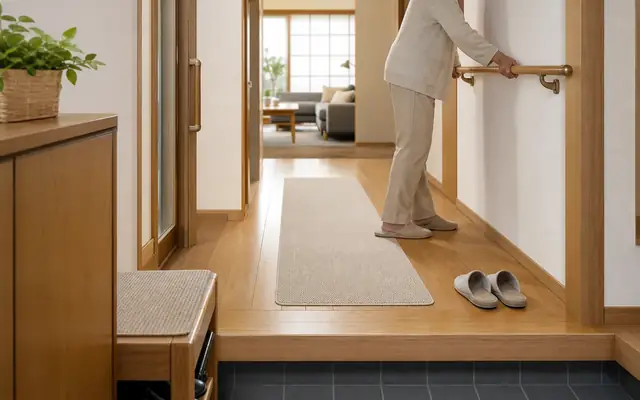
Fall Prevention for an Elderly Parent in Japan
A fall is the event that most often ends an older person's independence in Japan, turning a manageable situation into a hospital stay and a care decision overnight. The Japanese home has its own specific hazards, and most of them are cheap to fix. This is a room-by-room guide, plus the subsidies that pay for the bigger changes.
Read article2026-06-09
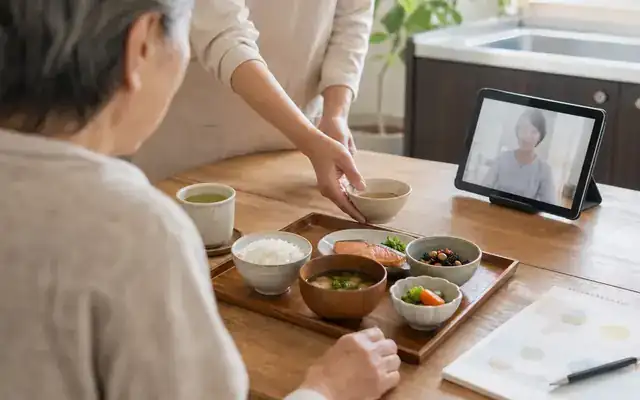
When an Elderly Parent in Japan Is Not Eating: Frailty and Nutrition
An aging parent eating less and quietly losing weight is easy to miss from a distance and easy to underrate up close, yet it can be one of the most important early signals of decline. Japan treats this under a specific concept, frailty, with its own screening and services. This explains what to watch, what it may mean, and the Japan-specific options that help, while pointing clearly to the professionals who should be involved.
Read article2026-06-09
Incontinence Care for an Elderly Parent in Japan
Incontinence is one of the most common and least discussed parts of caring for an aging parent, and it quietly drives both distress and cost. In Japan the practical answers are specific: a funding gap families do not expect, municipal help that is easy to miss, and a care routine that protects dignity. This explains the logistics, the money, and when a doctor should be involved.
Read article2026-06-09
Responding to Sundowning and Difficult Dementia Behaviors in Japan
The agitation, evening confusion, and occasional aggression of dementia are among the hardest parts of caring for a parent, and families often feel there is nothing to do but endure them. There is. This explains how to read difficult behavior, what to rule out with a doctor first, the calm responses that actually help, and the professional support Japan offers, while leaving medical decisions to the professionals.
Read article2026-06-09
Hearing and Vision Loss in an Elderly Parent in Japan
Failing hearing and sight rarely arrive as a crisis, so families underrate them, yet they quietly drive isolation, accidents, and confusion that can look like something worse. In Japan there is real support, with its own eligibility rules, and practical ways to adapt. This explains why to get it assessed, what help exists, and how to make daily life work.
Read article2026-06-09
A Sudden Change in an Elderly Parent in Japan: When to Act
When an older parent changes suddenly, becoming confused, drowsy, or unwell over hours or a day or two, families often wait to see if it passes, or assume the dementia has worsened. A sudden change is different, and it is usually a reason to seek professional help promptly. This explains how to tell, who to call in Japan, and what to do, without trying to diagnose anything from home.
Read article2026-06-09
Can You Lower the Risk of Dementia? What That Means in Japan
Families understandably want to know whether anything can be done to keep dementia from arriving. The honest answer, and Japan's official one, is more modest and more useful than a yes or no: some risk can be reduced and onset possibly delayed, but nothing prevents dementia with certainty. This explains what that means, what the evidence points to, and the Japanese resources, without selling false hope.
Read article2026-06-09
After a Parent's Stroke in Japan: Recovery, Rehab, and Home Care
A stroke is sudden, frightening, and one of the events most likely to turn an independent parent into someone who needs care, often within days. Japan has a well-defined recovery pathway, but it moves on a clock most families do not know is running. This explains how to navigate the rehab and home-care journey, while leaving every clinical decision to the parent's medical team.
Read articleBrowse every topic on the full article index, or see all care system guides.
Contact
Start with a free 30-minute consultation.
If an article sounds close to your situation, send the family context and we will help identify the next step.