
Why a fall is the event to prevent
Among the things that change an older parent's life suddenly, a fall is near the top. A broken hip or a head injury can take someone from living independently to a hospital bed and then a care facility in the space of a few weeks, and the fear of falling again shrinks the world even when the body recovers.
That is why prevention pays off out of proportion to its cost. Most of what makes a home safer is cheap and quick, and the Japanese home has a handful of specific traps that a foreign family may not register as hazards because they are simply how Japanese houses are built.
The scale is not abstract. In Japan's 2022 Comprehensive Survey of Living Conditions, fractures and falls were the cause behind roughly one in seven people newly needing long-term care, placing them among the top handful of reasons alongside dementia and stroke. A fall is not merely a bad day; for a meaningful share of older people it is the specific event that begins the slide from independence into requiring care, which is exactly why the inexpensive fixes in this article earn back their cost many times over.
The genkan, the step that Japanese homes build in
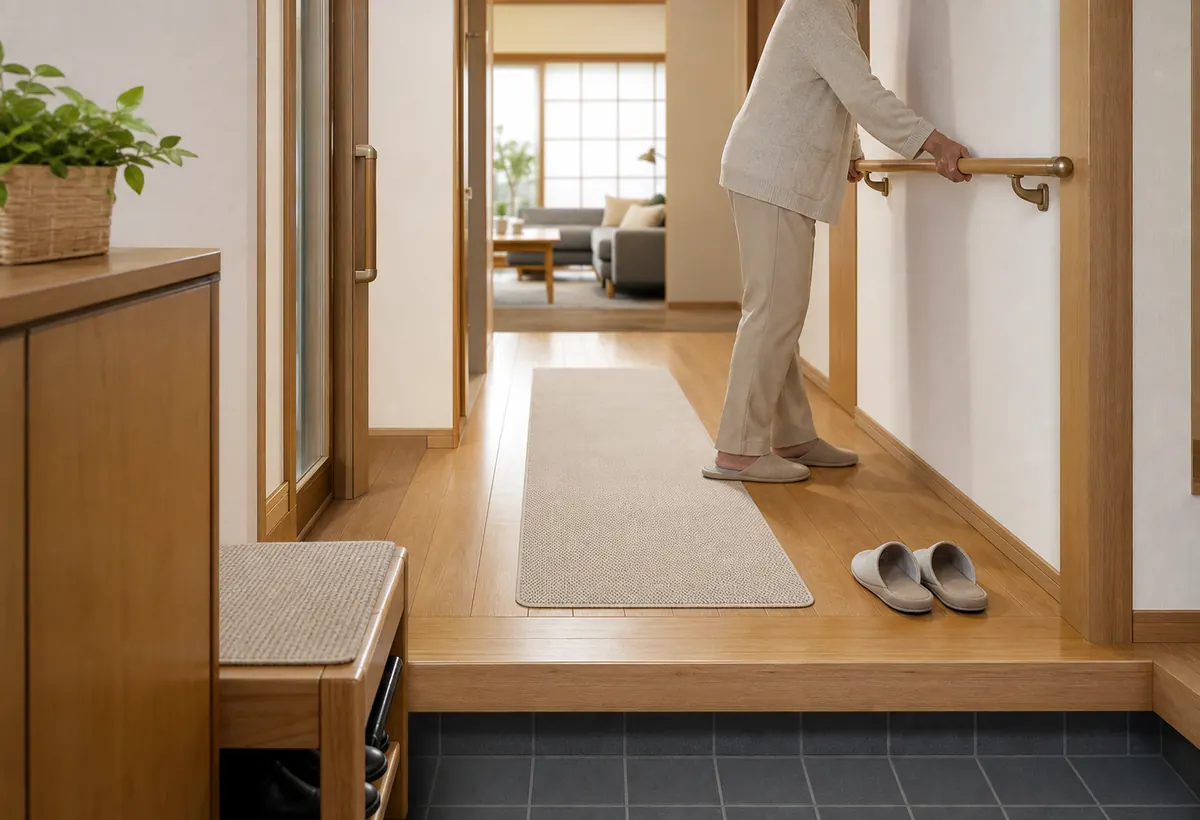
The entrance (genkan) has a deliberate step up into the house, often a tall one, exactly where a parent stands on one leg to remove or put on shoes. It concentrates several fall risks in one spot at the busiest threshold in the house.
The fixes are standard and effective: a sturdy vertical grab bar beside the step, a low bench to sit on while changing shoes rather than balancing, good lighting, and non-slip footwear kept by the door. Grab-bar installation and small step changes are exactly the kind of work the public renovation subsidy is designed to fund, covered in our home-modification subsidy article.
The bathroom, the most dangerous room
The Japanese bathroom combines wet tile, a deep soaking tub climbed into and out of, and often a cold room that adds the blood-pressure swing of heat shock. It is where many serious falls and bathroom emergencies happen.
Prioritize this room: grab bars by the tub and toilet, a non-slip mat inside and outside the tub, a bath board or stool to manage the deep tub, and heating so the room is not a cold shock. A shower chair turns a risky standing wash into a seated one. Many of these are available through the welfare-equipment rental and purchase system, covered in our welfare equipment rental article, and the bathing risks themselves are covered in our article on bathing an elderly parent.
Tatami, futons, and the floor-level life
Traditional Japanese living happens close to the floor, and getting up and down from a futon or a floor cushion many times a day is hard and risky for weak knees and poor balance. The transitions, not the floor itself, are where falls happen.
- Consider a low bed instead of a futon, which removes the hardest daily up-and-down and is often the single highest-value change
- Watch the edges of tatami mats, thresholds between rooms (shikii), and the lips between flooring types, which are classic trip points
- Remove or secure loose rugs and trailing cords, and clear the habitual walking paths through the house
- Add a grab bar or sturdy furniture anchor where the parent rises from a low seat or futon
The rest of the house, quickly
Beyond the three big zones, a short sweep catches most of the remaining risk, and it costs little more than an afternoon.
- Stairs: a handrail on both sides if possible, non-slip strips on the edges, and a light switch reachable from top and bottom
- Lighting: brighter bulbs, night lights on the route to the toilet, and switches the parent does not have to cross a dark room to reach
- Floors: clear clutter from walking paths, tape down cords, and remove the small rugs people slide on
- Footwear: supportive non-slip slippers or socks, replacing the smooth-soled ones older parents often keep
- A reachable phone or alarm at floor level, so a fall does not become hours on the floor unable to call
Beyond the house: the body and the system
Home changes prevent the trip; keeping a parent strong prevents the fall in the first place. The two work together, and both connect to services a certified parent can use.
Leg strength and balance decline with inactivity, and the fear of falling accelerates it by keeping people still. Day services and rehabilitation through the care system include exercise aimed squarely at fall prevention, and a physical therapist can assess a specific home and body. If a parent has had a fall or is visibly less steady, it is also a reason to start or review care-need certification, since it unlocks both the equipment and the rehabilitation. This is general guidance; a parent with frequent falls, dizziness, or a recent injury should be assessed by a doctor, since falls can signal a medical problem rather than just a hazardous home.
Where these falls happen is itself instructive. Japan's Consumer Affairs Agency reports that most accidents among people aged 65 and over occur at home, and that the single most common location is not the stairs or the bath people fear but the ordinary living room, on the flat, during everyday movement. That is the case for pairing a decluttered, well-lit everyday environment with the strength work: the dramatic spots draw the attention, while the room a parent crosses a hundred times a day is where the statistics quietly accumulate.
Frequently asked questions
What are the biggest fall hazards in a Japanese home?
The genkan entrance step where a parent balances to change shoes, the bathroom with its wet tile and deep tub, and the floor-level life of futons and tatami with their hard daily up-and-down and trip-prone thresholds. Each concentrates risk, and each has cheap, standard fixes such as grab bars, a low bed, and bath aids.
Does Japan's care system pay for home safety changes?
Yes, in two ways for a certified parent. The renovation subsidy helps fund fixed changes like grab bars and step modifications, and the welfare-equipment system rents or subsidizes items such as shower chairs, bath boards, and handrails. Both require care-need certification, which is a reason to start that process after a fall or a visible loss of steadiness.
Should an elderly parent in Japan switch from a futon to a bed?
Often yes. Getting up and down from a floor futon many times a day is one of the hardest and riskiest movements for weak knees and poor balance, so a low bed is frequently the single highest-value fall-prevention change. It also makes care easier if a helper is involved later. Weigh it against the parent's strong attachment to familiar habits.
Can preventing falls reduce the chance of a parent needing a care facility?
It meaningfully lowers one of the most common triggers. A serious fall, especially a hip fracture or head injury, is a frequent path from independence to hospital to facility. Removing home hazards and keeping a parent strong through rehabilitation and day-service exercise addresses both the trip and the underlying frailty, though no measure removes the risk entirely.
How Japan Care Concierge can help
Home care runs against a monthly unit ceiling of 16,765 at Care 1 and 27,048 at Care 3. We help families build a plan that fits inside it, supervise the providers, and report back in English.
Home care coordination serviceBook a free 30-minute consultation
Primary and official references
We checked 4 primary or official sources below before writing this article. Rules, costs, and local procedures change by municipality and over time. Confirm the linked official source before a final decision. Last source check: 2026-06-10.
About this article
This page is general orientation, not medical, legal or individual care advice. Japan Care Concierge is operated with the care-service experience of Social Welfare Corporation Shinkou Fukushikai, established in 1999, which runs elderly care facilities and services in Kanagawa under the Cross Heart name. We take no referral fees from facilities or providers. We do not provide medical treatment, diagnosis, emergency response or hands-on care. Japan has 1,559 long-term care insurers and each sets its own rules and timelines, so confirm your own case with the municipal long-term care insurance desk or your local community support center. The publication and update dates above are actual dates. How we research, source, and correct content is described in our editorial policy.