
Articles
Elder care articles by situation
211 articles, each written for one decision. What to do in the six weeks a certification usually takes, what the monthly unit ceiling covers, and how to compare facilities from another country.
 Articles
Browse by topic
Each topic below opens a hub with the pillar guide first and the related articles under it. The number is how many articles that topic currently holds.
All articles
All 211 articles, newest first, 40 to a page. Use the topic links above to narrow the list first.
2026-10-04
Finding a Care Facility in Japan for a Parent with Frontotemporal Dementia
Few Japanese care facilities advertise experience with frontotemporal dementia, and a parent who is still strong and walks a great deal can sit awkwardly against admission rules built around care levels. This guide sets out the gates for each facility type, the public records and restraint rules you can check before calling, the public young-onset dementia network that knows local services, and the questions that show whether a home will protect your parent's walking, outdoor time and conversation or quietly restrict them.
Read article
2026-10-04
Where Your Parent Stays Before Care Certification in Japan
A parent who arrives in Japan needing care usually waits four to eight weeks before insured services start, because registration, the care-need application and certification come first. The gap is bridged with self-pay options such as trial stays, self-pay short stays, residential homes with outside care or an apartment with private helpers, with a provisional care plan possible once the application is filed.
Read article
2026-10-04
Arranging a Care Facility in Japan Before Your Parent Arrives
A family abroad can shortlist facilities, send a medical summary and get an informal view of fit before a parent arrives, but binding admission waits for registration in Japan, a facility interview and, for most facility types, a care-need certification. Registration is due within 14 days of moving in, and certification takes 39.3 days at the median insurer in practice, so private homes are the only realistic option for a bed on arrival.
Read article
2026-08-19
Japan Is Moving the Long-Term Care Insurance Certificate onto the My Number Card
The paper long-term care insurance certificate your parent keeps in a drawer is being replaced by electronic eligibility checks tied to the My Number card. The rollout runs municipality by municipality from April 2026, with a national target of April 2028, so for the next two years the answer to "how does my parent prove eligibility" depends entirely on which city they live in.
Read article
2026-07-05
No Guarantor for Elderly Care in Japan? Options for Families Abroad
A hospital cannot legally refuse to admit your parent just because no guarantor is available, but most still ask for one, and a private guarantor company typically costs ¥1 million to ¥2 million in Japan.
Read article
2026-07-05
A Care-Check Visit to Your Aging Parent in Japan: What to Look For
A few days home lets you check four things fast: the refrigerator and unopened mail, medication and walking, the neighbors, and one call to the local Comprehensive Community Support Center before you fly back.
Read article
2026-07-05
Japan's Room-and-Meal Cost Reduction (Futan Gendogaku Nintei): Who Qualifies and How to Apply
A tax-exempt resident at a tokuyo or rouken can pay as little as ¥300 a day for meals and ¥0 for a shared room instead of the standard ¥1,545 and ¥915 (from August 2026), but only after filing the burden limit certification (futan gendogaku nintei) with the municipality.
Read article
2026-07-05
Moving Back to Japan to Care for Aging Parents: A Returnee's Decision Guide
About 93,000 people in Japan left a job in 2024 for reasons of nursing or caregiving, and Japan's own care-leave law gives an employed carer up to 93 days, not an open-ended budget, which is why the return-or-stay question needs a real decision framework rather than a gut call.
Read article
2026-07-05
What a Week of Home Care in Japan Actually Looks Like, by Care Level
A care level 2 certification in Japan authorizes roughly ¥197,050 a month in services at the standard unit rate, and most plans turn that into two or three helper visits and two or three day-service trips a week, not a fixed timetable set by the government.
Read article
2026-07-05
Free Annual Checkups and Cancer Screening in Japan: What Foreign Retirees Are Entitled To
Foreign residents staying three months or more must join Japan's public health insurance; a private policy does not replace it. Once you are enrolled, the checkups follow. If you are 40 to 74 and enrolled in National Health Insurance, the specific health checkup (tokutei kenshin) is free or near-free in most municipalities; at 75 the late-stage elderly checkup is fully free, and cancer screening for stomach, lung, colon, breast, and cervical cancer typically runs ¥700 to ¥3,000 per test outside age-based free coupons.
Read article
2026-07-05
Renewing Care-Need Certification in Japan: Deadlines, Documents, and Doing It from Abroad
A care-need certification is only valid for a set period, usually 12 months after the first renewal and up to 48 months if the level stays the same, and the window to renew opens 60 days before it expires; miss the window and services revert to full self-pay until a new certification is issued.
Read article
2026-07-05
Should I Move Back to Japan to Care for My Parent?
Around 106,000 people in Japan left a job for family care in 2022, and about 83,000 of them did not move into new work afterward. Before you resign and relocate, a rough breakdown of what care manager coordination, insured services, and paid leave can already cover from a distance often changes the answer.
Read article
2026-07-05
Small Multifunctional Care in Japan: Kayoi, Visits, and Overnight Stays Under One Contract
Small multifunctional care bundles day visits, home visits, and overnight stays into one flat monthly fee, from about ¥10,400 at care level 1 to roughly ¥27,100 at care level 5, but it comes with a catch families often miss: the provider becomes the care manager too.
Read article
2026-07-05
Touring a Care Facility in Japan: A Visit Checklist for Families
One facility visit, done during a short trip home, needs three things to be worth it: a set time of day, three categories of questions, and a copy of the important-matter document (juyo jiko setsumeisho) to take with you.
Read article
2026-07-05
Earthquakes and Typhoons: Preparing an Elderly Parent in Japan
Two Japanese systems do most of the real work: dial 171 (or web171) to confirm your parent is safe when phone lines jam, and register your parent on the municipality's evacuation-support list before a disaster, not during one.
Read article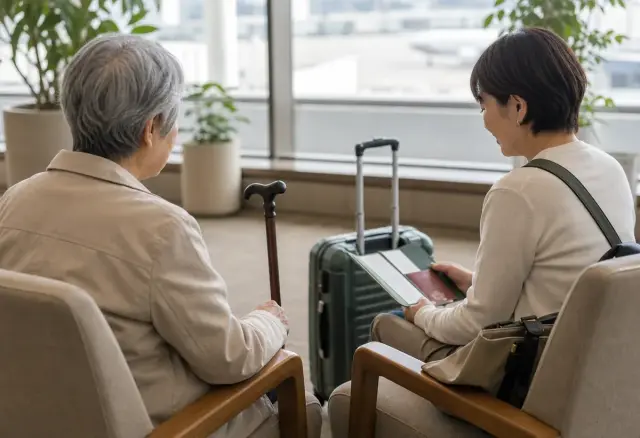
2026-07-05
Flying an Elderly Parent Back to Japan: Fit-to-Fly, Escorts, and Airline Assistance
A MEDIF fit-to-fly certificate is only required if your parent needs oxygen, a stretcher, or has had a recent illness or surgery; ANA and JAL want the certificate dated within 14 days of departure (10 days for a JAL stretcher case), and a commercial medical escort typically costs 70 to 90 percent less than an air ambulance for a stable patient.
Read article
2026-07-05
Japan's Free Nursing Home Referral Centers: Who Really Pays Them
A "free" nursing home referral center (shoukai center) in Japan is not paid by the family. It is paid by the facility once a resident moves in, usually one to two months of the monthly fee or a share of the move-in deposit, and that success-fee model is exactly why the recommendation is not always neutral.
Read article
2026-07-05
Vetting a Japanese Care Facility: Public Records, Inspections, and Staff Ratios
Every Japanese care facility funded by long-term care insurance is legally required to disclose staffing, service, and fee data on a national database, and the prefecture or city that licensed a facility publishes formal orders and license suspensions separately, so families can check a candidate before they ever book a flight.
Read article
2026-07-05
Visiting Japan with a Parent Who Has Dementia: An Honest Guide
In 2024, Japanese police recorded 18,121 missing-person reports involving people with dementia, so a trip needs a real plan, not just good intentions. This guide covers how to judge whether the trip should happen, what Japan's systems do and don't offer a visitor, and how to build an itinerary that holds up past day one.
Read article
2026-07-05
Hospital Accompaniment in Japan: Who Can Take Your Parent to the Doctor
Long-term care insurance pays for the ride to the hospital and help boarding the vehicle, but it rarely pays for someone to sit through the actual consultation or send you an English report; that gap is filled by care taxis, private companions, and family, each at a different cost and with a different answer to "can they come into the exam room."
Read article
2026-07-05
Using Japan's Long-Term Care Insurance Under 65: The 16 Specified Diseases Route
A resident aged 40 to 64 can use Japan's long-term care insurance only if the condition is one of 16 government-listed diseases, such as early-onset dementia, stroke, or terminal cancer; outside that list, the route runs through disability welfare services instead.
Read article
2026-07-05
Meal Delivery for an Elderly Parent in Japan: Haishoku Services, Soft Foods, and Safety Checks
A private haishoku meal costs roughly ¥450 to ¥800 delivered, and most providers check on your parent at the door; some cities also subsidize a portion of that cost or run their own safety-check meal program for people living alone.
Read article
2026-07-05
Medicare, NHS, and Home-Country Health Cover When You Move Back to Japan
US Medicare does not pay for care in Japan, so the real decision is whether to keep paying Part B while abroad; drop it and you risk months without US coverage plus a permanent 10% late penalty per 12 months if you ever move back.
Read article
2026-07-05
Driving in Japan After 65 as a Foreign Resident: License Conversion, Renewal Tests, and Giving Up the Car
Converting a foreign license after October 2025 now clears roughly 4 in 10 applicants on the written test and about 1 in 10 on the practical test, and renewing after 75 adds a ¥1,050 cognitive test on top of the usual course, so the age you move at changes which parts of this process actually apply to you.
Read article
2026-07-05
Caring for a Bedridden (Netakiri) Parent at Home in Japan: The Full Service Stack
Care level 4 gives a household ¥309,380 a month in insured home-care spending power and care level 5 gives ¥362,170, which in practice is enough to combine daily visiting care, visiting bath care, and visiting nursing into a full stack for a bedridden parent without moving to a facility.
Read article
2026-07-05
Japan's Combined Medical-and-Care Refund (Gassan): The Once-a-Year Cap Families Forget to Claim
If a parent's medical and care co-payments together topped roughly ¥560,000 in the year running August 1 to July 31 (the exact ceiling depends on income), the combined high-cost medical-and-care system refunds the excess, but only if someone applies within two years of that July 31.
Read article
2026-07-05
Entrance Fees at Japanese Care Homes: Amortization, Refunds, and the 90-Day Rule
A private care home entrance fee in Japan is not a purchase; it is prepaid rent that amortizes on a fixed schedule, and by law you get an unused portion back if your parent leaves within 90 days or dies before the schedule ends.
Read article
2026-07-05
Signing and Getting Japanese Documents From Overseas: Consulate Routes
A Japanese consulate's signature certificate (sign shomei) stands in for the registered seal your parent's bank, hospital, or care office will ask for, and a certificate of residence from the same consulate costs the yen equivalent of about ¥1,200 and takes roughly 3 to 5 business days online.
Read article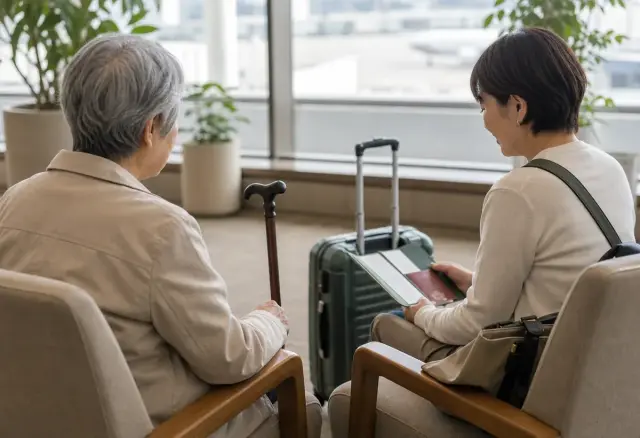
2026-07-05
Visiting a Parent in a Japanese Care Home: Rules, Outings, and Meetings
A short visit needs little more than notice to reception, but a day outing needs a written outing form, and an overnight leave from a tokuyo facility is capped at a reduced-rate allowance of 6 days a month. A care-plan meeting can often be scheduled around your stay if you ask two weeks ahead.
Read article
2026-07-05
Choosing a Japanese Care Facility When Your Parent Has Medical Needs
A parent on tube feeding, insulin, or suctioning is not shut out of Japanese long-term care; the nurse staffing ratio of the facility type, not the diagnosis, decides whether admission is possible.
Read article
2026-07-05
When Your Elderly Parents Visit You in Japan: A Resident's Prep Guide
Most visa-waiver countries get your parents 90 days in Japan, Japan's national health insurance will not pay a yen of their medical bills, and a short-term travel insurance plan for a 70-something traveler runs roughly $150 to $200 for a four-week trip.
Read article
2026-07-05
The My Number Health Insurance Card (Maina Hokensho) for Foreign Seniors in Japan
Japan stopped issuing paper health insurance cards on December 2, 2024, and even the grace period for expired cards ends on July 31, 2026, so a foreign senior now needs either a My Number card registered as a maina hokensho or a free shikaku kakuninsho to see a doctor.
Read article
2026-07-05
Shigo Jimu Inin: Japan's After-Death Affairs Contract, Explained
A shigo jimu inin (after-death affairs) contract pays someone in Japan roughly ¥1 million to ¥2 million upfront to cremate you, notify offices, and clear the room a will cannot cover, because a will only says who inherits, not who acts.
Read article
2026-07-05
Shipping Your Household Back to Japan: Customs, Unaccompanied Baggage, and the 6-Month Rule
Used household goods clear Japanese customs duty-free if you declare them as unaccompanied baggage on a C-5360 form at entry and they arrive within 6 months, but electric beds, wheelchairs, and a second CPAP machine each carry their own rule.
Read article
2026-07-05
Wandering and Dementia in Japan: SOS Networks, GPS, and What to Set Up Before It Happens
Japan's National Police Agency logged 18,121 missing-person reports tied to dementia in 2024, and most of the tools that bring someone home fast (municipal SOS registration, QR seals, GPS rental) have to be set up before a parent ever goes missing.
Read article
2026-07-05
Hospitalized in Japan as a Foreign Resident: What the Paperwork Actually Costs
A Japanese hospital can ask a foreign resident for a cash deposit at admission, a fixed meal charge of ¥550 per meal (as of June 2026), and a private-room fee averaging ¥6,862 a day, while the limit certificate caps everything else at about ¥85,800 a month, plus 1% of a very large bill, for most incomes under 70.
Read article
2026-07-05
Setai Bunri: Splitting the Household Register to Lower a Parent's Care Costs in Japan
Splitting your parent's juminhyo household from yours (setai bunri) can drop their monthly care-cost cap from the ¥44,400 tier toward ¥24,600 or ¥15,000 if their own income becomes tax-exempt, without anyone moving out, but it also strips out the household health-insurance and tax perks that assumed a shared household in the first place.
Read article
2026-07-05
When the Parent Who Was the Caregiver Collapses: A Japan Playbook
When the parent who was doing the caregiving is suddenly hospitalized, call Japan's regional comprehensive support center the same day: emergency short-stay beds (kinkyu tanki nyusho) hold a reserved 5% of capacity for exactly this situation, and a provisional care plan can start services before certification is finalized.
Read article
2026-07-05
When Your Japanese Spouse Dies: A Guide for the Foreign Widow or Widower in Japan
You have 14 days to notify immigration of your spouse's death and, generally, up to six months to change your residence status; most surviving foreign spouses move to a Long-Term Resident permit, and a survivor's pension follows separate income and record rules from immigration entirely.
Read article
2026-07-05
What Happens to Care Services When a Parent in Japan Is Hospitalized: Rentals, Day Service, and the Facility Bed
Kaigo hoken (long-term care insurance) services generally stop the day a parent is admitted to a Japanese hospital because medical insurance takes over, and a tokuyo (special nursing home) resident keeps a right to return for roughly three months under the facility's operating standard rather than losing the placement outright.
Read article