
Articles
All articles, page 3
Page 3 of 6, 40 articles on this page, newest first. Older articles sit further back; the topic hubs on page 1 are the faster route to one subject.
 Articles
2026-07-05
Keeping an Elderly Parent Warm in Winter in Japan: Cold Houses, Heaters, and What Family Abroad Can Check
A nationwide survey of 2,190 Japanese homes found living rooms averaging 16.8C and bedrooms 12.8C in winter, both well under the WHO's 18C minimum, and morning blood pressure rises 8.2 mmHg for every 10C the room drops. This covers why Japanese houses stay this cold, which heaters carry the most risk for an elderly parent, and what a family abroad can check before the season turns.
Read article
2026-07-05
Moving an Elderly Parent Out of Japan to Live With You Abroad
The day your parent's residency in Japan ends, kaigo hoken (long-term care insurance) and kouki koureisha iryo (late-stage elderly health insurance) end with it, while the Japanese pension keeps paying overseas; plan the paperwork and the receiving country's care system before you book the flight.
Read article
2026-07-05
Arranging a One-Time Welfare Check on a Parent in Japan From Overseas
When a parent in Japan stops answering and you cannot travel, there are three ways to get someone to their door within roughly 24 to 48 hours: a police welfare check, a call to the local comprehensive support center or minsei-iin, or a paid proxy visit that costs about ¥3,300 to ¥7,700.
Read article
2026-07-05
When a Parent Can't Take the Garbage Out: Japan's Waste Rules and Collection Support for Seniors
About 34.8% of Japanese municipalities now run a doorstep garbage collection service for seniors who can't carry bags to the curb, and most are free once your parent applies through the local cleaning office.
Read article
2026-07-05
Managing Incontinence on a Japan Trip: Supplies, Toilets, Dignity
Pack about twice the daily supply you use at home for the length of the trip, then restock at any Japanese drugstore using three labels on the shelf: テープ型 (tape), パンツ型 (pants), and 尿とりパッド (pad).
Read article
2026-07-05
Which Care Costs Count for Japan's Medical Expense Deduction: The Iryohi Kojo Rules for LTCI Services
A tokuyo resident's family can deduct only half of the self-paid care and food costs, while a rouken or care medical institution resident can deduct the full self-paid amount, and home-visit nursing is always deductible while home help only counts when a medical-type service sits on the same monthly care plan.
Read article
2026-07-05
You Lost Japanese Permanent Residence While Abroad: The Ways Back
A special re-entry permit expires after one year abroad (two for special permanent residents), and once it lapses your permanent residence is gone with it; there is no formal appeal, only a fresh application under a new residence status, which typically restarts the years-in-Japan clock unless you married a Japanese national.
Read article
2026-07-05
Switching Care Facilities in Japan: How to Move a Parent Without a Gap
A facility-to-facility move in Japan usually means overlapping two bills for two to four weeks, a 30-day cancellation notice at the current facility, and a full entrance-fee refund only if the original move-in was within the last 90 days.
Read article
2026-07-05
The Doctor's Opinion Letter for Care Certification in Japan: What to Do With No Regular Doctor
Japan's care-need certification cannot finish without a doctor's opinion letter (shujii ikensho), which the municipality requests directly from a physician, not from the family; a parent with no regular doctor is assigned one through the ward office, and the application generally stalls until that doctor is confirmed.
Read article
2026-07-05
The Emergency Flight Back to Japan: Leave, Logistics, and First Hours
Once you have decided to go, the questions change from "is this serious" to "how do I get there and what do I do the moment I land." Most families lose their first useful hours at the airport, not at the hospital.
Read article
2026-07-05
Do You Qualify for the Lower National Health Insurance Rate? Your First Year Back in Japan
File the zero-income declaration at the ward office in your first year back, and a single returnee with no prior Japan income can drop from roughly ¥58,600 to about ¥17,600 in annual National Health Insurance per-capita premium under Kawasaki's FY2026 (Reiwa 8) rates. Skip the filing and the ward has no basis to apply any reduction at all.
Read article
2026-07-05
Trial Stays (Taiken Nyukyo) at Japanese Care Facilities: How to Test Before Committing
A trial stay (taiken nyukyo) at a Japanese paid nursing home usually runs ¥5,000 to ¥15,000 a night, is not available at every facility type, and MHLW guidance requires paid homes to offer one before you sign a contract.
Read article
2026-07-05
Your Parent's Japanese Care Home Raised Its Fees: What Families Can Do
A care home fee increase in Japan is legal if the contract's fee-change clause and notice period were followed, but the amount and who absorbs it depend on whether the rise comes from a national reimbursement revision, a standard cost adjustment, or the facility's own management and food charges.
Read article
2026-07-05
The Only Child Abroad: Caring for a Parent in Japan With No Siblings
With no sibling to split the load, you cannot outsource decisions, only the tasks behind them. Japan's care manager, community support center, and voluntary guardianship system can carry the local workload; your job is to set that team up before a crisis forces it.
Read article
2026-07-05
Japan's Special Disability Allowance: A Monthly Payment for Parents at Care Levels 4 and 5 at Home
Japan's special disability allowance (tokubetsu shogaisha teate) pays ¥30,450 a month as of April 2026 to a severely disabled parent living at home, with no upper age limit, but a stay in a facility or a hospital admission past three months cancels it.
Read article
2026-07-05
Certified "Support Level" Instead of Care Level in Japan: What Yosien 1-2 Actually Unlocks
A support-level (yosien 1 or 2) result is not a failed application; it routes home help and day care through the municipality's own Comprehensive Program with monthly ceilings of about ¥50,320 (yosien 1) and ¥105,310 (yosien 2), planned by the community support center rather than a private care manager.
Read article
2026-07-05
No Helpers Available: What to Do When Home Care in Japan Can't Be Staffed
When a care plan is approved but no provider will take the case, this is a national supply problem, not a paperwork error: home helpers had a 14.14-to-1 job-vacancy ratio in fiscal 2023, and 89.4% of facility managers reported turning down requests for lack of staff in a 2025 industry survey. Here is what actually moves a stalled case.
Read article
2026-07-05
On the Tokuyo Waiting List: How Families Bridge the Gap in Japan
A tokuyo wait commonly runs months to a couple of years, and the 12 months in between are not empty time: rouken stays, short-stay rotations capped at 30 consecutive covered days, and a heavier home-care plan carry the family until a bed opens.
Read article
2026-07-05
Care Facilities for Couples in Japan: Staying Together When Needs Differ
Couple rooms exist mainly in kaigo-tsuki and jutaku-gata paid homes and in sa-ko-ju housing, not in tokuyo, and most operators can keep two spouses under one roof even when one needs far more care than the other.
Read article
2026-07-05
The Care-Needs Assessment Visit in Japan: How to Prepare So Your Parent's Real Condition Shows
The nintei chosa visit covers 74 items across six domains in roughly an hour, and the single biggest risk is a parent answering "I can do it" about a task they actually cannot manage daily, so the family's written notes and spoken account during the visit matter as much as the interview itself.
Read article
2026-07-05
The Social Welfare Corporation Reduction: A Third Layer of Savings Few Foreign Families Claim
For a tax-exempt, low-asset household, Japan's social welfare corporation reduction cuts the remaining co-payment and room-and-meal charges by a further one-quarter (one-half for old-age welfare pension recipients), but only at facilities that opted in and only after a household applies for it directly.
Read article
2026-07-05
Haircuts at Home: Visiting Hairdressers and Grooming for the Elderly in Japan
A licensed home-visit stylist (homon riyou-biyoushi) can cut, shampoo, and shave a parent who can no longer leave the house, and cities like Kawasaki subsidize it down to about ¥2,000 a visit, six times a year.
Read article
2026-07-05
Returning to Japan After Giving Up Japanese Nationality: Visa Routes for Former Nationals and Nikkei
If you personally naturalized abroad and lost Japanese nationality, no Long-Term Resident notification covers you directly; your children and grandchildren have a notification route, but your own return is filed as a separately reviewed case, usually after you are already in Japan on another status.
Read article
2026-07-05
Using Japanese Pharmacies as a Senior: Okusuri Techo, Kakaritsuke Pharmacists, and Home Visits
Under the fee schedule in force since June 1, 2026, an okusuri techo still shaves 14 points (about ¥140 before insurance) off a refill counseling fee, but the old flat kakaritsuke pharmacist fee is gone; naming one now costs nothing extra by itself, with two new add-on fees (50 points, 230 points) billed only when that pharmacist actually does follow-up work.
Read article
2026-07-02
Building a Bilingual Care Team in Japan: A Practical Guide for Non-Japanese Families
How non-Japanese families can find English-speaking or bilingual care managers, home helpers, and support staff in Japan: and how to keep the whole care team working together when you cannot be there in person.
Read article
2026-07-02
Family Care Leave in Japan for Foreign Workers: Your Rights, How to Apply, and What Employers Must Do
Japan's Childcare and Family Care Leave Act gives foreign workers the same caregiver leave rights as Japanese employees: up to 93 days of family care leave, 5 annual care leave days, and flexible working options. This guide explains what you are entitled to, how to apply, and how to talk to your employer.
Read article
2026-07-02
Your Parent Got the Designated Activities Visa. Now What? The Full Japan Care Setup Roadmap
A month-by-month roadmap from the day your elderly parent lands in Japan on a Designated Activities status to the day their first LTCI-funded care service begins: covering registration, bridge care, and assessment.
Read article
2026-07-02
When Your Parent in Japan Needs Emergency Care: A Decision Guide for Overseas Families
A step-by-step guide for overseas families when a parent in Japan faces a sudden hospitalization or medical crisis: covering the first 24 hours, remote decision-making authority, hospital communication, and what to arrange before the next emergency.
Read article
2026-07-02
Leaving Japan with Long-Term Care Insurance: What Foreign Residents Need to Do Before They Go
A step-by-step guide for foreign retirees and long-term residents leaving Japan permanently: covering LTCI disenrollment, premium refunds or final invoices, active service wind-down, and what to keep on record for a potential return.
Read article
2026-06-24
Naturalization vs. Permanent Residence in Japan: The Choice for Retirees
For a younger applicant the choice between Japanese citizenship and permanent residence turns on convenience. For a retiree it turns on your home-country pension, what happens to your estate, and whether you can keep the status alive when an aging year abroad pulls you away. This walks the late-life version of the decision and points you to the professionals who actually rule on it.
Read article
2026-06-24
End-of-Life Planning (Shukatsu) for Foreign Retirees in Japan: Wills, Repatriation, and a Cross-Border Family
Japanese shukatsu guides are written for a Japanese person whose family, bank, and grave are all in Japan. A foreign retiree's plan has a second country in it. This walks the legal and administrative groundwork a foreigner can set in advance: an ending note that works across borders, a Japan will that does not accidentally cancel your home-country will, who settles the estate when the heirs live abroad, and the consular and funeral steps for repatriation. It does not touch medical end-of-life decisions, and it signposts the tax and legal questions to the licensed professionals who answer them.
Read article
2026-06-24
What National Health Insurance Does Not Cover in Japan: Aging-Body Costs Retirees Should Budget
Japan's national health insurance covers doctors and hospitals well, but the three costs that grow with age (dental work beyond basic repair, prescription glasses, and hearing aids) fall largely outside it. This maps where the 30 percent co-payment stops, the 70-decibel disability-certificate gate that decides whether a hearing aid is subsidized, and how a retiree on pension income can budget all three.
Read article
2026-06-24
Living in Japan Without Fluent Japanese: A Realistic Plan for Retirees
You can retire in Japan without fluent Japanese, but where the language wall bites changes with age. This is the honest map: what apps and workarounds actually run, the hospital, city hall, and bank moments that need a real interpreter, the free services that exist, and how to build a bilingual support layer before you need it.
Read article
2026-06-24
Continuing Your Medication After Moving to Japan: Chronic Care, Refills, and the Bridge Period
Import guides cover the bag you fly in with. This covers what happens after: Japanese pharmacies will not fill a foreign prescription, your exact drug may not exist here, and you need a Japanese doctor to take over a chronic condition. How to plan the bridge period, find that doctor, and keep treatment unbroken.
Read article
2026-06-24
Banking and Money for Foreign Retirees in Japan: Opening an Account, Receiving a Pension, and Managing Two Countries
A neutral, procedure-first guide to money for foreign retirees settling in Japan: opening an account with no salary, the realistic banks that say yes, receiving an overseas pension under the new SWIFT rules, sending money across borders without a private-banking relationship, and planning for the years when getting to a branch becomes hard.
Read article
2026-06-24
Getting Around Japan With Limited Mobility: Trains, Taxis & Luggage
How a slow-moving senior traveler actually moves around Japan: JR Pass math, step-by-step shinkansen wheelchair-seat booking, station ramp assistance, care taxis, and hands-free luggage forwarding, with realistic yen costs and the cross-border angle for families arranging it from abroad.
Read article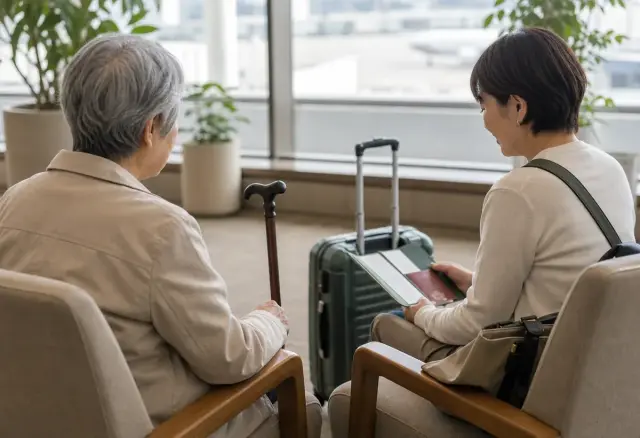
2026-06-24
Accessible Japan: Renting a Wheelchair and Finding Barrier-Free Places
What it actually costs to rent a wheelchair or power chair in Japan, where Japan is barrier-free (and where it is not), and how to book accessible gear and lodging from overseas for an elderly parent.
Read article
2026-06-23
Repatriating an Aging Japanese Parent: Moving a Parent Back to Japan and Landing the Care System
How families bring a Japanese parent back to Japan after years abroad and build a care system that actually holds: what to settle before the flight, the registration and care-insurance clock in the first two weeks, how to apply for care-need certification on arrival, and how to line up home care or a facility before they land.
Read article
2026-06-23
Bringing a Foreign Spouse to Japan in Later Life: The Visa Is the Start, Not the Finish
Most guides stop at the spouse visa. This one starts after it: how a non-Japanese partner enrolls in health and long-term care insurance, the language barrier in late-life care, who gives medical consent for someone who cannot follow a Japanese doctor, and the residence question that surfaces if the Japanese spouse dies first.
Read article
2026-06-23
Pension When Returning to Japan: How Your Overseas Years Totalize, and the Withdrawal You Cannot Undo
If you spent your working life abroad and are coming back to Japan in later life, your scattered contribution years can either count toward a pension or quietly disappear. This explains how totalization combines credits across countries, the lump-sum withdrawal that permanently cancels those periods, what re-joining the National Pension looks like after you re-register, and which offices actually decide your case.
Read article