
Why the Pharmacy Stops Being an Errand
From an Occasional Stop to a Standing System
Once medication becomes routine, the pharmacy shifts from a place you visit to a system you belong to, and three separate pieces of that system exist to be used on purpose.
The first few months after continuing your medication after moving to Japan are about getting a bridge prescription honored and finding a pharmacy at all. What comes after is different: refills every month, possibly several prescribers, and a growing list of drug names that no single doctor sees in full. That is the point where the pharmacy stops being a counter you stop at and becomes an infrastructure layer, the same way a bank account or a health insurance card is.
Japan built three specific tools for exactly this stage. The okusuri techo (お薬手帳) is a running medication record, paper or app, that any pharmacist or doctor can read. Naming a kakaritsuke pharmacist (かかりつけ薬剤師) turns one specific person into your accountable point of contact for your whole medication list. And in-home visits from a pharmacist exist for the point where getting to a pharmacy counter is no longer realistic. None of these are mandatory. All three are underused by residents who never had an equivalent system at home and do not know to ask.
Three Layers, Not One Choice
The three tools are not competing options. They stack, and most residents end up using at least two of them at the same time.
Think of it as three layers of the same relationship, each optional. The techo is the record. The kakaritsuke pharmacist is a named person who reads that record and takes responsibility for your whole medication list, not just the box in front of them. The home visit is a delivery mechanism for when the first two matter most but you cannot physically get to the pharmacy to use them. A resident in reasonable health typically starts with the techo alone, names a kakaritsuke pharmacist once the drug list gets complicated or a specific pharmacist earns their trust, and only moves to home visits when mobility genuinely limits errands.
English-language guidance almost never separates these three, and general "how pharmacies work in Japan" pages written for short-term visitors do not mention the kakaritsuke system or home visits at all, because a healthy 30-year-old tourist has no reason to need either.
What Changed in the June 2026 Fee Reform, and What Did Not
What the Okusuri Techo Still Saves You
The techo is free to start, and presenting one at the same pharmacy within three months still shaves 14 points, about ¥140 before insurance, off the counseling fee, unchanged by the 2026 reform.
Under the fee schedule that took effect June 1, 2026, the medication counseling fee (服薬管理指導料) that a pharmacy charges on every prescription fill is 45 points if you present a techo used at that pharmacy within the past three months, and 59 points if you do not, the same 14-point gap, worth about ¥140 on the total bill before your coinsurance share, that existed under the previous schedule. It is a small discount on any single visit, but it recurs every refill, and the record itself is the more valuable part: any pharmacist in the country can see your full drug history, past allergic reactions, and side effects, which matters most in an emergency or after a disaster when your usual pharmacy is unreachable.
Both the paper booklet and app versions (electronic techo, sometimes called e-okusuri techo) count for the discount, and either one is issued free at any dispensing pharmacy on request; no doctor's referral or prior enrollment is needed. If you take medication from more than one clinic, one techo covering all of them is the entire point, since a second or third notebook defeats the purpose of a single readable record.
Why Naming a Kakaritsuke Pharmacist No Longer Has a Flat Monthly Fee
The 2026 reform abolished the standalone kakaritsuke pharmacist guidance fee that used to be billed at every visit; the base counseling fee is now the same 45 or 59 points whether or not you have named one.
Before June 2026, naming a kakaritsuke pharmacist added a separate charge, the kakaritsuke pharmacist guidance fee, on top of the ordinary counseling fee at nearly every visit. The 2026 revision removed that fee entirely. The point-scoring table in force from June 1, 2026 lists the same 45-point and 59-point counseling fee for patients with and without a registered kakaritsuke pharmacist, meaning the act of naming one no longer changes what a routine refill costs. The Ministry of Health, Labour and Welfare framed the change as shifting the evaluation from the title itself to the actual work a kakaritsuke pharmacist does, so that patients choose one because of a real service, not because the designation itself is billed.
That work is now paid for through two new add-on fees rather than a recurring subscription-style charge. A kakaritsuke pharmacist follow-up add-on (かかりつけ薬剤師フォローアップ加算) of 50 points, about ¥500 before coinsurance, can be billed up to once every three months when the pharmacist proactively checks in by phone or another channel on how the medication is going between visits. A kakaritsuke pharmacist home-visit add-on (かかりつけ薬剤師訪問加算) of 230 points, about ¥2,300 before coinsurance, can be billed up to once every six months when that pharmacist visits your home to sort leftover medication and review how you are taking it, then reports back to your prescribing doctor. Neither fee applies unless the pharmacist actually does that specific work in that period; naming a kakaritsuke pharmacist and simply refilling as usual triggers neither add-on.
Registering with a kakaritsuke pharmacist is still worth doing even though it is no longer billed on its own. The designation is what makes you eligible for those two add-ons at all, and it is also what raises the value of a related correction fee, covered next, whenever that pharmacist catches a problem with your medication.
The Fee That Rewards Catching a Problem
When a pharmacist flags a duplicate, an interaction, or unused leftover medication and your prescription is actually changed as a result, the pharmacy bills a correction fee that pays more when your kakaritsuke pharmacist is the one who caught it.
The 2026 reform replaced the old combined interaction-and-leftover-medication add-on with two separate items, each still tiered by whether a kakaritsuke pharmacist is involved. A pharmacological adverse-event prevention add-on (薬学的有害事象等防止加算) applies when a pharmacist's review leads to an actual prescription change, such as removing a dangerous interaction or an unnecessary duplicate; it pays 50 points, about ¥500, when billed by your kakaritsuke pharmacist (the same 50-point tier also covers pharmacists managing home-care patients) and 30 points, about ¥300, when billed by any other pharmacist at the same pharmacy. A separate leftover-medication adjustment add-on (調剤時残薬調整加算) follows the same 50-point or 30-point split when the fix is simply adjusting a prescription's day count to use up medication you already have at home. Both are billed on top of the base counseling fee, not instead of it.
That fee gap, 50 points against 30 points for the same catch, is the clearest evidence the reform is trying to reward substance over title: a kakaritsuke pharmacist who actually knows your full list is worth more precisely because they are more likely to catch something, not because the relationship itself carries a listed price.
When a Pharmacist Comes to You
Once regular pharmacy visits are no longer realistic, a home-visit pharmacist bills under a separate fee schedule tied to how many other patients in the same building also receive visits, and living alone is actually the highest-billed tier, not the lowest.
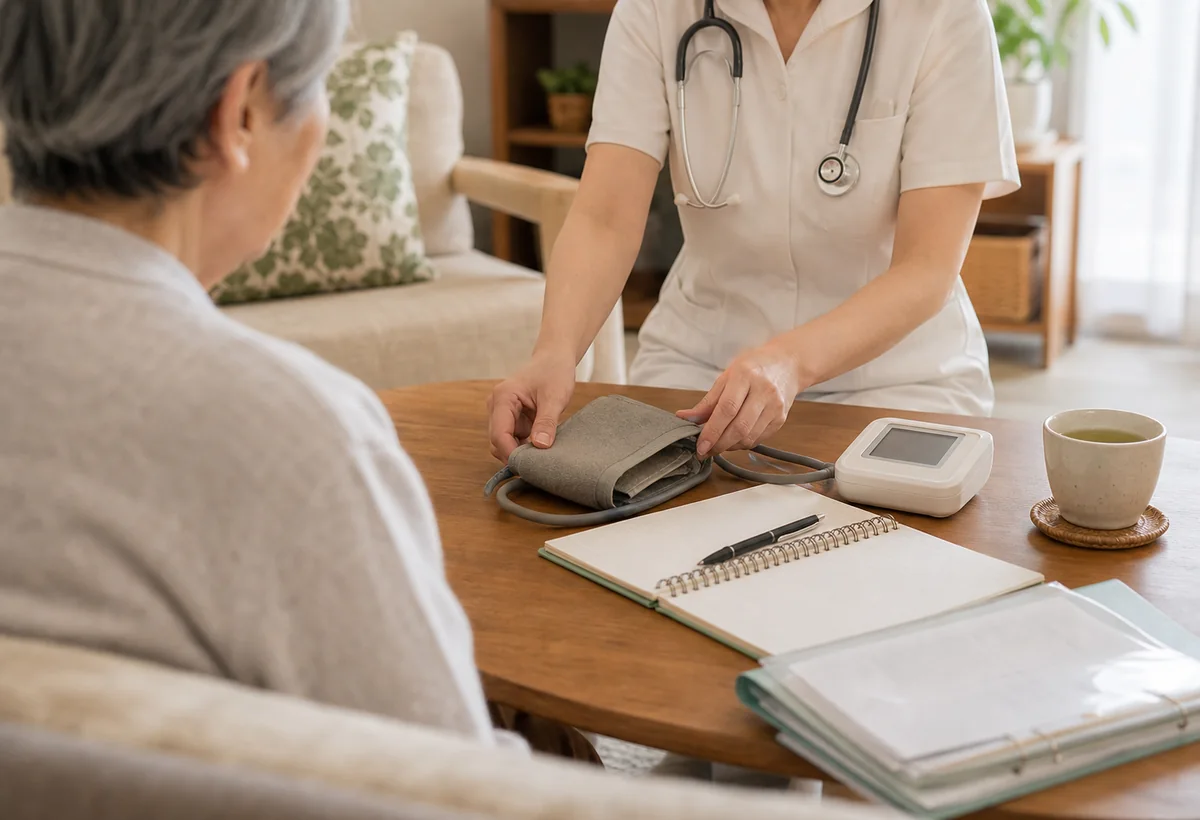
In-home patient medication management guidance (在宅患者訪問薬剤管理指導料) is the formal name for a pharmacist visiting your home to manage your medication in person, typically arranged monthly and coordinated with your doctor's home-visit plan. It sits alongside home medical care in Japan as one more house-call service rather than something you have to find on your own; most pharmacies offering home visits already work with the same house-call doctors and visiting nurses your household may be using.
The fee depends on how many other people classified as home-visit patients live in the same building (単一建物診療患者数), and the schedule in force since June 2026 sets it at 650 points, about ¥6,500 before coinsurance, for a patient living alone; 320 points, about ¥3,200, when 2 to 9 other visited patients share the building, such as a group home; and 290 points, about ¥2,900, for a building with 10 or more. At a 10% coinsurance rate, common among many residents aged 75 and over, that works out to roughly ¥650 a visit living alone versus about ¥320 in a shared building; at a 30% rate typical of working-age National Health Insurance members, the same visits run about ¥1,950 and ¥960. What does not change with a home visit is the record: the same techo and, if you have one, kakaritsuke pharmacist relationship carries over, so a home visit is a delivery method, not a different system.
Deciding What You Need, and What It Costs
Pharmacy Services Compared
Laid side by side under the fee schedule in force since June 1, 2026, the four services differ mainly in whether they are billed on every visit, only when work actually happens, or by the household you live in.
| Service | What it covers | Typical out-of-pocket | How to request it |
|---|---|---|---|
| Okusuri techo (paper or app) | Running record of all medications, allergies, and side effects across pharmacies | Free to obtain; saves about ¥140 per refill on the counseling fee when shown at the same pharmacy within 3 months | Ask any dispensing pharmacy; no referral needed |
| Kakaritsuke pharmacist (base designation) | Named pharmacist tracking your full drug list, no separate fee for the designation itself since June 2026 | No added cost beyond the standard 45 or 59 point counseling fee | Ask your regular pharmacy to register you; sign a consent form |
| Kakaritsuke follow-up and home-visit add-ons | Proactive phone check-ins (up to 4 times a year) or a home visit to sort medication (up to twice a year) by your named pharmacist | About ¥50 to ¥150 per follow-up call, about ¥230 to ¥690 per home visit, depending on coinsurance rate | Billed automatically when your kakaritsuke pharmacist performs that specific work |
| In-home visit (在宅患者訪問薬剤管理指導) | Pharmacist visits your home to manage medication and coordinate with a house-call doctor | Roughly ¥290 to ¥650 per visit before coinsurance, higher for a patient living alone than one in a shared building | Arranged through your doctor's home-care plan or the pharmacy directly once regular visits become impractical |
How to Choose Between the Options
The decision runs in one direction: start with the techo, name a kakaritsuke pharmacist once your medication list gets complicated, and move to home visits only when mobility, not convenience, is the limiting factor.
If you take medication from a single clinic and rarely change dose, an okusuri techo alone is enough; the discount is modest but the safety record is worth carrying regardless. If you see more than one prescriber, take five or more regular medications, or have had a dose changed and second-guessed the reason, naming a kakaritsuke pharmacist costs nothing extra to set up and gives you a specific person who is accountable for the whole list, with the follow-up and home-visit add-ons available if you ever need them. If getting to a pharmacy at all has become the obstacle, whether from mobility, a recent hospital discharge, or advancing frailty, ask your house-call doctor or a care manager whether a home-visit pharmacist can be added to your existing care plan rather than starting from scratch.
Cost should not be the reason to skip any of these. Even at the higher end, the combined cost of a kakaritsuke pharmacist's add-on fees and an in-home visit in a given month is a small fraction of what a single avoidable hospitalization from a missed drug interaction would cost, and residents whose overall medical spending is high in a given month may also be eligible for the high-cost care refund, which caps total out-of-pocket medical costs, pharmacy fees included, at a monthly ceiling based on income and age.
Setting It Up
Getting Your First Techo
A techo takes one request at any dispensing pharmacy, and consolidating everything into one notebook is the entire benefit.
Ask for a お薬手帳 the first time you fill a prescription at a Japanese pharmacy; most pharmacies will also offer the electronic version if you show interest, which stores the same record on a smartphone app instead of paper. If you already have one from a previous pharmacy, bring it rather than accepting a second one, since a split record defeats the purpose. Bring it to every pharmacy and every clinic visit, including English-speaking doctor appointments, so it stays current across your whole care team, not just one provider.
For residents who moved with medication from abroad, the techo is also where the translated drug names from your original prescriptions belong once a Japanese pharmacy has matched them to local equivalents, giving future pharmacists a single reference instead of scattered paperwork from two countries.
Naming a Pharmacist or Requesting a Home Visit
Both the kakaritsuke designation and a home visit start with a direct request, not an automatic assignment, so nothing changes until you ask.
To name a kakaritsuke pharmacist, tell your regular pharmacy you would like to register with a specific pharmacist there; they will explain the consent form and, since the June 2026 reform, the fact that the designation itself adds nothing to your routine counseling fee. There is no waiting period and no medical requirement to qualify, though the relationship works best once you have used the same pharmacy long enough for a pharmacist to actually know your history.
A home visit is usually arranged through whoever already manages your home medical care, such as a house-call doctor or a care manager coordinating your overall plan, since the pharmacist's visit schedule is set to align with your doctor's. If no home-care plan exists yet, a pharmacy that already offers visiting services can usually explain the referral path directly. Families relocating a parent should also review the checklist before moving to Japan with elderly parents for how pharmacy enrollment fits into the earlier arrival steps, since this article covers only the ongoing system once someone is already settled and filling regular prescriptions, not the initial handoff of an overseas prescription.
Frequently asked questions
Does naming a kakaritsuke pharmacist cost extra money each month?
Not since the fee reform that took effect June 1, 2026. The designation used to carry its own guidance fee billed at nearly every visit, but that fee was abolished, and the routine counseling fee is now the same 45 or 59 points whether or not you have a named kakaritsuke pharmacist. What is billed separately are two add-ons: a follow-up check-in fee of 50 points, up to four times a year, and a home-visit fee of 230 points, up to twice a year, and only when that specific work happens.
Does bringing an okusuri techo actually lower my pharmacy bill?
Yes, by a fixed amount that did not change in the 2026 fee reform. Presenting a techo used at the same pharmacy within the past three months keeps the medication counseling fee at 45 points instead of 59, a 14-point difference worth about ¥140 on the total bill before your coinsurance share is applied.
Is an okusuri techo the same as an electronic health record?
No. It is a self-carried record of medications, allergies, and side effects that you present at each visit; pharmacies and doctors do not automatically share it with each other outside of what you show them. Paper and app versions both work the same way and both qualify for the presentation discount.
How much more does it cost when a kakaritsuke pharmacist catches a drug interaction, compared to any other pharmacist?
If a pharmacist's review leads to an actual prescription change, the pharmacy bills a prevention add-on of 50 points, about ¥500, when your registered kakaritsuke pharmacist is the one who caught it, versus 30 points, about ¥300, for the same catch by another pharmacist at the same pharmacy. The same 50-point and 30-point split applies to the separate add-on for adjusting leftover medication.
How much does an in-home pharmacist visit cost if I live alone versus in a shared residence?
Under the schedule in force since June 2026, a patient living alone is billed at the highest tier, 650 points, about ¥6,500 before coinsurance, while a shared building with 2 to 9 other visited patients is billed at 320 points, and a building with 10 or more is billed at 290 points. At a 10% coinsurance rate that is roughly ¥650 versus ¥320 per visit; at 30% it is roughly ¥1,950 versus ¥960.
Can I use online medication guidance instead of visiting the pharmacy every time?
Yes. Video-call medication guidance has been legal in Japan since a 2019 law change, and the 2026 fee reform folded it into the same medication counseling fee structure rather than billing it as a separate item, at 45 points for a refill within three months and 59 points otherwise. It suits residents who find travel difficult but do not yet need a full home visit, and the coinsurance rate applies the same way as an in-person counseling fee.
Do I need to switch pharmacies to get a kakaritsuke pharmacist?
No. You register with a pharmacist at a pharmacy you already use; there is no requirement to change pharmacies or find a specialist location. The designation is about naming a specific person as accountable for your full medication record, not about which storefront you visit, and since June 2026 it no longer adds a fee to routine visits by itself.
How Japan Care Concierge can help
We prepare the care and medical side of a move: continuity of treatment, insurance enrolment, and the support waiting on arrival. Certification cannot be filed before the resident registration exists, so the order of these steps decides the timeline.
Primary and official references
We checked 5 primary or official sources below before writing this article. Rules, costs, and local procedures change by municipality and over time. Confirm the linked official source before a final decision. Last source check: 2026-07-13.
- Japan Pharmacists Association: Dispensing Fee Schedule effective June 1, 2026 (Japanese, PDF)
- Japan Pharmacists Association: Summary of the Reiwa 8 (2026) Dispensing Fee Revision Items (Japanese, PDF)
- MHLW: Guidelines on Appropriate Use of Medicines for the Elderly (General Principles, 2018) (Japanese)
- MHLW: Information on Online Medication Guidance (Japanese)
- Japan Pharmaceutical Association: About the Electronic Okusuri Techo (Japanese)
About this article
This page is general orientation, not medical, legal or individual care advice. Japan Care Concierge is operated with the care-service experience of Social Welfare Corporation Shinkou Fukushikai, established in 1999, which runs elderly care facilities and services in Kanagawa under the Cross Heart name. We take no referral fees from facilities or providers. We do not provide medical treatment, diagnosis, emergency response or hands-on care. Japan has 1,559 long-term care insurers and each sets its own rules and timelines, so confirm your own case with the municipal long-term care insurance desk or your local community support center. The publication and update dates above are actual dates. How we research, source, and correct content is described in our editorial policy.