
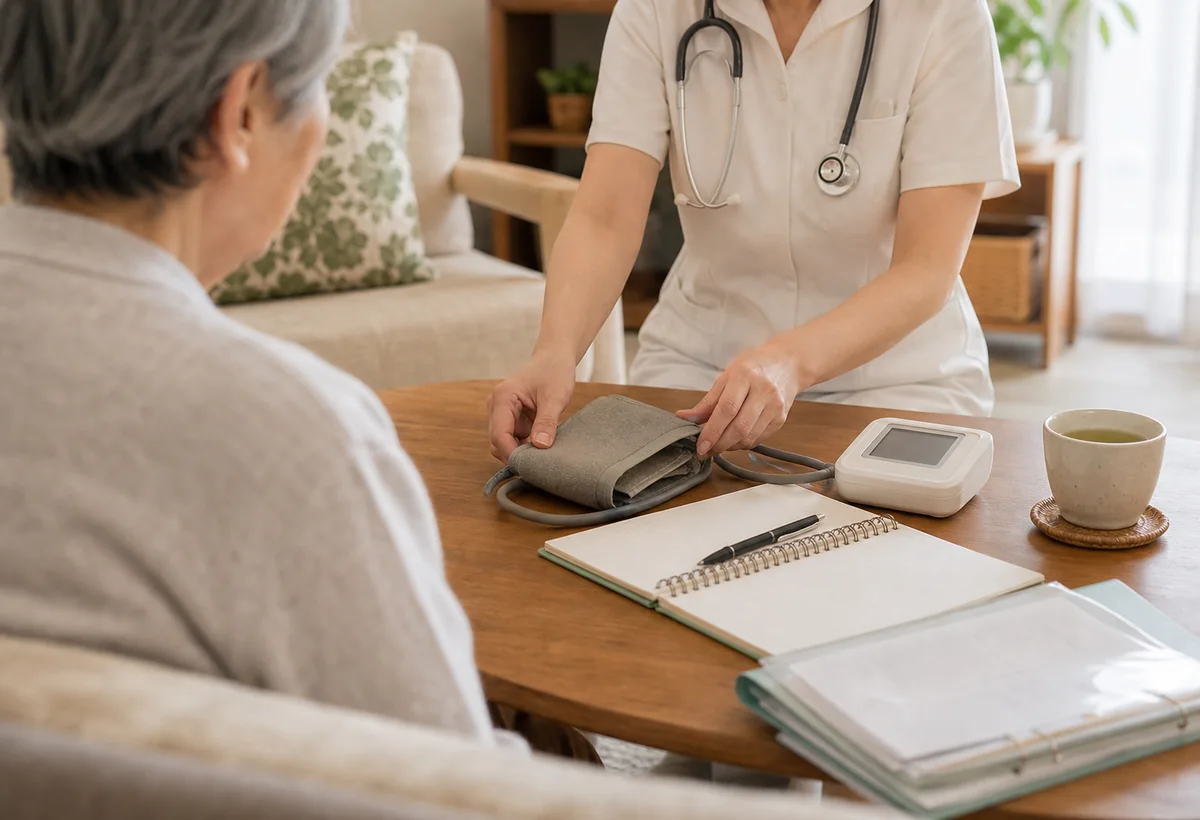
Yes, doctors make house calls in Japan
Home medical care (zaitaku iryou) is an established part of Japan's medical system, not a luxury service. It rests on two distinct visit types: scheduled, recurring physician visits (houmon shinryou), typically a couple of times a month for a patient under ongoing home management, and urgent house calls (oushin) when something happens between them.
The backbone is the home-care support clinic (zaitaku ryouyou shien shinryoujo), a category of clinic committed to round-the-clock contact for its home patients, in many cases including night and weekend response. For an older person who struggles to reach a clinic, this replaces the exhausting ritual of quarterly hospital outpatient trips with medicine that comes to the kitchen table.
One thing overseas families should check before assuming any of this is the geography, because home medical care in Japan is distributed very unevenly. A nationwide study covering all 1,741 municipalities found home-care support clinics ranging from zero to 35.5 per 10,000 older residents, averaging about 3.4, and roughly one municipality in five had none at all. In a dense city ward the round-the-clock home-clinic model is realistic; in a thinly served rural town it may simply not exist within reach. The first practical question is therefore not how home medical care works, but whether a clinic with genuine 24-hour cover operates at your parent's actual address, which the community support center or care manager can answer directly.
Visiting nurses are the system's workhorse
Visiting nurse stations (houmon kango station) send nurses into the home for medical management: condition monitoring, medication management, wound and catheter care, injections, rehabilitation support, and the practical judgment calls between doctor visits.
Visiting nursing always works under a physician's written instruction, and its billing straddles the two insurance systems: depending on age, condition, and certification, it runs under medical insurance or long-term care insurance, which determines limits and co-payments. Families do not need to resolve that distinction themselves; the care manager, the doctor, and the station sort it out. What families should know is simpler: if a parent has real medical needs at home, a visiting nurse is usually the single highest-value service to add, because it puts clinical eyes on the person regularly and a clinical voice on the phone when something looks wrong.
Who arranges it, and how to start
Home medical care is arranged through people, not portals, and three doors lead into it.
- Hospital discharge: the discharge planning office can hand a patient directly to a home-care clinic and visiting nurse station before they leave the ward, which is the smoothest entry
- The care manager: for a certified parent, the care manager knows which local clinics take home patients and can coordinate the medical and care sides into one schedule
- Direct approach: families can contact a home-care support clinic or visiting nurse station themselves, or ask the community support center for the local list; the current doctor's referral letter helps
What it costs, in shape rather than yen
Home medical care bills through medical insurance with the usual 10 to 30 percent co-payment, plus monthly management fees for the round-the-clock framework, and the high-cost medical expense cap (kougaku ryouyouhi) limits a heavy month.
The practical effect for most older patients is that regular home medical management costs more than sporadic clinic visits but stays bounded, and the cap protects against the months when things go wrong. Exact amounts depend on income category, services used, and whether nursing runs on the medical or care side, so ask the clinic's office staff for a monthly estimate; they produce these routinely. Equipment such as home oxygen or rental hospital beds is arranged separately, partly through the care plan.
There is a timing twist worth knowing for end-of-life situations. Research comparing physician-led home care with hospital care found that home care can actually cost more per day when it is started only in the final days, because the setup and intensive visits pile up at once, yet for sustained care of a month or more it ran cheaper than the hospital equivalent, by roughly a sixth. The planning lesson mirrors the medical one: home medical care rewards being arranged early rather than summoned at the very end.
End-of-life care at home is part of this system
For families weighing whether a parent can spend their last months at home, home medical care is the structure that makes it realistic: physician visits, nurse support, pain management, and a clinician reachable at night.
Home-care support clinics handle deaths at home (mitori) as part of their role, which spares families the ambulance-and-emergency-room ending nobody wanted. Whether it works in a specific case depends on the condition, the home, the family's capacity, and the availability of a clinic with genuine 24-hour response in that area, all of which vary; this is a conversation to have early with the doctor and care manager rather than in the final weeks. It is general orientation, not a medical recommendation for any individual case.
Where a parent can die at home is partly a question of postcode, too. In the nationwide municipal study, the share of deaths occurring at home ranged from under 1 percent to over half depending on the area, and the rate tracked the local supply of home-care clinics and visiting-nurse stations even after accounting for hospital beds and care facilities. A family set on a home death is not only choosing it; they are relying on whether the surrounding infrastructure can support it, which is one more reason to confirm local capacity early rather than discover its absence in the final weeks.
The pieces foreign families should add
The system itself works the same for any insured resident, and language is the layer that needs deliberate construction.
- English-speaking home-visit doctors exist mainly in metro areas and fill up; ask candidate clinics directly, and early
- A bilingual medication list and a written Japanese summary of conditions and preferences in the home keeps every visit functional regardless of who comes
- Decide how findings travel: who attends visits, who asks questions, and how the result reaches family abroad in their language
- If nobody in the family can hold the Japanese-side communication, budget for a coordination layer; medical visits that nobody understands quietly lose their value
Frequently asked questions
Will a doctor really make house calls in Japan?
Yes. Scheduled home visits (houmon shinryou) are standard for patients under home management, and urgent house calls (oushin) cover problems between them. Home-care support clinics build their practice around this, including round-the-clock phone access; availability is densest in urban areas.
Is home medical care in Japan paid by medical insurance or long-term care insurance?
Physician visits bill through medical insurance with normal co-payments. Visiting nursing runs under either system depending on age, condition, and certification, with the doctor's instruction and the care manager determining which. Families get a single practical schedule either way.
How do we arrange a visiting nurse for a parent in Japan?
It requires a physician's written instruction, so the route runs through the parent's doctor, the hospital's discharge planners, or the care manager, who can connect a local visiting nurse station and fold the visits into the care plan. The community support center keeps the local list.
Can a parent receive end-of-life care at home in Japan?
Often yes, when a home-care support clinic with genuine 24-hour response operates in the area and the family wants it. Pain management, nurse visits, and death at home are an established part of the home medical system; feasibility is case-by-case, so raise it early with the doctor and care manager.
How Japan Care Concierge can help
We take one family's case through the steps this page describes. That means naming the office to call first, listing what to bring, and mapping the 30-day certification clock onto your own dates.
Primary and official references
We checked 4 primary or official sources below before writing this article. Rules, costs, and local procedures change by municipality and over time. Confirm the linked official source before a final decision. Last source check: 2026-06-10.
About this article
This page is general orientation, not medical, legal or individual care advice. Japan Care Concierge is operated with the care-service experience of Social Welfare Corporation Shinkou Fukushikai, established in 1999, which runs elderly care facilities and services in Kanagawa under the Cross Heart name. We take no referral fees from facilities or providers. We do not provide medical treatment, diagnosis, emergency response or hands-on care. Japan has 1,559 long-term care insurers and each sets its own rules and timelines, so confirm your own case with the municipal long-term care insurance desk or your local community support center. The publication and update dates above are actual dates. How we research, source, and correct content is described in our editorial policy.