
Travel & Visits

Visiting Japan with an Older Parent

Visiting Japan with an older traveler means planning around medication rules, mobility, and what happens if health interrupts the stay. These articles cover short trips and stays of one to three months: bringing medicines in legally, the 90-day limit, seeing a doctor without public insurance, and getting help where you stay.

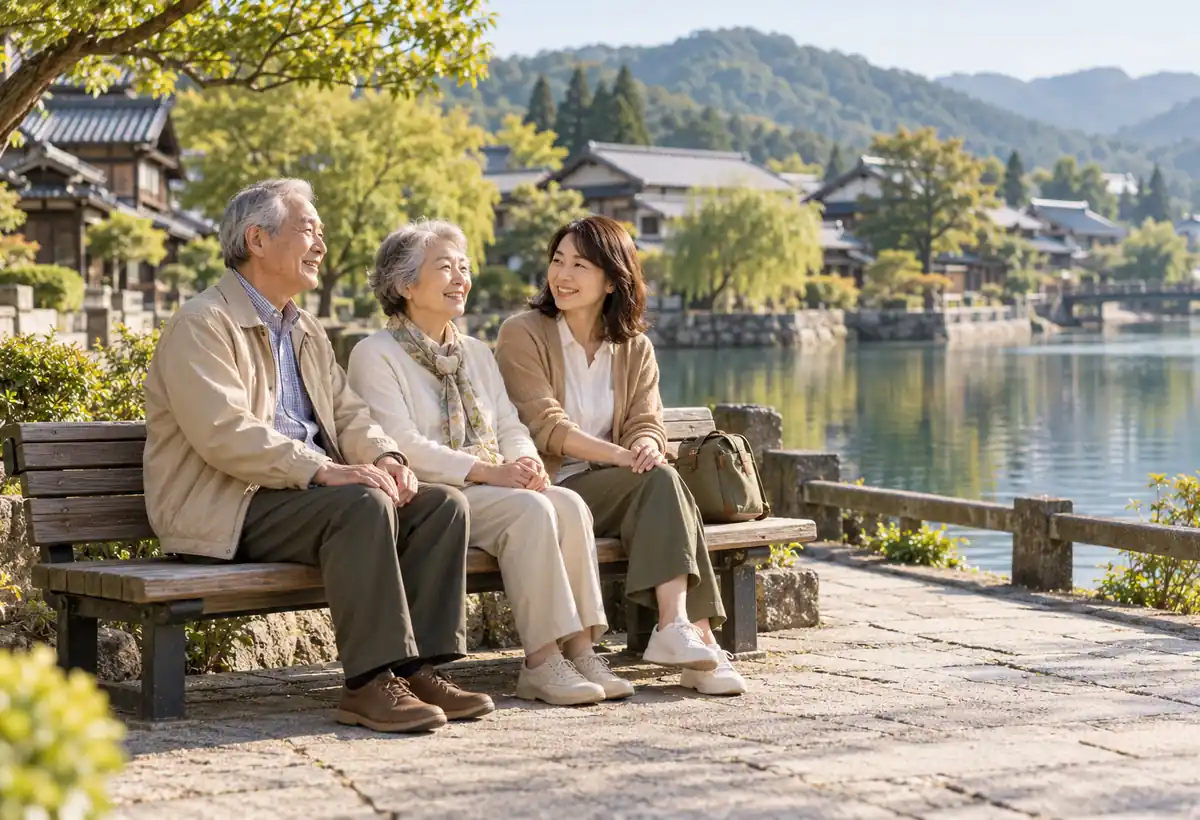
Older parents and their adult daughter resting on a waterside bench during a Japan trip.Travel & Visits

Start with the pillar guide for this topic: Traveling to Japan with elderly parents. It covers the system end to end, and the 32 articles below go deeper on one decision each.

If you are at the very beginning, the sequence is the same for every topic. Apply for a care-needs certification at the community support center for your parent's municipality, then use the wait to compare costs and housing. The first consultation with us is 30 minutes and free.

Reading order by stage

Each stage names the decision in front of you. All 32 articles stay listed below.

Articles on this topic

Care-aware planning for visiting Japan with an older traveler, from a short trip to a stay of one to three months.

2026-07-05

A Care-Check Visit to Your Aging Parent in Japan: What to Look For

A few days home lets you check four things fast: the refrigerator and unopened mail, medication and walking, the neighbors, and one call to the local Comprehensive Community Support Center before you fly back.

Read article

2026-07-05

Visiting Japan with a Parent Who Has Dementia: An Honest Guide

In 2025, Japanese police recorded 17,345 missing-person reports involving people with dementia, so a trip needs a real plan, not just good intentions. This guide covers how to judge whether the trip should happen, what Japan's systems do and don't offer a visitor, and how to build an itinerary that holds up past day one.

Read article

2026-07-05

Visiting a Parent in a Japanese Care Home: Rules, Outings, and Meetings

A short visit needs little more than notice to reception, but a day outing needs a written outing form, and an overnight leave from a tokuyo facility is capped at a reduced-rate allowance of 6 days a month. A care-plan meeting can often be scheduled around your stay if you ask two weeks ahead.

Read article

2026-07-05

When Your Elderly Parents Visit You in Japan: A Resident's Prep Guide

Most visa-waiver countries get your parents 90 days in Japan, Japan's national health insurance will not pay a yen of their medical bills, and a short-term travel insurance plan for a 70-something traveler runs roughly $150 to $200 for a four-week trip.

Read article

2026-07-05

Flying to Japan with an Elderly Parent: Clearance, Assistance, and Jet Lag

Most families do not need a doctor's clearance form to fly, but a parent using oxygen, a stretcher, or recovering from recent surgery does, and both ANA and JAL want that paperwork in before you reach the airport.

Read article

2026-07-05

If a Family Member Dies While Visiting Japan: Procedures and Costs

Japanese law requires at least 24 hours between death and cremation, and a family choosing to bring ashes home instead of the body typically pays roughly ¥300,000 to ¥600,000 in shipping on top of local funeral costs, while a full-body repatriation runs several times higher.

Read article

2026-07-05

Visiting Japan Again After Decades Away: An Older Traveler's Guide

Trains now run on tap-and-go IC cards instead of ticket windows, 94.2% of higher-traffic stations have step-free routes as of the end of fiscal 2024, and cashless payment covers 58.0% of consumer spending as of 2025, so the Japan you remember is still recognizable but the daily mechanics have moved on without you.

Read article

2026-07-05

Travel Helpers in Japan: Paid Care Companions for an Older Visitor

A certified Travel Helper, an off-insurance outing escort, or a kaigo taxi (fares from about ¥800 plus ¥500 to ¥2,000 in assist fees) can cover a few hours or a full day of hands-on help during a Japan visit, and none of them require Japanese residency or a care-insurance certificate to book.

Read article

2026-07-05

Eating Out in Japan with an Elderly Parent: Soft Meals and Restrictions

A parent who chews or swallows less well, watches salt or sugar, or carries a food allergy can still eat out across most of Japan; the fix is knowing which restaurant genres bend easily, the handful of Japanese phrases that get a kitchen to adjust a dish, and Japan's own care-food labeling (blue, yellow, and red Smile Care Food marks) that make packaged backup food easy to identify.

Read article

2026-07-05

Managing Incontinence on a Japan Trip: Supplies, Toilets, Dignity

Pack about twice the daily supply you use at home for the length of the trip, then restock at any Japanese drugstore using three labels on the shelf: テープ型 (tape), パンツ型 (pants), and 尿とりパッド (pad).

Read article

2026-11-02

Japan Travel Changes 2026: What Older Visitors Should Check

Six changes reach older visitors to Japan: power bank limits in the cabin from 24 April 2026, a ¥3,000 departure tax and a new visa fee from 1 July, extension fees set by permitted period from 1 October, a tax-free refund system for purchases from 1 November, and the JESTA pre-arrival check planned for fiscal 2028. This page lists each one with its date, its government source and the points that matter for health and time at the airport. We update it when a source changes.

Read article

2026-11-02

Where to Base a Long Stay in Japan

There is no single best city for an older visitor on a one-to-three-month stay. This guide compares a base by five checks: emergency hospital access, slopes and steps, stations and buses, season, and English help. Each check points to a public source, and the five example cities are examples of a range, not a ranking.

Read article

2026-11-02

Buying Care Supplies in Japan as a Visitor

A visitor can buy diapers, walkers, wheelchairs and soft foods in Japan without insurance or a doctor's note, but cannot use care insurance rental. Qualifying wheelchairs and walkers are sold without consumption tax, while used-up items such as diapers and thickener cannot be refunded under the tax-free system that started on 1 November 2026. This guide covers sizing, shop questions and what customs can confirm at departure.

Read article

2026-11-02

Japan Tax-Free Refund for Older Travelers

Since 1 November 2026, Japan's tax-free shops charge the full price and generally refund the consumption tax after customs confirms at departure that the goods are leaving the country. For older visitors the order matters: the check comes before checked bags, the buyer's own passport is needed at the shop and at the terminal, and anything eaten or used up in Japan can sink the refund for its whole receipt. This guide follows one purchase from the counter to the refund.

Read article

2026-11-02

Private Care During a Long Stay in Japan

An older visitor in Japan cannot use public long-term care insurance, because it is built for people whose home base is in a Japanese municipality, and a temporary visitor is not a registered resident. Help with bathing, meals, medicines or nursing during a one- to three-month stay is arranged and paid for privately. This guide sorts common tasks by who may do them under Ministry of Health, Labour and Welfare notices, shows what moves the price, and lists questions to settle before departure.

Read article

2026-11-02

Monthly Apartments in Japan for Older Visitors

A visitor can look for a room by the month in Japan, but the room falls under one of several legal types, and the type decides the contract, the notice period and who is responsible when something goes wrong. This guide sorts hotels, minpaku, monthly rentals and ordinary leases, then lists the guarantor, emergency-contact and safety questions an older visitor should settle in writing.

Read article

2026-11-02

Medication for a Long Stay in Japan: Carry, Mail or Refill

A visitor can carry one month of ordinary prescription medicine into Japan with no paperwork. For months two and three there are three routes: an import confirmation obtained before the flight, a parcel from home, or a Japanese prescription after arrival. This guide compares them and marks where psychotropics, narcotics and stimulant-related drugs change the answer.

Read article

2026-11-02

Seeing a Doctor in Japan on a Long Stay

A visitor to Japan stays outside public health insurance, so a planned doctor visit is self-pay at a price the facility sets. This guide walks through costs, the referral letter rule, papers from home, language, prescriptions and claiming later.

Read article

2026-11-02

One Month in Japan for Older Travelers

A month in Japan is long enough for medicines to run short and for a health problem to appear. This guide lays out the one-month medicine line, insurance questions, a week-by-week outline, emergency contacts and how many bases to use. It is a planning aid, not medical or immigration advice.

Read article

2026-11-02

Two Months in Japan for Older Travelers: Bases, Season and Medicine

Two months in Japan fits inside the 90-day temporary visitor period for many passports, but it is long enough that medicine, insurance and heat shape the plan. This guide compares one base, two bases and several moves, shows average temperatures by month from the Japan Meteorological Agency, and explains why 60 days of prescription medicine needs an Import Confirmation.

Read article

2026-11-02

Three Months in Japan for Older Travelers: A Backward Plan from Day 90

A 90-day stay uses the whole short-stay period, so there is no slack. This guide counts backward from the departure date: the medicine line, insurance questions, papers with dates, the change of season, and what the Immigration Services Agency says about hospital stays that run past day 90.

Read article

2026-11-02

Japan's 90-Day Limit for Older Visitors: Can You Extend?

Most visitors cannot extend a stay in Japan past the date on the landing stamp. Passport holders from seven countries may reach six months by applying at an immigration bureau before that date, and illness that makes travel impossible can justify an extension with a doctor's certificate. This guide sets out each rule, the fee, and what overstaying costs, so you know what to ask the bureau.

Read article

2026-11-02

Japan Long Stay Visa for Retirees: Who Needs It and Who Does Not

Most retirees who visit Japan for one to three months do not need the long stay visa. It is a Designated Activities status for sightseeing and recreation, open to listed nationalities aged 18 or older with ¥30 million in savings and private insurance, for up to one year. This guide gives the rules from the public notice, what the status leaves out for an older person, and a way to decide.

Read article

2026-06-10

Bringing Medications to Japan: Yakkan Shoumei and What Senior Travelers Must Check First

A practical, source-checked guide for older travelers and families: the one-month rule, when a yakkan shoumei import confirmation is needed, controlled and prohibited drugs including opioids such as hydromorphone, and what to do at customs.

Read article

2026-06-10

Traveling to Japan with Elderly Parents: A Care-Aware Planning Guide

How to plan a one-to-three-week visit to Japan with an aging parent: a trip-fit reality check, season and pacing, flights and wheelchair assistance, accessible rail and luggage forwarding, hotels, whether you need a senior tour, health groundwork, early dementia, and a weeks-before-departure checklist.

Read article

2026-06-10

What If an Elderly Parent Gets Sick While Visiting Japan?

A visiting parent who falls ill in Japan is not covered by national health insurance and pays the full bill. The real costs, the insurance to check before the flight, who to call, how payment and claims work, and what repatriation involves.

Read article

2026-06-10

Onsen and Ryokan with an Elderly Parent: An Honest Accessibility Guide

The onsen stay is often the dream of a last trip to Japan and the part most likely to go wrong physically. What care professionals would ask, book, and plan for.

Read article

2026-06-14

Holiday Dialysis in Japan: How to Arrange Treatment as a Visitor

A parent on dialysis can still visit Japan, but the treatment has to be booked weeks ahead, paid in full out of pocket, and arranged directly with a clinic that accepts visitors. What travel dialysis costs, how far ahead to apply, the records a clinic needs before it says yes, and where overseas families get stuck.

Read article

2026-06-14

Oxygen, CPAP and Medical Devices on a Japan Trip

A portable oxygen concentrator, a CPAP machine, or another powered medical device can travel to Japan, but each has an airline step, a customs step, and a Japanese-power step to set up before departure. What needs advance clearance, the 100V plug reality, and how a visitor arranges oxygen in Japan.

Read article

2026-06-14

Traveling to Japan with a Chronic Condition: Diabetes, Heart, and Lungs

An older traveler who manages diabetes, a heart condition, or a lung disease can still enjoy Japan, but the medical side has to be set up before departure. Carrying medication and insulin legally, the yakkan shoumei rule, fit-to-fly clearance, onsen and security cautions, and what travel insurance will and won't do.

Read article

2026-06-24

Getting Around Japan With Limited Mobility: Trains, Taxis & Luggage

How a slow-moving senior traveler actually moves around Japan: JR Pass math, step-by-step shinkansen wheelchair-seat booking, station ramp assistance, care taxis, and hands-free luggage forwarding, with realistic yen costs and the cross-border angle for families arranging it from abroad.

Read article

2026-06-24

Accessible Japan: Renting a Wheelchair and Finding Barrier-Free Places

What it actually costs to rent a wheelchair or power chair in Japan, where Japan is barrier-free (and where it is not), and how to book accessible gear and lodging from overseas for an elderly parent.

Read article

Browse every topic on the full article index, or see all care system guides.