
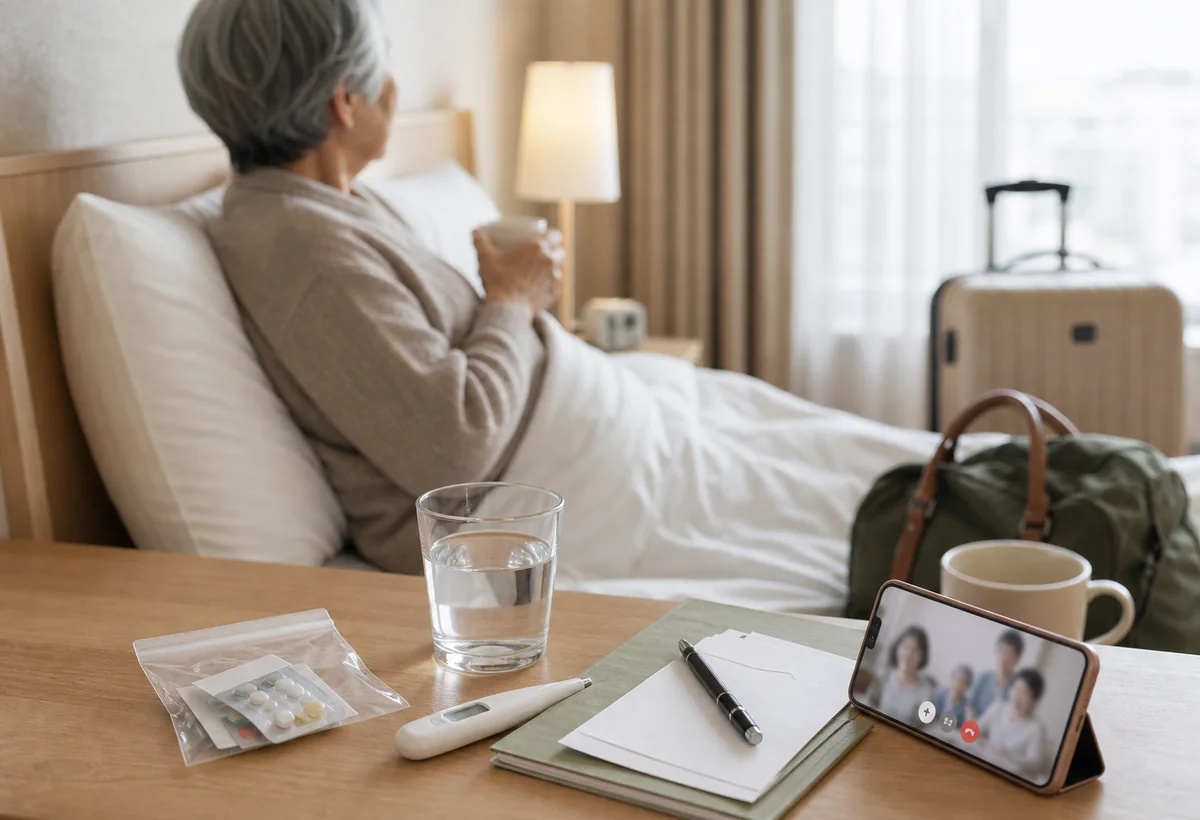
Yes, you can have dialysis on a Japan trip, but you book it, not improvise it
A parent who needs hemodialysis three times a week can still travel to Japan. Many clinics and hospitals accept visitors for travel dialysis (rinji toseki, sometimes called transient or holiday dialysis), including foreigners with no Japanese health insurance. The catch is that it is a booked medical appointment arranged weeks in advance by direct application to a specific clinic, not something a family sorts out after arrival or through a hospital emergency room.
This article is the navigator's view: how the booking, the cost, the paperwork, and the language actually work, so a family can decide whether the trip is feasible and plan it properly. We are not a clinic and not a travel agency; the booking itself is always between the patient and the dialysis facility. If a parent's condition is medically complex, the home renal team has the final say on whether travel is safe at all, and that conversation comes before any of this.
Book the dialysis first, then plan the trip around it
The single most useful reframe is to treat the dialysis schedule as the fixed skeleton of the trip. A standard pattern is three sessions a week of about four hours each, on set days, so those slots anchor everything else; sightseeing is planned around them, not the other way round.
Lead time is the part families underestimate. The norm for booking a facility within Japan is roughly three weeks to a month ahead, and the clinic reviews the patient's records before accepting, so confirmation can itself take up to a week and a complex case can be declined. Japan's national kidney-patients' association advises lining up domestic travel-dialysis well in advance, and longer still when arranging from overseas. Start by deciding the city and dates, find clinics there that publish a travel-dialysis acceptance page, and apply early enough that a 'no' from the first choice still leaves time for a second. For a parent who travels with elderly parents on a care-aware itinerary, the dialysis days are simply the first fixed points on the calendar.
What it costs, and why travel insurance will not help
Because a visiting tourist is not enrolled in Japan's public health insurance, travel dialysis is billed as full self-pay (jihi). The insured domestic rate of around ¥10,000 a session that circulates online does not apply to an uninsured visitor.
Verified visitor-facing prices run roughly ¥40,000 to ¥55,000 per session, varying by clinic, by treatment type (standard hemodialysis is cheaper than hemodiafiltration), and by session length. For a two-week trip at three sessions a week, that is six treatments, so the dialysis alone is a real four-figure line in the budget before flights or hotels. Two practical traps follow. Some clinics take Japanese-yen cash only and do not accept cards, so the money has to be on hand. And travel insurance generally will not cover this: routine, planned dialysis for a known condition is ongoing maintenance treatment, not a sudden emergency, so it falls outside most policies. Budget for the full self-pay figure rather than assuming insurance absorbs it, and confirm the exact per-session price with the clinic at booking, since figures change.
The records a clinic needs before it says yes
Acceptance is decided on paper, before the visit, from the patient's recent treatment history. Sending a clean, complete file early is what turns a tentative enquiry into a confirmed booking.
- Recent dialysis records, commonly the latest three sessions: treatment conditions, dry weight, and the dialyzer and settings used
- A dialysis summary or prescription, and in many cases a referral letter from the home physician
- The clinic's own medical or patient information form, completed in advance
- A current medication list
- Recent blood-borne-virus test results (hepatitis B and C and similar), which many overseas-facing facilities request before accepting
- Passport or photo ID, used in place of a Japanese insurance card for an uninsured visitor
Language: do not assume the clinic works in English
Language support is uneven and should be checked rather than assumed. A handful of facilities are set up for international patients, but many operate in Japanese and ask visitors to bring their own interpreter.
At the well-prepared end, some clinics keep English, Chinese, or Vietnamese-speaking staff on site, and at least one national public hospital offers remote interpretation in dozens of languages for uninsured travelers. At the other end, a clinic's acceptance page may state plainly that you must arrange your own interpreter if you do not speak Japanese, and that all the booking correspondence runs by email or form weeks ahead. A bilingual medical summary the patient carries, the same one that helps in any medical situation while visiting Japan, smooths both the application and the treatment day, and our article on finding English-speaking doctors covers the wider language map.
Where overseas families get stuck, and what helps
The hard part is rarely the dialysis itself, which Japan does to a high standard, but the coordination around it from another country and another language.
Matching a clinic to the trip's area and dates, relaying the medical records in a form the clinic will accept, confirming the price and what to bring, and bridging the language gap are all doable, but they take time and Japanese, and they have to be finished before the flights are booked. This is exactly the layer an in-country coordination service is built for, and it sits alongside the wider care-aware travel support a family may want for the rest of the trip. The booking always remains a direct agreement between the patient and the clinic; what a navigator adds is getting a complex, time-bound arrangement set up correctly the first time, from overseas, when a missed detail can mean a refused booking and a trip that cannot go ahead.
Frequently asked questions
Can a tourist get dialysis in Japan?
Yes. Many Japanese clinics and hospitals accept visitors for travel dialysis (rinji toseki), including foreigners with no Japanese insurance. It is arranged by direct application to the clinic weeks ahead, with the patient's recent records reviewed before acceptance, rather than as a walk-in or emergency.
How much does travel dialysis cost in Japan for a visitor?
As a rough guide, roughly ¥40,000 to ¥55,000 per session, paid in full out of pocket, varying by clinic, treatment type, and session length. It is not covered by Japan's public insurance for a visiting tourist, and travel insurance generally will not cover routine planned dialysis. Some clinics accept Japanese-yen cash only.
How far in advance do I need to book dialysis in Japan?
About three weeks to a month ahead for a facility within Japan, and longer when arranging from overseas. The clinic reviews the patient's records first and confirmation can take up to a week, so book the dialysis sessions before fixing flights and the itinerary, and apply early enough to try a second clinic if the first declines.
What documents does a Japanese dialysis clinic need?
Typically the latest three dialysis records, a dialysis summary or prescription, often a referral letter from the home physician, a current medication list, recent blood-borne-virus test results, and a passport for ID. A bilingual English-Japanese medical summary is strongly advised, since many clinics operate in Japanese.
How Japan Care Concierge can help
The first consultation is 30 minutes and free, and we reply to inquiries within two business days. You leave it with a sequence: which office to contact first, what to prepare, and what your family abroad needs to see.
Primary and official references
We checked 5 primary or official sources below before writing this article. Rules, costs, and local procedures change by municipality and over time. Confirm the linked official source before a final decision. Last source check: 2026-06-14.
- Japan Association of Kidney Disease Patients (ZJK): travel and dialysis (Japanese)
- Center Hospital, National Center for Global Health and Medicine: hemodialysis for travelers (English)
- Tokatsu Clinic Hospital: transient dialysis for visitors (English)
- Tokyo Shimbashi Dialysis Clinic: travel-dialysis acceptance (English)
- HORIE R.P. Clinic, Osaka: travel dialysis for overseas patients (English)
About this article
This page is general orientation, not medical, legal or individual care advice. Japan Care Concierge is operated with the care-service experience of Social Welfare Corporation Shinkou Fukushikai, established in 1999, which runs elderly care facilities and services in Kanagawa under the Cross Heart name. We take no referral fees from facilities or providers. We do not provide medical treatment, diagnosis, emergency response or hands-on care. Japan has 1,559 long-term care insurers and each sets its own rules and timelines, so confirm your own case with the municipal long-term care insurance desk or your local community support center. The publication and update dates above are actual dates. How we research, source, and correct content is described in our editorial policy.