
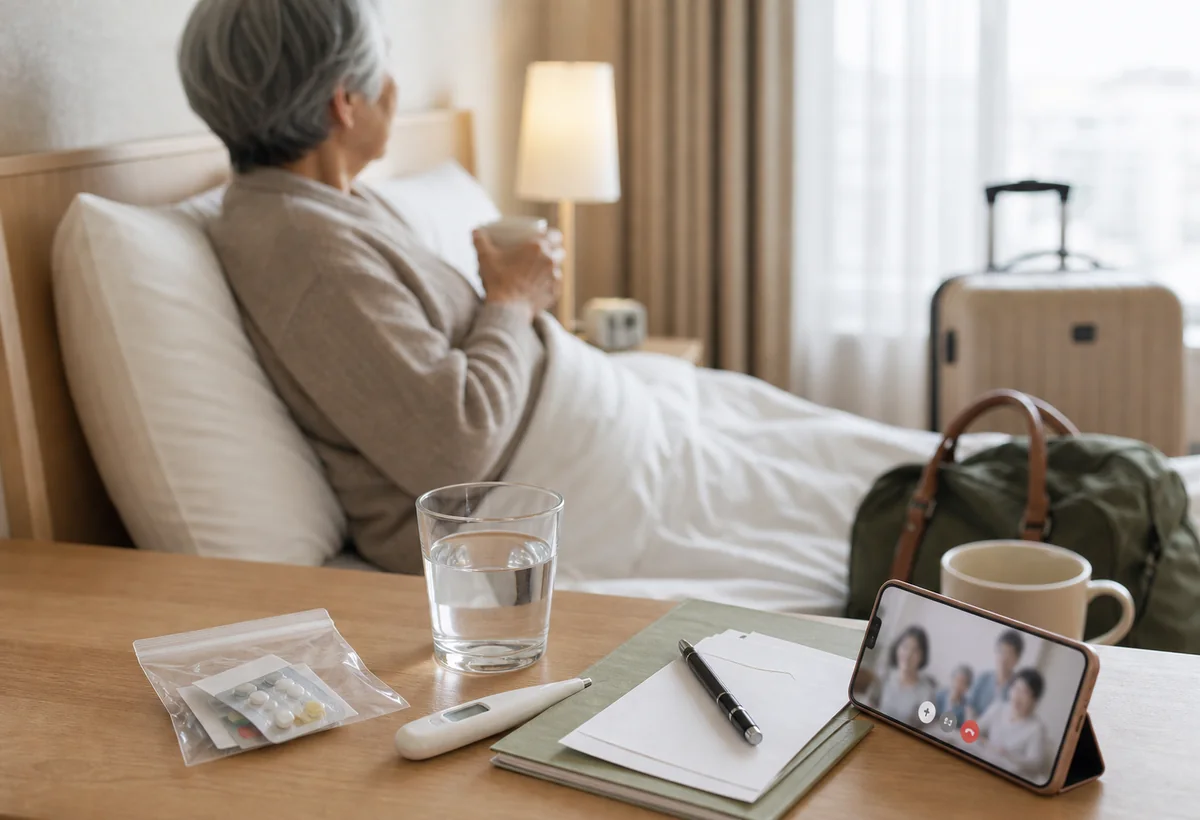
The situation this guide covers
An older parent on holiday in Japan can be fine one morning and in an emergency room by afternoon. The fall in a train station, the chest pain after a long flight, the fever that will not come down in a ryokan far from any city. What makes this different from the same event at home is not the quality of the care, which is high, but two things tourists rarely plan for: visitors are not covered by Japan's national health insurance, and the people answering the phone usually work in Japanese. This guide is for families on the trip and for relatives watching from abroad. It does not give medical advice. When in doubt about an older person who has taken a turn, the safe answer is to call 119 or see a doctor. For planning the trip itself, start with our guide to traveling to Japan with elderly parents.
The cost reality for visitors
A visitor on a tourist visa is outside Japan's national and employee health insurance entirely. Residents pay a set co-payment under Japanese public insurance; a visitor generally pays the full self-pay bill, and some hospitals set separate rates for uninsured foreign patients. The figure varies by hospital and is worth asking about directly. The numbers below are hypothetical orientation for insurance planning, not quotes or official averages, and real bills swing with the diagnosis, the tests ordered, and the time of day.
For planning, separate low-risk clinic visits, emergency-room assessment, admission, surgery or intensive care, and possible medical repatriation. Each layer can change the bill materially, especially for uninsured visitors.
Public ambulance dispatch after calling 119 is generally not billed like a taxi ride, so fear of the ambulance charge should not delay an emergency call; the major costs usually begin at the hospital.
Travel medical insurance for an older traveler: what to check before buying
The single most useful thing a family can do is buy the right travel medical insurance before the flight, and read it as criteria rather than as a brand to chase. We do not sell or rank policies. For an older traveler, the coverage that matters is rarely the headline price.
Pre-existing conditions are the biggest trap. Many policies exclude anything related to a condition the traveler already has, and for a parent with heart disease, diabetes, or a recent procedure, that exclusion can quietly cancel the cover that mattered most. Look for a policy that either includes stable pre-existing conditions or offers a paid waiver, and confirm in writing what "stable" means and over what look-back period.
Age caps are the second issue: cover often gets harder or pricier at 70, 75, or 80, and some products stop offering it at all. The medical limit has to be large enough to absorb a Japanese hospital stay plus a possible flight home with medical escort, which is why a six-figure limit in dollars is a sensible floor rather than a generous one. Check that medical evacuation and repatriation are included, not just in-country treatment, and that there is a 24-hour assistance desk the family can call from any time zone.
Where to go when something happens
When something happens, the order of calls depends on how bad it looks. For a clear emergency, breathing trouble, chest pain, stroke signs, a serious fall, heavy bleeding, dial 119 for fire and ambulance. The operator usually works in Japanese, so say the address slowly, repeat the building or hotel name, and if a Japanese speaker is nearby hand them the phone. For a problem that is worrying but not obviously an emergency, several regions run a #7119 consultation line where a nurse or doctor helps decide whether to call an ambulance or wait for a clinic. It runs around the clock in places such as Tokyo and Osaka, but it does not cover the whole country and English is not guaranteed everywhere, so treat it as a useful option where it exists rather than a national service.
The number that works anywhere for a visitor is the JNTO Japan Visitor Hotline, 050-3816-2787, run by the Japan National Tourism Organization. The official JNTO page lists 24-hour, year-round support in English, Chinese, and Korean for emergencies, disasters, and general tourist information. From outside Japan the number is +81-50-3816-2787, which is the line for a relative abroad to call as well. To find a facility yourself, JNTO's "Guide for when you are feeling ill" includes a medical institution search that filters by area, department, and language support, and lists hospitals used to foreign patients, including those recognized through the JMIP accreditation and Japan International Hospital schemes.
For a minor issue, a clinic is cheaper and faster than an emergency room, and a pharmacy can handle the smallest things. Japanese pharmacies sell many over-the-counter remedies, though a pharmacist cannot prescribe, and for anything needing a prescription the parent has to see a doctor first. Using a clinic by day for a non-urgent problem avoids the ER surcharges and the long waits.
Language and what to bring
Language turns a stressful visit into a manageable one when a little is prepared in advance. Bring a one-page bilingual health summary listing the parent's diagnoses, allergies, and a current medication list with generic names and doses; the import rules for carrying the medicines themselves belong to the medication article and are not repeated here. Many large hospitals have interpretation by phone or tablet, and the JNTO hotline can interpret during an emergency call. A relative abroad can often join by phone to confirm history or help with a decision, which matters most when the patient is too unwell to speak for themselves.
Paying, and getting the receipt for your claim
Paying is its own small ordeal if no one expects it. Hospitals frequently ask uninsured visitors to pay upfront or leave a deposit before or right after treatment, and an admission can mean settling the bill before discharge. Large hospitals usually take international credit cards; small clinics may be cash only, so carry enough yen or a card the parent can use. The document that matters for any later claim is the itemized receipt, the shinryou meisaisho, which breaks the bill into line items. Ask for it in English if possible, keep every receipt and prescription, and photograph them, because an insurer will not reimburse without that detail.
If it becomes serious: extending the stay and getting home
A holiday illness sometimes stops being a quick fix. If a parent cannot fly on schedule, the first call is the insurer's assistance desk, not the airline, because they coordinate the medical side and confirm what the policy will pay. Extending the stay means more nights of accommodation and possibly more treatment, and the airline will want a fitness-to-fly clearance from the treating doctor before a sick passenger boards. In a serious case the option is medical repatriation, a flight home with medical support that can run into very large sums and is exactly what evacuation cover exists for; the assistance desk arranges it and decides, with the doctors, whether the parent is stable enough to travel. The embassy or consulate has a real but limited role: it can issue documents, notify relatives, and provide lists of hospitals and lawyers, and it does not pay medical bills or fund a flight home.
A decision table you can save
It helps to map symptoms to action before anyone is panicking. The table below pairs rough severity with where to go, the likely cost category, and what to carry. It is a planning aid, not a price table.
| How it looks | Where to go | Cost category | What to bring |
|---|---|---|---|
| Minor: cold, mild stomach upset, small ache | Pharmacy, or a clinic by day | Lower outpatient bill | Cash or card, medication list |
| Worrying but not clearly urgent | #7119 where available, or JNTO hotline 050-3816-2787 | Call plus clinic or hospital bill if seen | Health summary, phone, interpreter app |
| Bad: high fever, possible fracture, persistent pain | Emergency room (taxi, or 119 if unsafe to move) | Higher emergency and test costs; admission adds more | Passport, card, health summary, receipts |
| Emergency: chest pain, stroke signs, breathing trouble, heavy bleeding | Dial 119 immediately | Potentially large hospital bill; insurance assistance matters | Policy number, deposit funds, family contact |
Two worked examples
A worked example makes the risk concrete without pretending to quote a hospital. Picture a 78-year-old who slips on wet stone at a temple in Kyoto and cannot put weight on a wrist: the family needs a clinic or hospital, imaging if the doctor orders it, medication, payment on the spot, and an itemized receipt for the insurance claim. Now picture the same traveler with sudden chest pain at the hotel at midnight: the front desk dials 119, the hospital may run emergency tests and admit the patient, and the family may need the insurer's assistance desk before discharge or any flight change. The first scenario is usually a contained outpatient problem; the second is the reason the medical limit and assistance desk on the policy were worth checking.
For the family helping from abroad
For the family watching from abroad, the work is coordination, and it is real work. Be the steady contact the hospital and the insurer's assistance desk can reach in your own waking hours, keep a running file of receipts, the itemized bill, and the doctor's notes as they arrive, and be ready to confirm the parent's medical history when a clinician asks. If the parent cannot decide for themselves, know in advance who in the family speaks for them and make sure the people on the ground have that name. Calling the JNTO hotline on +81-50-3816-2787 from overseas, or the insurer's 24-hour desk, often moves things faster than messaging a frightened relative in a waiting room.
Two habits make the remote support workable across time zones. Set a shared cloud folder and have whoever is with the parent photograph every receipt, prescription, and discharge note into it as the day goes, so nothing is lost and the claim can be assembled later from anywhere.
Agree early on a single family contact for the insurer and the hospital, because an assistance desk that hears one consistent voice resolves a case faster than one fielding three relatives with different questions. Keep the policy number, the assistance desk line, and the parent's passport and medication list in that same folder, ready to quote on any call.
Frequently asked questions
Does Japan's #7119 line work in English for a visiting parent?
Not reliably. #7119 is a nurse-and-doctor consultation line that helps decide whether to call an ambulance, but it operates only in listed regions and does not guarantee English everywhere. For a visitor, the JNTO Japan Visitor Hotline on 050-3816-2787 is the safer first call because the official JNTO page lists 24-hour support in English, Chinese, and Korean.
Will Japanese national health insurance cover my parent who is visiting on a tourist visa?
No. National and employee health insurance is for residents only. A visitor generally pays the full self-pay bill, and some hospitals set separate rates for uninsured foreign patients. This is why travel medical insurance bought before the trip, and the itemized receipt for the claim, both matter so much.
Is the ambulance really free in Japan, even for foreign tourists?
Public ambulance dispatch after dialing 119 is generally not billed like private transport, so fear of the ambulance charge should not delay a real emergency call. The major charges begin at the hospital, where an uninsured visitor pays the treatment bill and may be asked for a deposit.
What is the shinryou meisaisho and why do I need it?
It is the itemized medical receipt that breaks a Japanese hospital bill into individual line items: consultation, tests, medication, and so on. A travel insurer will usually not reimburse without it, so ask for it in English if possible, keep every receipt and prescription, and photograph them before you leave the hospital.
My elderly parent has a heart condition. Can travel insurance still cover a problem in Japan?
Sometimes, but only if the policy is chosen carefully. Many policies exclude anything linked to a pre-existing condition, which is the single biggest gap for older travelers. Look for cover that includes stable pre-existing conditions or offers a paid waiver, confirm in writing what counts as stable and over what period, and check the age cap before buying. We do not recommend specific insurers; confirm the terms with the provider.
Who arranges getting a seriously ill parent home from Japan, and who pays for it?
Call the insurer's 24-hour assistance desk first; they coordinate medical repatriation and confirm what the policy pays. A medically supported flight home can be very expensive and is exactly what evacuation cover exists for. The airline will require fitness-to-fly clearance from the treating doctor. The embassy can issue documents and notify relatives but does not pay medical bills or fund the flight.
How Japan Care Concierge can help
The first consultation is 30 minutes and free, and we reply to inquiries within two business days. You leave it with a sequence: which office to contact first, what to prepare, and what your family abroad needs to see.
Primary and official references
We checked 3 primary or official sources below before writing this article. Rules, costs, and local procedures change by municipality and over time. Confirm the linked official source before a final decision. Last source check: 2026-06-10.
About this article
This page is general orientation, not medical, legal or individual care advice. Japan Care Concierge is operated with the care-service experience of Social Welfare Corporation Shinkou Fukushikai, established in 1999, which runs elderly care facilities and services in Kanagawa under the Cross Heart name. We take no referral fees from facilities or providers. We do not provide medical treatment, diagnosis, emergency response or hands-on care. Japan has 1,559 long-term care insurers and each sets its own rules and timelines, so confirm your own case with the municipal long-term care insurance desk or your local community support center. The publication and update dates above are actual dates. How we research, source, and correct content is described in our editorial policy.