
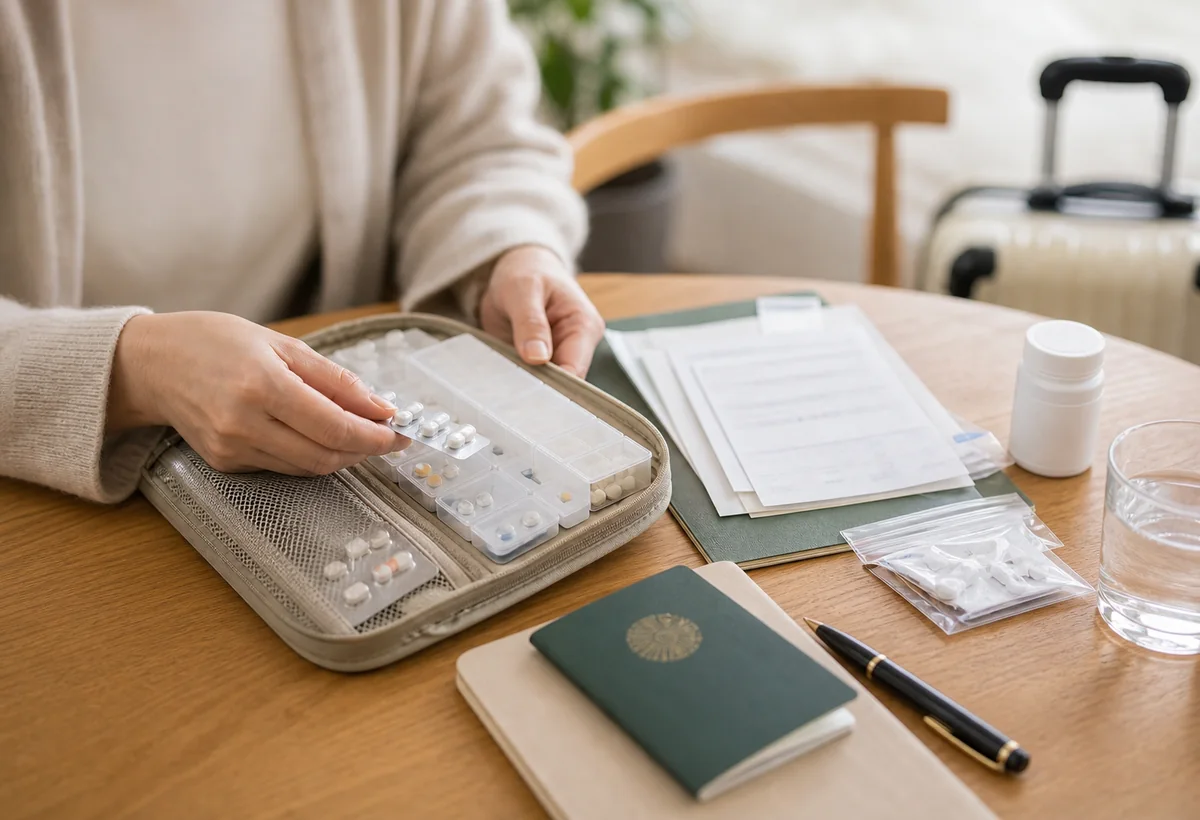
What this guide covers, and what it doesn't
Most older travelers bring more medicine to Japan than they realize: a blood pressure pill, a statin, something for sleep, maybe an inhaler, plus a few over-the-counter standbys. For a short trip, the rules are usually simple. The trouble starts with three things: bringing more than a one-month supply, carrying anything injectable, or carrying a drug that Japan treats as a controlled or prohibited substance. Get those checked before you fly and the rest is paperwork you can finish at home. This guide walks through the personal-import rules as published by Japan's Ministry of Health, Labour and Welfare (MHLW) and Japan Customs, with the older traveler and the family abroad doing the arranging in mind. We are not a travel agency and we do not arrange trips; we help families plan care, and medication is one of the parts that trips people up. If you are planning the wider trip, our care-aware guide to traveling to Japan with elderly parents covers pacing, transport, and hotels.
The one-month rule for prescription drugs
Japan does not require any special procedure for most prescription medicine carried for your own use, as long as the quantity is one month's supply or less. The MHLW Q&A for travelers states you can bring prescription medicine in without a certificate on four conditions: it is for your own use, it is an oral or external medicine and not an injection, it is not a prohibited drug such as a stimulant, and it is not an especially controlled drug such as a narcotic. Over-the-counter and quasi-drug products get a more generous allowance of two months' supply. External-use items such as ointments, eye drops, and toothpaste with fluoride are counted by piece, up to 24 of each. Vitamins run to a four-month supply.
The "one month" is counted per drug, by the dosing on the label, not by the size of the box. If your parent takes one tablet a day, 30 tablets is the line; a 90-day mail-order bottle is three months even though it is a single container. Count each medication separately. A traveler can be under the limit on five drugs and over it on the sixth, and it is the sixth that needs a certificate. When in doubt, add up the days, not the pills, and round honestly.
When a yakkan shoumei is required
When the trip runs longer than a month, or you simply want to carry a buffer, you cross from "no procedure" into needing a yakkan shoumei. The yakkan shoumei (薬監証明), now issued as a yunyu kakunin-sho or import confirmation, is a document MHLW issues confirming that the medicine you are carrying is permitted to enter Japan for personal use. You apply before you travel, carry the confirmation with the medicine, and show it to customs on request. It is required when you exceed the personal-use quantity for ordinary prescription or OTC medicine. MHLW's English page for travelers sets the same one-month line for injectables, which are allowed only as pre-filled syringes or self-injection kits such as insulin pens, and it lets a traveler bring one set of a household medical device such as a CPAP with no confirmation. A few categories sit outside this system entirely, which is the part that catches people, so they are worth taking one at a time.
Categories with stricter rules: stimulants, ADHD drugs, and narcotics
Stimulants are the hard wall. Japan prohibits medicines containing amphetamine or methamphetamine outright, with no personal-import route at all. The MHLW Q&A is blunt: nobody can bring a medicine containing methamphetamine or amphetamine into Japan, and being found with one can mean arrest on the spot. This squarely covers Adderall, which contains amphetamine salts, and it covers some Vicks-type nasal inhalers that contain levomethamphetamine. There is no certificate that makes Adderall legal to bring; the answer is to talk to the prescribing doctor well before the trip about what to do, never to pack it and hope. Methylphenidate (Ritalin, Concerta) is handled differently. It is treated as a psychotropic and, for ADHD, as a controlled substance requiring advance permission from the Narcotics Control Department (NCD) rather than an ordinary yakkan shoumei. Do not assume the two ADHD drugs work the same way at the border; they do not.
Narcotics are the second special category. Opioid painkillers such as those containing fentanyl, hydrocodone, oxycodone, or morphine are controlled narcotics in Japan, and a yakkan shoumei does not cover them. To carry them you need a separate import permit issued through the Narcotics Control Department of a Regional Bureau of Health and Welfare, obtained before you leave home. One detail surprises families: codeine counts as a narcotic in Japan when a medicine contains more than one percent codeine phosphate, so a cough syrup or combination painkiller that seems ordinary at home can fall into the controlled bracket. Check the label percentage, and when an opioid is involved, treat NCD permission as a specialist step and start it early.
Prohibited and limited substances round out the list. Japan classes pseudoephedrine as a stimulant raw material when a medicine contains more than 10 percent of it, and such products cannot be brought in; common cold and sinus remedies sold freely elsewhere can run afoul of this. Cannabis and CBD products carry their own restrictions and product-confirmation requirements. The reliable habit is to check each active ingredient and its percentage rather than the brand name, because the same brand can have a permitted version in one country and a restricted one in another.
Quick reference table
The thresholds and the office you deal with depend on the drug category. This table summarizes the common cases as published by MHLW and the Narcotics Control Department; confirm your own medicines against the official sources, since quantities and classifications are updated over time.
| Drug category | Quantity threshold | What you need | Where to apply |
|---|---|---|---|
| Prescription oral/external medicine | Up to 1 month's supply | Nothing; carry prescription and original packaging | No application |
| Prescription medicine over the limit | More than 1 month's supply | Yakkan shoumei (import confirmation) | MHLW online import confirmation portal |
| Over-the-counter / quasi-drugs | Up to 2 months' supply (24 each for ointments, eye drops, etc.) | Nothing within the limit | No application |
| Self-injection kits / pre-filled syringes (e.g. insulin) | Up to 1 month's supply | Nothing within the limit; yakkan shoumei above it; declare at customs | MHLW online import confirmation portal, above the limit |
| Household medical device (e.g. CPAP) | One set | Yakkan shoumei not needed for one set; declare and carry device note | Declare at customs |
| Psychotropics (e.g. methylphenidate / Concerta) | Set per-drug limits; over limit needs permission | NCD permission; doctor's documentation | Narcotics Control Department |
| Narcotics (opioids: fentanyl, oxycodone, morphine, codeine over 1%) | Any amount | Separate narcotics import permit | Narcotics Control Department, Regional Bureau |
| Stimulants (amphetamine, methamphetamine; Adderall) | Prohibited | No import route exists | Cannot be brought in |
| Pseudoephedrine over 10% | Prohibited | No import route exists | Cannot be brought in |
The online application: documents, time, and cost
The application route is now online and free of charge. MHLW moved the yakkan shoumei application to a web portal, and an applicant creates an account, enters the medicines and quantities, uploads supporting documents, and receives the confirmation back through the system. You will need your flight information to complete the form, so have the itinerary settled first. Older paper guidance describing posting documents to a Regional Bureau still circulates, and an email and fax route to the inspectors exists for questions, but the portal is the current path for most travelers. Verify the live portal before you start, since government systems and addresses change.
Plan on roughly two weeks, and give yourself more. The official guidance has long said a complete application takes about two weeks to process, and practical guides from embassies and the JET programme office recommend applying at least a month before departure because review can take up to four weeks, longer around Japanese public holidays. If the inspector finds a document missing or a quantity unclear, they will come back with questions, and each round trip adds days. Apply early enough that one revision will not threaten the flight.
The documents are straightforward once you know the set. You provide an import report of medication listing each drug and quantity, an explanation of the products (a manufacturer pamphlet or package insert is usually accepted), a copy of the prescription or a doctor's direction showing the drug names and amounts for your own use, and your arrival details such as a flight itinerary. A short letter from the prescribing doctor stating the diagnosis and that the medicines are for the patient's personal treatment is worth including even when not strictly demanded, because it answers the inspector's main question in advance. There is no government fee for the confirmation itself.
Senior-specific advice: packing, devices, and customs
For an older traveler, a few habits prevent most problems at the airport. Keep every medicine in its original labeled packaging; loose pills in a daily organizer are hard for an officer to identify and harder to match to a prescription. Pack medicines in carry-on, not checked baggage, so a lost suitcase does not become a medical emergency, and so the medicine is with you for any customs question. Carry a bilingual medication list with the generic (international) drug name, the dose, and the daily quantity, since brand names rarely translate and the active ingredient is what matters under the rules. Do not plan to buy replacements in Japan: many Western medicines are unavailable here, sold only on a Japanese prescription, or stocked only in different doses and formulations, and getting a foreign prescription filled is genuinely difficult. Bring enough, properly documented, rather than counting on a pharmacy.
Medical devices and injectables need a little extra attention. A CPAP machine is allowed as a single household-use device, but declare it and keep it accessible; carrying the prescription or a clinic note for it smooths the conversation. Self-injection kits and pre-filled syringes such as insulin pens are permitted for personal use, though as a rule loose syringes and injectable medicines are otherwise restricted, so anything injectable should be declared and, beyond a one-month supply, covered by a yakkan shoumei. An EpiPen or similar emergency auto-injector should be declared at customs and carried with its prescription. The pattern is the same across devices: have a document that explains what it is and why the traveler has it, and volunteer it rather than waiting to be asked. Oxygen and other powered devices add airline and power-supply questions, covered in oxygen, CPAP, and medical devices on a Japan trip.
When you arrive, the medicine in your carry-on may simply pass through with everything else, or an officer may ask about it. Customs can ask to see the yakkan shoumei or NCD permission for anything that requires one, and the confirmation is only valid when your actual luggage matches what is written on it, so do not change the medicines or quantities after the confirmation is issued. If you are carrying more than the personal-use limit and cannot produce the required document, the medicine can be held or refused. Declaring openly and having the paperwork in hand is what turns a potential problem into a brief check. A calm "here is my prescription and my import confirmation" is the whole interaction in most cases.
A worked example: a three-week trip
It helps to walk through a realistic case. Suppose a daughter in California is bringing her 78-year-old father to Japan for a three-week trip. He takes amlodipine for blood pressure, atorvastatin for cholesterol, metformin for diabetes, tamsulosin, a low-dose aspirin, and a zopiclone tablet for sleep, plus he uses a CPAP at night. For a three-week trip, none of the oral drugs exceeds a one-month supply if she packs about 25 to 30 days of each, so for those six drugs no yakkan shoumei is needed at all. The CPAP is allowed as one household device but should be declared, and she should tuck the device prescription or a clinic note into his carry-on. The one item to check carefully is the sleep tablet: some sleep and anxiety medicines are psychotropics with their own limits, so she confirms zopiclone's status and quantity against the Narcotics Control Department guidance before assuming it travels freely. The rest of her job is documentation: original boxes, a bilingual list with generic names and daily doses, and a short letter from his physician. If she had decided to pack a full 90-day supply "to be safe," every drug over 30 days would have flipped into needing an import confirmation, which is exactly the kind of well-meant decision that creates paperwork. Carrying close to what the trip actually needs is usually the simpler path.
One more point on quantity confuses people: the limit is about your own personal use for the trip, not a customs tax allowance you can spread across a household. You cannot pool four travelers' allowances to bring one person a four-month supply, and you cannot have a relative carry the overflow on a separate ticket, because controlled and confirmed medicines must travel with the patient named on the documents. If a genuinely long stay means a real need for more than a month's supply, the import confirmation is the route designed for exactly that, and there is no shame or penalty in using it; it exists so that people with chronic conditions can travel with what they need. The mistake is carrying the extra without the document, not carrying the extra at all.
For families doing the paperwork from abroad
Families abroad can do almost all of this on the elderly traveler's behalf, and it is sensible to. One person can gather the prescriptions, ask the doctor for a signed letter with diagnoses and generic drug names, build the online application, and assemble the document pack, leaving the traveler only to carry the printed confirmation, the medicines in original packaging, and the doctor's letter in their carry-on. A few things cannot be delegated at the border: the medicine has to travel with the patient, not be mailed ahead or carried by a relative on a separate flight, and controlled drugs in particular must move with the person named on the permit. Coordinate the timeline so the application is filed well before the flight, and make a one-page summary the traveler can hand over without having to explain anything in Japanese.
Authority, medical advice, and changing rules
A clear word on authority and on medicine. We do not decide what is legal for any individual to bring; the final authority is MHLW and Japan Customs, and every traveler should confirm their own medicines with those bodies before flying. Nothing here is medical advice: do not change a dose or stop a medication to fit a limit, and raise any concern with the prescribing doctor. Rules change, classifications get updated, and portals move, so verify the current requirements close to your travel date rather than relying on a guide written earlier. For anything in the narcotic or psychotropic categories, treat the Narcotics Control Department as the specialist authority and contact them directly. For refilling long-term prescriptions once you live here, see continuing medication after a move to Japan.
Frequently asked questions
Can I bring Adderall to Japan for a two-week trip?
No. Adderall contains amphetamine, which Japan prohibits as a stimulant with no personal-import route, and there is no yakkan shoumei or permit that makes it legal to carry, even for a short trip and even with a valid foreign prescription. The MHLW Q&A states nobody can bring a medicine containing amphetamine or methamphetamine into Japan, and being found with one can lead to arrest. Talk to the prescribing doctor well before the trip about alternatives, and never pack it on the assumption that a prescription will be accepted at the border.
When do I need a yakkan shoumei to bring my prescription medicine to Japan?
You need a yakkan shoumei (import confirmation) when you carry more than a one-month supply of a prescription drug, more than a two-month supply of an over-the-counter product, or more than a one-month supply of a self-injected medicine such as insulin pens. Within those personal-use limits, ordinary oral and external medicines need no certificate, only the prescription and original packaging. Stimulants, narcotics, and psychotropics are handled under separate rules and are not covered by an ordinary yakkan shoumei.
How long does the yakkan shoumei online application take and does it cost anything?
The official guidance says a complete application generally takes about two weeks to process, and embassy and programme guides recommend applying at least a month before departure because review can run up to four weeks, longer around Japanese public holidays. There is no government fee; the confirmation itself is free. You apply online through the MHLW import confirmation portal, where you create an account, enter your medicines and quantities, and upload your prescription, an explanation of the products, and your flight details. Apply early so that one round of questions will not threaten your flight date.
Can I bring my CPAP machine and insulin pens into Japan as an elderly traveler?
Yes, with the right handling. A CPAP machine is allowed as a single household-use medical device; declare it at customs and carry the device prescription or a clinic note. Self-injection kits and pre-filled syringes such as insulin pens are permitted for personal use, but anything injectable should be declared, and if you carry more than a one-month supply you need a yakkan shoumei. Keep these items in your carry-on, not checked baggage, and have a bilingual document on hand that explains what each device and medicine is.
Are opioid painkillers and codeine cough medicine allowed when bringing medication to Japan?
Opioids such as fentanyl, oxycodone, hydrocodone, and morphine are controlled narcotics in Japan and require a separate narcotics import permit obtained in advance through the Narcotics Control Department of a Regional Bureau of Health and Welfare; a yakkan shoumei does not cover them. Codeine is treated as a narcotic when a medicine contains more than one percent codeine phosphate, so a seemingly ordinary cough or combination medicine can fall into the controlled category. Check the label percentage, contact the Narcotics Control Department early, and never carry an opioid into Japan without the required permit.
How Japan Care Concierge can help
The first consultation is 30 minutes and free, and we reply to inquiries within two business days. You leave it with a sequence: which office to contact first, what to prepare, and what your family abroad needs to see.
Primary and official references
We checked 5 primary or official sources below before writing this article. Rules, costs, and local procedures change by municipality and over time. Confirm the linked official source before a final decision. Last source check: 2026-10-18.
- MHLW: information for those bringing medicines for personal use into Japan (English)
- MHLW import confirmation (yakkan shoumei) online portal
- U.S. Embassy in Japan: bringing medication into Japan
- Narcotics Control Department: application guidance for narcotics and psychotropics
- Japan Customs: information for passengers
About this article
This page is general orientation, not medical, legal or individual care advice. Japan Care Concierge is operated with the care-service experience of Social Welfare Corporation Shinkou Fukushikai, established in 1999, which runs elderly care facilities and services in Kanagawa under the Cross Heart name. We take no referral fees from facilities or providers. We do not provide medical treatment, diagnosis, emergency response or hands-on care. Japan has 1,559 long-term care insurers and each sets its own rules and timelines, so confirm your own case with the municipal long-term care insurance desk or your local community support center. The publication and update dates above are actual dates. How we research, source, and correct content is described in our editorial policy.