
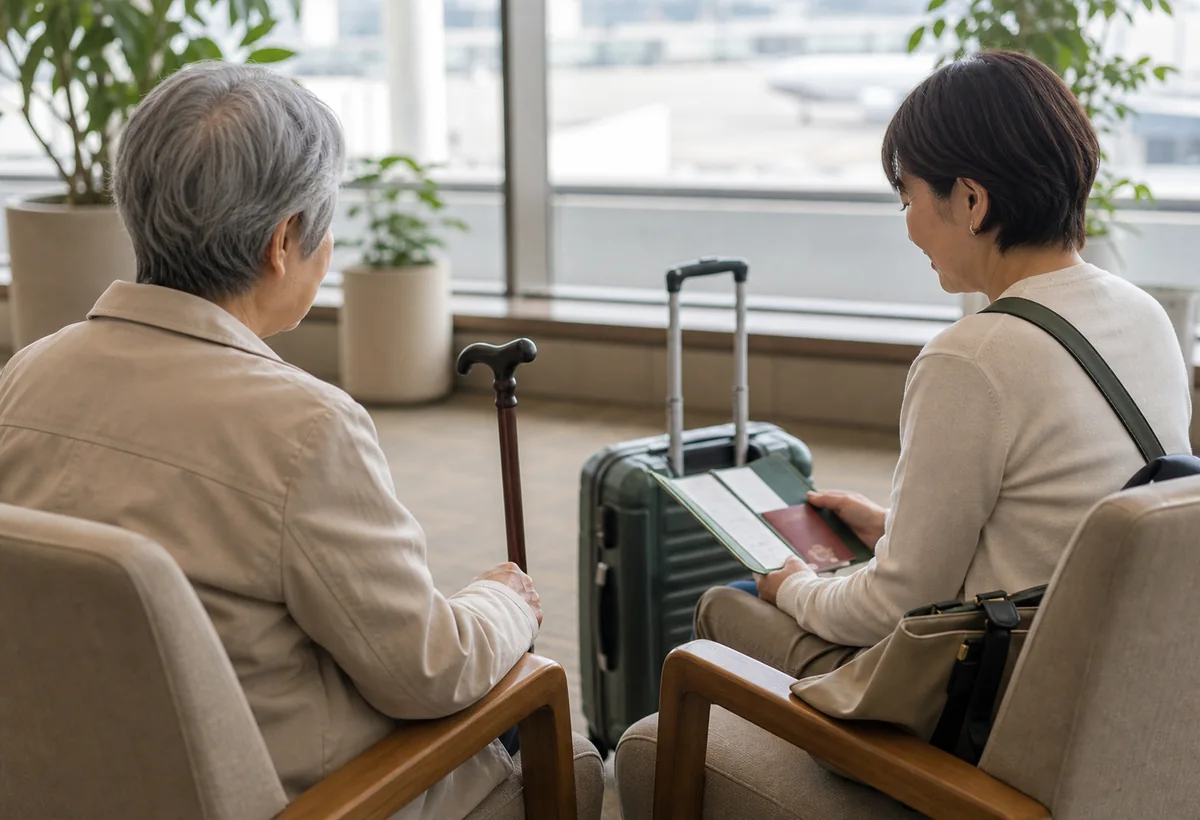
Start with what your parent can sustain in a day
A Japan trip with an aging parent is not a smaller version of a normal trip. It is a different trip with different limits. The single most useful thing you can do before booking anything is estimate what your parent can actually sustain in a day. A fit independent tourist in Tokyo walks 15,000 steps or more without noticing. A realistic senior day is one main outing, two or three rest points along the way, reliable toilet access, and a return to the hotel before exhaustion sets in. That often works out to 3,000 to 5,000 steps. If you plan the trip at a tourist pace and hope your parent keeps up, the trip gets cut short by a fall, a collapse, or a day spent in bed recovering. Plan at the slower pace from the start and the trip holds together.
This guide is for adult children planning a visit of roughly one to three weeks. It assumes mobility limits, stamina limits, possibly a chronic health condition, and sometimes early dementia. It does not cover relocation, multi-month stays, or day outings for people who already live in Japan. We are a care organization in Japan, not a travel agency, so this is planning guidance rather than a booking service.
If you only read one part of this guide, these six choices do most of the work.
- One main outing a day, with two or three seated breaks and a return to the hotel by mid-afternoon.
- Two or three hotel bases for several nights each, with day trips out and back.
- Wheelchair help requested from the airline at booking, even for a parent who walks short distances.
- Shinkansen wheelchair seats reserved as soon as booking opens, about one month before travel.
- Suitcases sent ahead by courier so nobody carries them through stations.
- Travel insurance that covers pre-existing conditions, plus a bilingual health summary in your parent's bag.
Run the trip-fit check before you book
Sit down with your parent, or with whoever sees them daily, and answer plain questions before you fall in love with an itinerary. How far can they walk before needing to sit? Can they manage stairs, or do they need a railing or an elevator every time? How long can they be on their feet at a museum or temple before they want to leave? Do they need a toilet within a few minutes of warning? How do they handle heat? What time of day are they sharpest, and when do they fade? Write the answers down. These numbers, not the photos in a guidebook, decide what the trip can include. If your parent fades by 2pm, the trip is built around mornings, and the famous evening district gets dropped without guilt.
Season, length, and why fewer bases win
The season matters more for older travelers than for anyone else. Japanese summers, roughly mid-June through September, combine high heat with high humidity, and heatstroke is a genuine medical risk for seniors whose bodies regulate temperature less well and who may not feel thirst reliably. Spring and autumn are kinder. Late March through May and October through November bring milder days, lower humidity, and outdoor time that does not punish. Cherry blossom and autumn foliage weeks draw crowds and raise prices, so the shoulder weeks on either side often give the same weather with more room to move. If summer is your only option, build the day around early mornings and indoor afternoons, and treat air conditioning as a requirement rather than a luxury.
Trip length and structure deserve as much thought as the destinations. A common mistake is packing a two-week itinerary with six cities, each connected by a train transfer and a new hotel. Every hotel change is a day of packing, hauling, checking out, traveling, checking in, and learning a new room in the dark. For an older traveler that churn is the most tiring part of the whole trip. Fewer bases beats hotel-hopping. Pick two or three places to stay for several nights each and take day trips out and back, returning to a room your parent already knows. A trip with one Tokyo base and one Kyoto base, a week in each, is calmer and usually more memorable than a trip that touches eight cities.
A paced sample week
The rhythm that holds up best is one main sight in the morning and a quiet afternoon. It helps to see that laid out across a week. The table below is a template for a first trip with a Tokyo base and a Kyoto base. Swap the sights for your parent's interests and keep the shape. That means a rest day after arrival and at most one big outing a day. Every travel day is followed by a light day.
Two habits keep the plan honest. Decide each evening whether the next day's outing still fits. Keep one unbooked afternoon in every three days as a buffer for a bad night or a sore knee. For pacing a single outing in more detail, see taking an elderly parent out in Japan.
| Day | Morning | Afternoon and evening |
|---|---|---|
| 1 Arrival | Airport wheelchair help and a pre-booked transfer to the hotel | Rest in the room and an early dinner close to the hotel |
| 2 Recovery | Late start and a short walk near the hotel | Nap or quiet time; dinner from a department store food hall |
| 3 Tokyo | One flat sight with benches, reached by taxi | Back at the hotel by mid-afternoon |
| 4 Tokyo | A museum or another sight with seating inside | Free time with nothing booked |
| 5 Travel day | Shinkansen to Kyoto in a reserved seat; bags sent ahead the day before | Check in and rest |
| 6 Light day | A garden or temple with level paths, by taxi | Rest and an early dinner |
| 7 Kyoto | One temple area visited early, before the crowds | Short taxi back and a quiet evening |
Heat and cold days
Japan's Ministry of the Environment and the Japan Meteorological Agency issue a Heat Stroke Alert for a region when the heat index used for heatstroke risk (WBGT) is forecast at 33 or higher. Alerts are announced at 5pm the day before and again at 5am on the day. The alert season runs from the fourth Wednesday of April to the fourth Wednesday of October. Late-spring and early-autumn trips can fall inside it.
On an alert day the official advice is to avoid going out as much as possible and keep rooms cool with air conditioning. It also says to drink on a schedule before thirst sets in. For an older parent, treat an alert as the signal to swap the outdoor sight for an indoor one or for a rest day. Our guide to protecting an elderly parent from heatstroke in Japan covers warning signs and what to do.
Winter brings the opposite problem. Older Japanese houses and some traditional inns have cold corridors and bathrooms. The jump from a cold changing room into a hot bath is hard on the heart and blood pressure. Pack warm layers for indoors as well as outdoors, and read the bath safety points in our onsen and ryokan guide before booking an inn.
The flight: assistance, seats, clots, and recovery days
The flight is the first hard test, and the work is in the booking, not the airport. Request wheelchair assistance when you book the ticket, by phone or through the airline, and confirm it in writing. Airlines offer different levels: a wheelchair to the gate for someone who can walk a little, or assistance all the way to the aircraft seat. Choose honestly. Even a parent who walks fine at home can struggle with the distances in a large international airport, where a single terminal can mean a kilometer of walking and a long immigration queue. For seating, an aisle seat makes toilet trips and leg-stretching easier, and a bulkhead row gives more legroom without a reclining seat in front. Long-haul flights to Japan run 10 to 14 hours from most of the world, and sitting still that long raises the risk of deep vein thrombosis, a blood clot in the leg, which is higher in older travelers. Ask the parent's doctor before the trip about compression stockings, hydration, and getting up to move every couple of hours. After arrival, schedule one or two recovery days with nothing demanding on them. Jet lag hits older bodies harder and clears more slowly, and a parent dragged straight from a long flight into a packed sightseeing day will pay for it all week.
Help at the arrival airport
Airline assistance and airport wheelchairs are two separate services. The airline handles the stretch from the aircraft door through immigration and customs, so that request goes in with the ticket. After customs, the airport's own help takes over. Narita Airport lends wheelchairs free of charge at the information counters in its passenger terminals to arriving passengers who have cleared passport control and customs. You return the chair to the nearest information counter. It covers the walk to the train or taxi rank and no further.
Haneda Airport rents wheelchairs at its information counters, including large and reclining models. If you call from one of the information phones in the terminal, staff can bring a chair to a spot such as the station or a car park. Haneda's page does not state a fee, so ask at the counter.
Narita also runs electric carts on the departure side of both terminals for seniors and others who need help with the long walk to the gate. The arrival-side cart service was suspended when we checked in October 2026. The Narita Airport information line is +81-476-34-8000.
If your parent will need help from the airport to the hotel, book the transfer before you fly. Our guide to getting around Japan with limited mobility covers accessible taxis, care taxis, and station ramp help in detail.
Getting around: shinkansen, stations, taxis, and luggage
Getting around Japan is where the country's strengths and its gaps both show. The shinkansen, the high-speed rail network, is genuinely accessible, but the wheelchair spaces work on a reservation system you have to understand. These spaces sit in a specific car, often car 11 on the Tokaido and Sanyo lines, and they are limited in number. Reserve them at a JR ticket office, the Midori-no-madoguchi, up to one month before travel. For Nozomi trains on the Tokaido and Sanyo Shinkansen, the official smartEX service also takes online bookings for the wheelchair seat in car 11 (seat 13-B, with 13-A for a companion). Online booking opens at 5:30am 28 days before travel and covers trips between Nozomi stops. JR Central also takes wheelchair-seat applications by phone on numbers listed by boarding station. Its automated menu is in Japanese, so a Japanese-speaking relative may find the call easier. If the wheelchair spaces are full, you may not be allowed to board that train, so book early. Some trains also have a multipurpose room, a small private room intended mainly for passengers with disabilities. Ask about it when you reserve. Station staff will help with ramps and boarding, and it is normal to ask them.
Stations themselves are mostly step-free, but the elevators exist more than they advertise themselves. A large station can have a dozen exits and one elevator route that involves backtracking. Leave extra time, and do not assume the nearest exit is the accessible one. Outside the rails, accessible taxis with ramps or lifts exist in major cities but usually need advance reservation rather than a curbside hail, so arrange them a day ahead through the hotel. The detail that saves the most strain is takkyubin, Japan's luggage forwarding service. You hand your suitcases to a counter at the airport, a hotel, or a convenience store, and they arrive at your next hotel the following day, so nobody drags a heavy case up station stairs or through a crowded train. Send the bags ahead and travel between cities with a small day bag. For the flight home, Yamato's airport delivery service asks you to drop bags off two days before departure, or three days in some areas. The bags then reach the airport by the day before your flight. If mapping the accessible routes, reservations, and equipment ahead of time is more than you want to take on, our accessible travel and outing support can plan it with you.
Rest stops and toilets
Plan the rest stops the way you plan the sights. Before each outing, note two or three places near the route where your parent can sit indoors and reach a toilet. Hotel lobbies, cafés inside stations and large department stores usually work. Benches in temple grounds and gardens can be few and far apart, so do not count on them.
Accessible toilets in Japan are often signed as multipurpose toilets. Large stations, airports and department stores are the most reliable places to find one. Our wheelchair travel guide covers how to find them, along with wheelchair rental and barrier-free sights. This guide does not repeat that detail.
It is fine to ask staff at a museum or attraction for somewhere to sit. A lightweight folding cane-seat also lets your parent rest in queues and on long platforms.
Mobility aids to pack
Decide early whether your parent will bring their own wheelchair, rent one in Japan, or manage with a cane. A parent who walks well at home but tires within twenty minutes may still need a light folding wheelchair for airports, big stations and large gardens. The details for each choice sit in different places.
- Own wheelchair: tell the airline when you book. For a powered chair, give the battery type, since each airline sets its own battery rules.
- Rental in Japan: book ahead from overseas and have it delivered to the hotel or airport. Our wheelchair travel guide covers costs and delivery.
- Airport chairs: Narita's free loan chairs go back to an information counter before you leave the terminal. They do not replace a chair for the trip.
- Cane or walker: bring the one your parent already uses. A new aid is harder to handle on unfamiliar stairs and platforms.
- Small extras: a folding cane-seat, a pill organizer set for the time difference, and a card with the hotel address in Japanese for taxi drivers.
Hotels: location, bathroom questions, beds
Where you stay shapes how the whole trip feels. Choose a hotel one stop away from a giant hub rather than inside it; the slightly quieter station is easier to navigate than the cavernous main terminal, and the price is often lower. Before booking, ask the hotel specific questions in writing rather than trusting a vague accessible label. Does the bathroom have grab bars by the toilet and in the shower? Is there a step into the bathroom or the shower? How wide is the bathroom door? Is there a Western bed, and how high is it? Many traditional places use a futon on the floor, which is hard to get down to and harder to get up from for anyone with knee or hip problems, so a Western bed is usually the safer choice for an older traveler. A ryokan stay can still be a highlight, and our guide to onsen and ryokan with an elderly parent covers the bath side in depth; just confirm beds and bathroom layout before you commit, and accept that some beautiful old inns will not work.
Do you need a senior tour?
This question sits behind a lot of searches. Group tours marketed for seniors solve logistics. Someone else books the hotels, moves the luggage, buys the train tickets, and handles the language, which removes a real source of stress. What they often do not solve is pacing and medical needs. A group tour moves at the speed the schedule demands, which is rarely the speed of the slowest member, and a parent who needs to sit every twenty minutes can feel like they are holding everyone back. The bus leaves when it leaves. If your parent's limits are mild and predictable, a senior-oriented group tour can work well. If their limits are significant, variable, or medical, the structure that helps an average traveler can become a trap. Two middle paths are worth knowing. A private guide for some days gives you local knowledge and language help while you keep control of the pace and can cancel an afternoon when energy runs out. A self-planned trip with a few fixed bases and day trips gives the most flexibility and the most work. We do not recommend or rank specific tour companies; the point is to match the format to your parent's real limits, not to a brochure.
Health groundwork: medication, insurance, and a summary card
Health groundwork starts weeks before departure and it is mostly paperwork. Bring more medication than the trip needs in case of delays, keep it in original labeled containers in carry-on luggage, and check whether any of it is restricted in Japan, because some common drugs require an import certificate called yakkan shoumei arranged before arrival. That procedure has enough detail to deserve its own article, and we cover it separately; the point here is to start the check early, not the day before you fly. On insurance, buy travel insurance that explicitly covers pre-existing conditions, since standard policies often exclude exactly the conditions an older traveler is most likely to need help with, and confirm the coverage in writing. What to do if a parent actually gets sick in Japan is its own topic, and we cover that separately too. One more thing carries real weight: a one-page bilingual health summary your parent keeps on them, listing conditions, medications with generic names and doses, allergies, and an emergency contact. If something happens, that page does the explaining that a frightened family member in a foreign hospital cannot.
Medical help on the trip
Save the key numbers before you fly. For an emergency, dial 119 for an ambulance. For help in English at any hour, the Japan Visitor Hotline run by JNTO answers on 050-3816-2787, or +81-50-3816-2787 from a foreign phone. It runs 24 hours a day with English, Chinese and Korean support. It handles accidents, illness and disasters as well as general questions.
For a non-emergency visit, JNTO's medical institution search lets you filter by area, language and medical department. Bookmark it on your phone before the trip. At the clinic, ask reception for a rough estimate of the cost first. JNTO notes that credit cards are accepted mainly at major hospitals, so carry enough cash for a clinic visit.
Check how your travel insurer pays before you need it. Whether the hospital can bill the insurer directly depends on the policy. JNTO also warns that visitors who leave medical bills unpaid may be refused entry to Japan in future. Policies can be bought after arrival, but they may not cover a condition your parent already has, so arrange cover at home. For diabetes and heart or lung conditions, see traveling to Japan with a chronic condition.
Traveling with a parent who has early dementia
Traveling with a parent in the early stages of dementia is possible for some families and not for others, and the difference is honest assessment rather than optimism. Unfamiliar environments are the core risk, because the routines and landmarks that hold someone steady at home are all gone at once, which can bring confusion, agitation, or sundowning in the late afternoon. Keep what routine you can: similar wake and meal times, familiar foods where possible, and the same room for several nights rather than constant moves. Have your parent carry an ID and contact card in Japanese and English with their name, your phone number, the hotel, and a line stating they have memory difficulties, in case you are separated in a crowd. Watch for the moment when novelty stops being a pleasure and becomes distress, and be ready to shorten the trip. We are not promising this will work for your family; we are describing what to weigh.
Coordinating the trip from abroad
Many of our readers are not in Japan at all. They are adult children living abroad, coordinating a trip for a parent who lives somewhere else, or joining from a third country. Coordinating remotely is harder because you cannot see the hotel bathroom or test the parent's stamina in person, so lean on written confirmations. Get the hotel's accessibility answers by email, get the airline assistance confirmed in writing, and put every booking reference, the bilingual health summary, and your parent's medication list in one shared document the whole family can reach. Agree in advance on who decides if the trip needs cutting short, because that call is far harder to make in the moment from another time zone. If a sibling or relative is closer to the parent, give them a clear role, even something as simple as confirming the medication supply two weeks out.
A weeks-before-departure checklist
Counting backward from departure keeps the slow-moving items, insurance and medication clearance, from getting squeezed into the final week when there is no time to fix a problem. The table below turns the guidance into a timeline.
| When | What to do |
|---|---|
| 8 weeks before | Buy travel insurance covering pre-existing conditions; start the medication check, including any yakkan shoumei certificate. |
| 6 weeks before | Lock in dates in spring or autumn; book flights with aisle or bulkhead seats; choose two or three hotel bases over many. |
| 4 weeks before | Request airline wheelchair assistance in writing; reserve shinkansen wheelchair spaces at a JR ticket office; confirm hotel bathroom and bed details by email. |
| 2 weeks before | Arrange accessible taxis where needed; set up the takkyubin luggage forwarding plan; confirm a relative has checked the medication supply. |
| 1 week before | Print the bilingual health summary and ID card; pack medication in carry-on; build in one or two recovery days after arrival. |
| Last days in Japan | Send suitcases to the departure airport two days before the flight (three in some areas); keep medication and a change of clothes in the day bag. |
Be honest about what the trip cannot include
Japan rewards careful planning with a trip that can genuinely be the highlight of a parent's later years, but it is not uniformly accessible, and pretending otherwise sets you up to fail. Famous temples have long stone staircases. Onsen towns are built on hills. Old streets have curbs and narrow doorways and no elevator in sight. Some of the things on your parent's wish list will not be feasible, and the planning job is partly the work of cutting the trip down to what their body can hold while keeping the parts that matter most. A shorter trip your parent enjoys beats an ambitious one that wears them out by the third day.
Frequently asked questions
Is Japan a realistic destination for a visit with an elderly parent who has limited mobility?
For many families it is, with planning. Train stations are largely step-free, the shinkansen has reservable wheelchair spaces, and luggage forwarding removes the heaviest physical strain. The real limits are historic sites with stone steps, hilly onsen towns, and some older buildings without elevators, so the itinerary has to be built around your parent's actual walking range rather than a standard tourist route.
When is the best season to travel to Japan with elderly parents?
Spring, from late March through May, and autumn, from October through November, are the most comfortable, with mild temperatures and lower humidity. Summer combines heat and humidity that pose a real heatstroke risk for older travelers, so if you must visit then, plan early mornings and air-conditioned afternoons and treat cooling as a medical priority rather than a comfort.
How do I arrange wheelchair assistance for a parent on the flight to Japan?
Request it when you book the ticket, by phone or through the airline, and get written confirmation, rather than asking at the airport on the day. State honestly whether your parent needs help to the gate or all the way to their seat, and ask about an aisle or bulkhead seat. On a 10 to 14 hour flight, also ask the parent's doctor about preventing blood clots, since the risk rises with age and long periods of sitting.
Should I book a senior group tour or plan the Japan trip with my parent myself?
A group tour handles logistics like hotels, luggage, and tickets, which lowers stress, but it moves at the schedule's pace rather than your parent's, and that suits mild, predictable limits more than significant or medical ones. A private guide for some days or a self-planned trip with a few fixed bases gives more control over pacing. Match the format to your parent's real limits. We do not rank tour companies.
How is this trip guide different from your articles about living in or moving to Japan?
This guide covers a visit of roughly one to three weeks with an aging parent. Separate articles cover relocating to Japan with an elderly parent, long-term stays of several weeks or months, and day outings for families who already live here. If you are moving rather than visiting, those articles fit your situation better.
Can an elderly parent borrow a wheelchair at Narita or Haneda after landing in Japan?
Yes, for use inside the airport. Narita lends wheelchairs free of charge at the information counters in its passenger terminals once arriving passengers have cleared passport control and customs, and the chair goes back to the nearest counter. Haneda rents wheelchairs at its information counters and can bring one to a spot such as the station on request. Help between the aircraft door and customs is arranged through your airline when you book.
Who can we call in English if a parent falls ill during a Japan trip?
For an emergency, call 119 for an ambulance. For non-emergency help in English, the Japan Visitor Hotline run by JNTO answers 24 hours a day on 050-3816-2787, or +81-50-3816-2787 from a foreign phone. JNTO's medical institution search lists clinics and hospitals by language and department. Call your travel insurer's assistance line as well, since payment arrangements depend on the policy.
How Japan Care Concierge can help
The first consultation is 30 minutes and free, and we reply to inquiries within two business days. You leave it with a sequence: which office to contact first, what to prepare, and what your family abroad needs to see.
Primary and official references
We checked 14 primary or official sources below before writing this article. Rules, costs, and local procedures change by municipality and over time. Confirm the linked official source before a final decision. Last source check: 2026-10-17.
- JNTO: Accessible Tourism in Japan
- JNTO: Traveling With a Disability
- Japan Rail Pass: Using wheelchairs on JR trains
- JR-West: Accessibility Information
- smartEX: reserving a wheelchair-accessible seat on Nozomi trains
- JR Central: phone applications for Tokaido Shinkansen wheelchair seats
- Narita Airport: wheelchair and stroller loan
- Narita Airport: electric cart service
- Haneda Airport: wheelchair rental for use within the airport
- Yamato Transport: airport luggage delivery
- Ministry of the Environment: Heat Stroke Alert
- JNTO: Japan Visitor Hotline
- JNTO: guide for when you feel ill, with medical institution search
- JNTO: travel insurance for visitors to Japan
About this article
This page is general orientation, not medical, legal or individual care advice. Japan Care Concierge is operated with the care-service experience of Social Welfare Corporation Shinkou Fukushikai, established in 1999, which runs elderly care facilities and services in Kanagawa under the Cross Heart name. We take no referral fees from facilities or providers. We do not provide medical treatment, diagnosis, emergency response or hands-on care. Japan has 1,559 long-term care insurers and each sets its own rules and timelines, so confirm your own case with the municipal long-term care insurance desk or your local community support center. The publication and update dates above are actual dates. How we research, source, and correct content is described in our editorial policy.