
About costs: figures in this article are estimates as of the source check date (2026-11-01). Care covered by long-term care insurance is billed at official rates, whatever language it is delivered in. Interpreting, translation and other services outside insurance, and fees a facility sets itself such as rent, can be charged on top. Hospitals may also charge an interpreter fee after explaining it in advance. Check the fee section of the contract summary (juyo jiko setsumeisho) before signing.
What a care house is
Name and four types
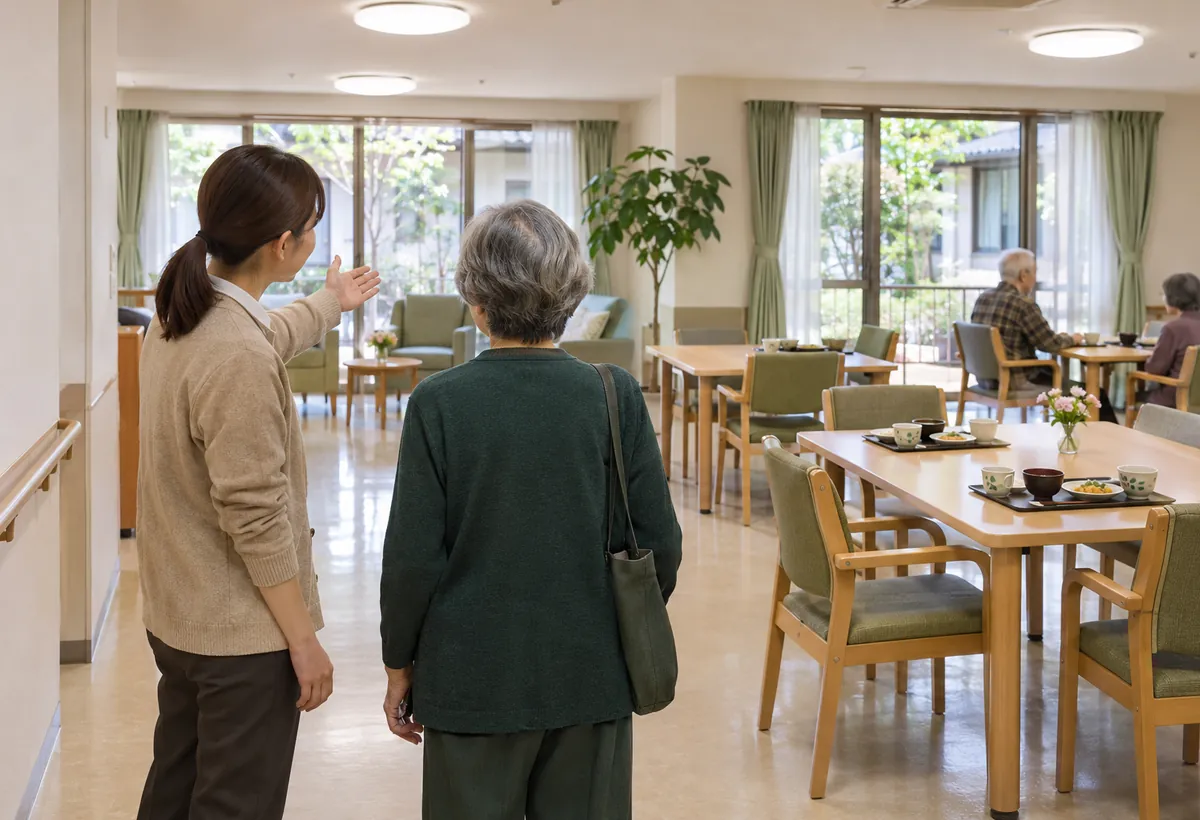
In Japan, a "care house" is the common name for a keihi rojin home (軽費老人ホーム, literally a low-cost home for older people). It is a welfare facility under the Act on Social Welfare for the Elderly, which describes such a home as one that takes in older people at no charge or a low charge and provides meals and other everyday help. What makes it different from a private nursing home is how the bill is built. One part of the monthly fee changes with the resident's income from the previous year, so two people in the same building can pay different amounts.
Strictly speaking there are four types, and the Ministry of Health, Labour and Welfare counted them on 1 October 2024.
Type A and Type B are older categories. They cover homes that already existed when the current ministerial ordinance took effect on 1 June 2008 and that the prefectural governor designated as transitional. Together they number 198 homes, so the search for a parent almost always means a care house. Kitakyushu City describes Type A as a home for low-income older people who cannot manage at home because of their family or housing situation.
Care houses make up about 87% of all keihi rojin homes. Residents number 74,324 against a capacity of 81,790, so roughly 91% of places are filled in the surveyed homes.
| Type | Who it is for | Homes | Capacity | Residents |
|---|---|---|---|---|
| Type A | Older people who feel unsure about living independently. Meals are provided | 187 | 11,026 | 10,046 |
| Type B | People whose physical function has declined but who can cook for themselves, or who feel unsure about living alone | 11 | 492 | 328 |
| Care house | People who feel unsure about independent daily life because of declining function and who cannot get help from family | 2,037 | 81,790 | 74,324 |
| Urban type | Small homes of 20 residents or fewer, generally in built-up areas and designated by the governor | 96 | 1,656 | 1,626 |
| All keihi rojin homes | Total of the four types | 2,331 | 94,963 | 86,325 |
Who can move in
The ministerial ordinance (article 13) sets two conditions for residents. One is that the person is judged to be unsure about living independently because of declining physical function, and cannot easily get help from family. The other is an age of 60 or older. A spouse or a relative within the third degree who needs to move in together because of special circumstances is exempt from the age limit.
The ordinance does not define "difficult to get help from family". Nor does it say how a family living abroad is treated, so ask the home directly before applying. Kagoshima City, for example, describes the target resident as someone able to live independently without daily assistance.
A fiscal 2020 survey cited by the National Association of Social Welfare Facilities for the Elderly (36,236 care house residents) found that 74.2% came straight from their own homes, 11.7% from medical institutions and 10.6% from other welfare facilities.
Care and staffing
General and care types
The ordinance has no official names for these, but local governments and homes commonly speak of a general type and a care type. The practical dividing line is whether the home holds the long-term care insurance designation called tokutei shisetsu (specified facility), which lets it provide nursing care in-house. A keihi rojin home can obtain it under article 15 of the Enforcement Regulations of the Long-Term Care Insurance Act.
According to the National Association of Social Welfare Facilities for the Elderly, 534 of 2,331 homes (22.9%) held the designation, based on the fiscal 2022 survey of long-term care service facilities. The remaining roughly four in five are homes without it, where residents use outside services if care becomes necessary.
Whether a home accepts a given care level, when it asks a resident to leave, and how care costs are set vary from home to home. Check the operating rules and the explanation of important matters (jūyō jikō setsumeisho) for each home.
| Point | General type (no designation) | Care type (designated) |
|---|---|---|
| Daily care | The home provides meals, bathing, consultation and emergency response. If care is needed, a resident uses home-visit care, day services and similar outside providers | The home plans and provides help with bathing, toileting, meals and rehabilitation itself |
| Care staff | At least one full-time-equivalent care worker for up to 30 general residents, two for up to 80 | At least one nursing or care worker (full-time equivalent) for every three residents who need care, or part of three |
| Care level | Kagoshima City's example describes the whole category as for people who can live without daily assistance | Kagoshima City's example lists the designated type as covering support levels 1 and 2 and care levels 1 to 5 |
When care needs rise
If a resident of a general-type home comes to need care, the ordinance gives the home two duties. It must support the resident, respecting their wishes, with procedures such as applying for a care-needs certification when the person or family cannot easily do so (article 19). And it must help the resident receive home-based care services appropriately (article 20).
So the system does allow a resident to keep living in a general-type home while using long-term care insurance services from outside providers. Kitakyushu City describes these homes the same way.
How far this works in practice depends on the home's staff, building and rules. The ordinance does not state the care level at which a resident must leave. That is decided in the operating rules and the contract, so read the termination clause closely. The ordinance does prohibit contract terms that unreasonably limit residents' rights (article 12).
Outside services carry the usual long-term care insurance co-payment of 10% to 30%, separate from the fee tiers described below. For how care levels work, see our guide to care levels in Japan, and for the person who arranges the services, the care manager guide for foreign families. If your parent needs heavier care, compare special nursing homes (tokuyo) and geriatric health facilities (rouken).
Fees and income
The monthly bill
The ordinance (article 16) lists the charges a care house may collect. Three make up the monthly core. A home must explain each charge in writing beforehand and obtain the resident's consent.
Municipal guides show how this adds up, as examples from one place at one date, not national rates. Kagoshima City gives the total of the three core charges as about 80,000 to 210,000 yen a month and says an entrance payment and personal utility and phone charges are extra. Yokohama City (as of 1 April 2025) lists living expenses of 48,764 yen and service costs from 10,000 to 161,616 yen. It gives a management fee of 5 million to 16.5 million yen but the document does not say whether that is monthly or a lump sum, so check the contract.
National summaries vary too. The National Association of Social Welfare Facilities for the Elderly describes care houses as roughly 40,000 to 150,000 yen a month. In winter, from November to March, a heating surcharge is added: 2,183 yen in Yokohama and 2,150 yen in Kitakyushu.
| Charge | What it covers | How the amount is set |
|---|---|---|
| Service cost (jimuhi) | Staff costs and similar. Collected in light of the resident's income | Set by the prefectural governor and tiered by income |
| Living expenses | Food ingredients plus utilities in shared areas | Set locally, with a cap decided by the governor |
| Management fee (kanrihi) | The equivalent of rent | Set by each home |
| Utilities in your own room | Electricity and water you use | Actual use |
| Optional services | Extras the resident chooses | Set by the home |
Income tiers
The service cost depends on the resident's target income (taishō shūnyū), meaning the previous year's income minus necessary expenses. Kitakyushu City publishes the table below, with figures as of 1 April 2026, for a care house. Yokohama City's table for care houses (1 April 2025) has the same amounts and breakpoints. Because the ordinance says the governor sets the amounts, ask the city or home for the current table in your parent's area.
Take a Kitakyushu home with 50 residents. At target income of 1.5 million yen or less, the monthly cost is 10,000 yen service cost plus 46,940 yen living expenses plus a management fee (the city's reference range is 15,024 to 40,824 yen). That comes to about 72,000 to 98,000 yen. At up to 2 million yen, the service cost rises to 25,000 yen and the total to about 87,000 to 113,000 yen. Room utilities, the winter surcharge and any entrance payment are extra.
Yokohama's notes add rules. For a married couple moving in together, the two incomes and expenses are added up and halved, and if the result is 1.5 million yen or less each person's service cost is reduced by 30%. A resident's payment never exceeds the actual cost of the home's services. The notes also say residents who cannot afford the fees can be helped to apply for public assistance.
| Target income (yearly) | Resident's service cost (monthly) |
|---|---|
| Up to 1.5 million yen | 10,000 yen |
| 1.5 to 2.0 million yen (five steps) | 13,000 to 25,000 yen |
| 2.0 to 2.5 million yen (five steps) | 30,000 to 50,000 yen |
| 2.5 to 3.0 million yen (five steps) | 57,000 to 85,000 yen |
| 3.0 to 3.1 million yen | 92,000 yen |
| Above 3.1 million yen | Full cost of the home's services |
How income is counted
The home assesses income when a resident moves in and once a year afterwards, using last year's income less necessary expenses, checked against tax certificates and receipts. The rules below come from a handbook by Saitama Prefecture (April 2018) that follows a national notice. Other prefectures and cities may differ, so confirm locally.
Two points are left open. The handbook says how to convert a foreign-currency pension but not what document a home accepts as proof of it. It also does not address money that relatives abroad send every month. Ask the home and the city office before moving in, so a later tier change does not surprise you. For how pensions are taxed in Japan, see pension and tax for foreign retirees.
The ordinance and the city guides cited here say nothing on whether nationality, residence status or resident registration affects admission. Confirm it with the home and, for visa questions, with a specialist.
- Pensions received regularly count at the amount actually received, whether public or private. The handbook adds that a pension paid in a foreign currency is converted to yen, in principle at the rate on the payment date, following the income tax treatment.
- Survivor's and disability pensions are not taxed, so they do not appear on a tax certificate. The home checks them through payment notices or copies of bank passbooks.
- The handbook lists income from one-off condolence money and remittances (shitaokuri) as not counted.
- Deductible expenses include taxes, social insurance premiums and medical costs, and the Saitama handbook also counts the co-payment for outside care services. Expenses without proof, such as receipts, are not accepted.
- For January to June the tier uses income from two years earlier. From July it moves to the previous year's income.
Contract and steps
Contract and documents
Admission is a contract between the resident and the home, not a placement by the city. Kitakyushu City says the contract is with each home's director and applicants apply to the home directly.
Before the contract, the home must give the applicant or the family a written explanation of important matters, such as an outline of its operating rules and staff schedules. The contract itself must also be in writing (ordinance article 12). If the applicant or family agrees, the explanation may be provided by electronic means. The home must also publish these important matters on its website in principle (article 28).
You may therefore be able to read the documents before you travel. How a contract is signed from abroad is something to settle with the home. The ordinance gives no detailed rules on the management fee or on refunds of an entrance payment, so read those terms in the contract closely.
Questions to ask first
Bring these to the first call or video meeting.
- How the service-cost tier is calculated, and when it is reviewed each year
- The management fee, whether there is an entrance payment, and what is refunded on leaving
- Living expenses, room utilities and the winter surcharge
- Whether the home is general type or designated, and which care levels it accepts if designated
- The conditions for leaving if the care level rises
- The partner medical institution, and whether the resident can return after a hospital stay
- How many emergency contacts it takes, and whether it contacts by phone or email, with your time zone noted
Order of steps
This order limits rework when you are arranging things from a distance.
A care house suits the stage when living alone becomes worrying, so choose with the next stage of care in mind. For the wider picture, see nursing homes in Japan for foreigners and finding assisted living for a parent in Japan.
- Ask the city office for elderly welfare or the community support center for a list of local care houses and a rough fee for your parent's income.
- Read each candidate's important-matters document and fee list from its website or by mail.
- Gather pension notices, the tax certificate and medical receipts so the target income can be estimated.
- Ask in a video visit or call whether the home is general or designated and what happens if care needs rise.
- Check the management fee, entrance payment, refund and termination clauses before signing.
Frequently asked questions
Why does one source put a care house at 40,000 to 150,000 yen a month and another at 80,000 to 210,000 yen?
The charges in the monthly bill differ by person and by home. The service cost depends on the previous year's income (in the Kitakyushu example, from 10,000 yen up to the full cost), living expenses are capped locally, and the management fee is set by each home. The National Association of Social Welfare Facilities for the Elderly gives roughly 40,000 to 150,000 yen. Kagoshima City gives about 80,000 to 210,000 yen. They differ in which charges they include and in the area. An entrance payment and room utilities may come on top, so ask each home for a written monthly estimate based on your parent's own income.
If my mother is in a general-type care house and is certified at care level 2, can she stay?
There is no single answer. The ordinance requires the home to help a resident receive home-based care services when care becomes necessary, so living there with outside services is possible under the system. Which care levels a home actually accepts depends on its staffing, building and operating rules. The conditions for leaving are set by the operating rules and the contract, so ask for them in writing before she moves in.
My father's pension is paid in dollars from overseas. How would a care house count it when setting his fee?
A Saitama Prefecture handbook, based on a national notice, says pensions received regularly count at the amount actually received, public or private. A pension paid in a foreign currency is converted to yen, in principle at the rate on the payment date, following income tax treatment. The handbook does not say what document is accepted as proof of a foreign pension. Other prefectures and cities may differ. Ask the home and the local city office which documents they want, before he moves in.
Do the monthly transfers I send to my parent raise the fee tier?
The Saitama handbook lists income from one-off condolence money and remittances (shitaokuri) as not counted. It does not say how regular monthly transfers from relatives abroad are treated, and neither do the ordinance or the city guides. Do not assume they are treated the same way. Ask the home and the city office, and keep your transfer records in case they ask for them.
Must a care house explain its key terms in writing before a parent signs?
Yes. The ordinance says the home must explain important matters in writing to the applicant or the family before the contract (article 12, paragraph 1). With the applicant's or family's consent, it can provide the document electronically instead (paragraph 3). Homes must also publish important matters on their websites in principle (article 28). The contract itself must be in writing, so ask the home how signing from abroad works.
How Japan Care Concierge can help
A facility search runs as a project, not a list of links. We read each facility's disclosure document, visit in person with a checklist and a camera, and hand back one comparison table with the fee breakdown and exit conditions on it.
Primary and official references
We checked 10 primary or official sources below before writing this article. Rules, costs, and local procedures change by municipality and over time. Confirm the linked official source before a final decision. Last source check: 2026-11-01.
- e-Gov Laws: Ordinance on Standards for Equipment and Operation of Low-Cost Homes for the Elderly (Japanese)
- e-Gov Laws: Act on Social Welfare for the Elderly (Japanese)
- e-Gov Laws: Enforcement Regulations of the Long-Term Care Insurance Act (Japanese)
- e-Gov Laws: Standards for Designated Home Services (Japanese)
- MHLW: 2024 Survey of Social Welfare Facilities, Overview (Japanese)
- National Association of Social Welfare Facilities for the Elderly via MHLW: Outline of Yogo and Keihi Rojin Homes (Japanese)
- Kagoshima City: Keihi Rojin Home (Care House) (Japanese)
- Kitakyushu City: Facility Services, Keihi Rojin Home (Care House) (Japanese)
- Yokohama City: Welfare Facilities No.57, Care House (Japanese)
- Saitama Prefecture: Handbook on Income Assessment for Keihi Rojin Homes (Japanese)
About this article
This page is general orientation, not medical, legal or individual care advice. Japan Care Concierge is run by Shinkokai, Inc. and draws on the care services of Social Welfare Corporation Shinkou Fukushikai, established in 1999 in the same group, which runs elderly care facilities and services in Kanagawa under the Cross Heart name. We take no referral fees from facilities or providers. We do not provide medical treatment or diagnosis; in an emergency, call 119 first. Hands-on care and guarantor support come through our group companies. Long-term care insurance is run by each municipality or union of municipalities, and each sets its own rules and timelines, so confirm your own case with the municipal long-term care insurance desk or your local community support center. The publication and update dates above are actual dates. How we research, source, and correct content is described in our editorial policy.