
Key numbers
At a glance
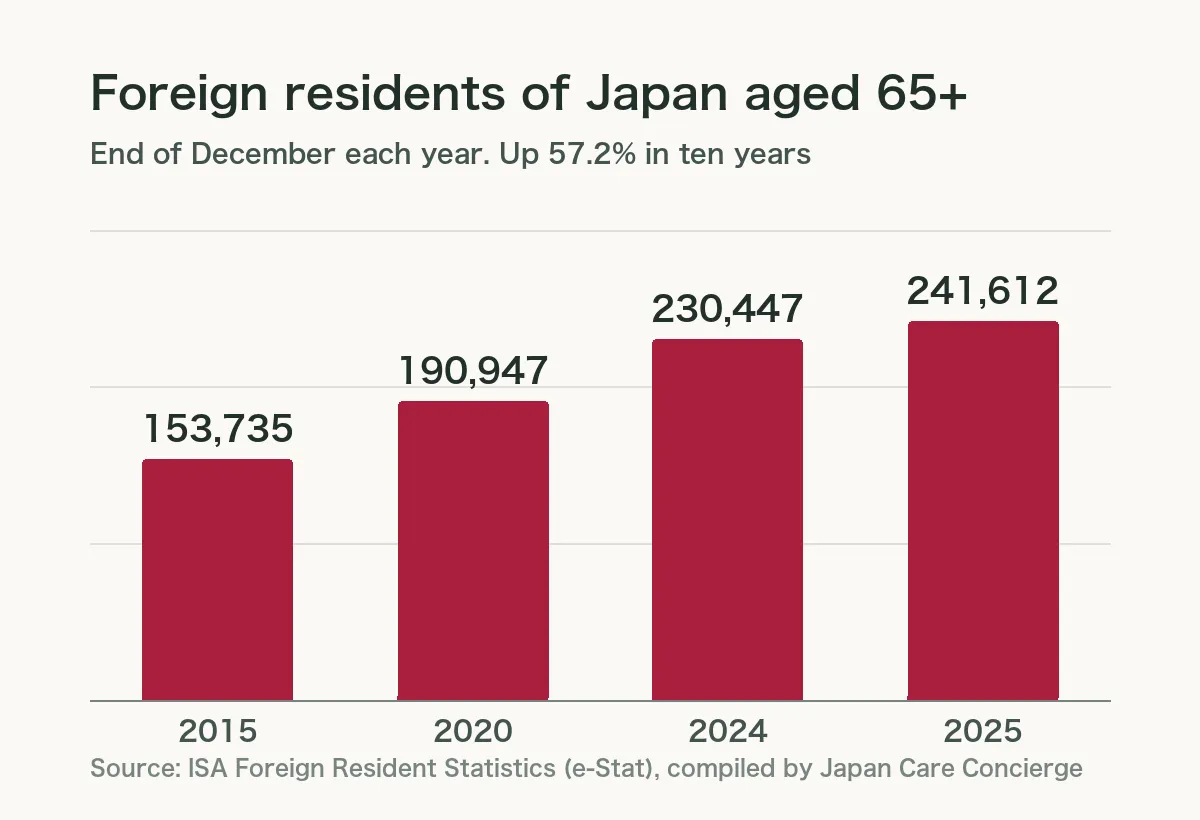
At the end of December 2025, 241,612 foreign residents of Japan were aged 65 or over. That is 5.86 percent of the 4,125,395 foreign residents counted on that date, and the age tables for that date are the latest the Immigration Services Agency (ISA) has put on e-Stat.
Download the CSV with every figure on this page, its reference date and the e-Stat table it came from. This page covers foreign nationals only. For Japan's whole older population, the care-certification counts and the care workforce, see Japan elderly care statistics.
- 241,612 foreign residents aged 65 or over, of whom 93,239 were 75 or over and 50,099 were 80 or over (end of 2025)
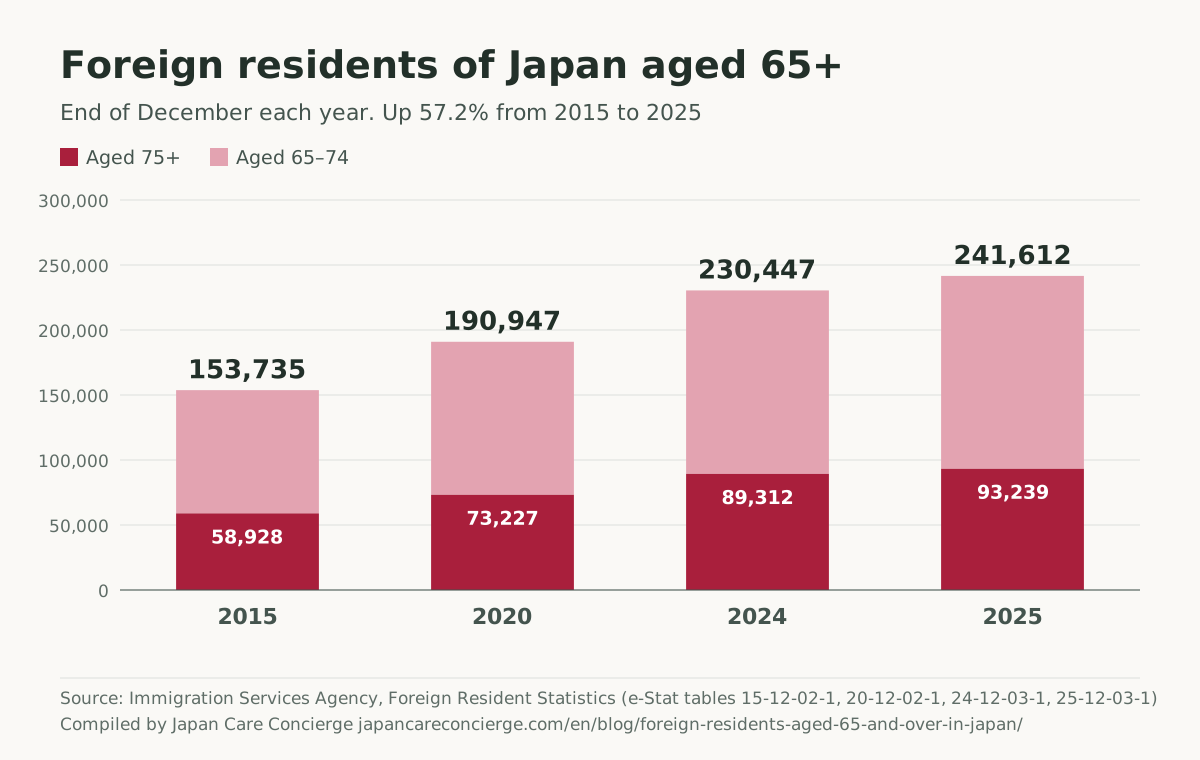
- Up 57.2 percent from 153,735 at the end of 2015, and up 26.5 percent from 190,947 at the end of 2020
- Up 4.8 percent in one year, from 230,447 at the end of 2024
- 305,321 foreign residents were aged 55 to 64 at the end of 2025. Most of them will reach 65 within the next ten years if they stay in Japan
- 88.2 percent of foreign residents aged 65 or over held either special permanent residence (110,809) or permanent residence (102,207)
- Osaka (41,375) and Tokyo (38,791) had the most; Kanagawa ranked fifth with 18,539, almost double its 2015 figure of 9,741
Why the 2025 tables
The ISA released its mid-2026 headline count on October 16, 2026: 4,281,026 foreign residents at the end of June 2026, a record and 3.8 percent more than six months earlier.
That release does not break the total down by age. The age-by-nationality tables arrive on e-Stat later, and when we checked on October 18, 2026, the newest age tables there were for the end of December 2025, published on July 10, 2026. Every age figure on this page therefore refers to December 31, 2025. We will replace them when the June 2026 age tables appear, and the reference date on each row will change with them.
Growth since 2015
Ten-year trend
The older foreign population has grown in every period we measured, though more slowly than the foreign population as a whole, because most new arrivals are young workers and students.
Between 2015 and 2025 the foreign population grew by 84.8 percent while its 65-and-over segment grew by 57.2 percent. So the share aged 65 or over fell, from 6.89 to 5.86 percent, even as the number of older people rose by 87,877. A falling share can hide a rising headcount, and the headcount is what a ward office, a care manager or a home-help agency actually has to serve.
The 75-and-over group, the age at which care need climbs steeply in Japan, grew from 58,928 to 93,239 over the same ten years, an increase of 58.2 percent.
| Year end | All foreign residents | Aged 65+ | Share 65+ | Aged 75+ |
|---|---|---|---|---|
| 2015 | 2,232,189 | 153,735 | 6.89% | 58,928 |
| 2020 | 2,887,116 | 190,947 | 6.61% | 73,227 |
| 2024 | 3,768,977 | 230,447 | 6.11% | 89,312 |
| 2025 | 4,125,395 | 241,612 | 5.86% | 93,239 |
By nationality
Top nationalities
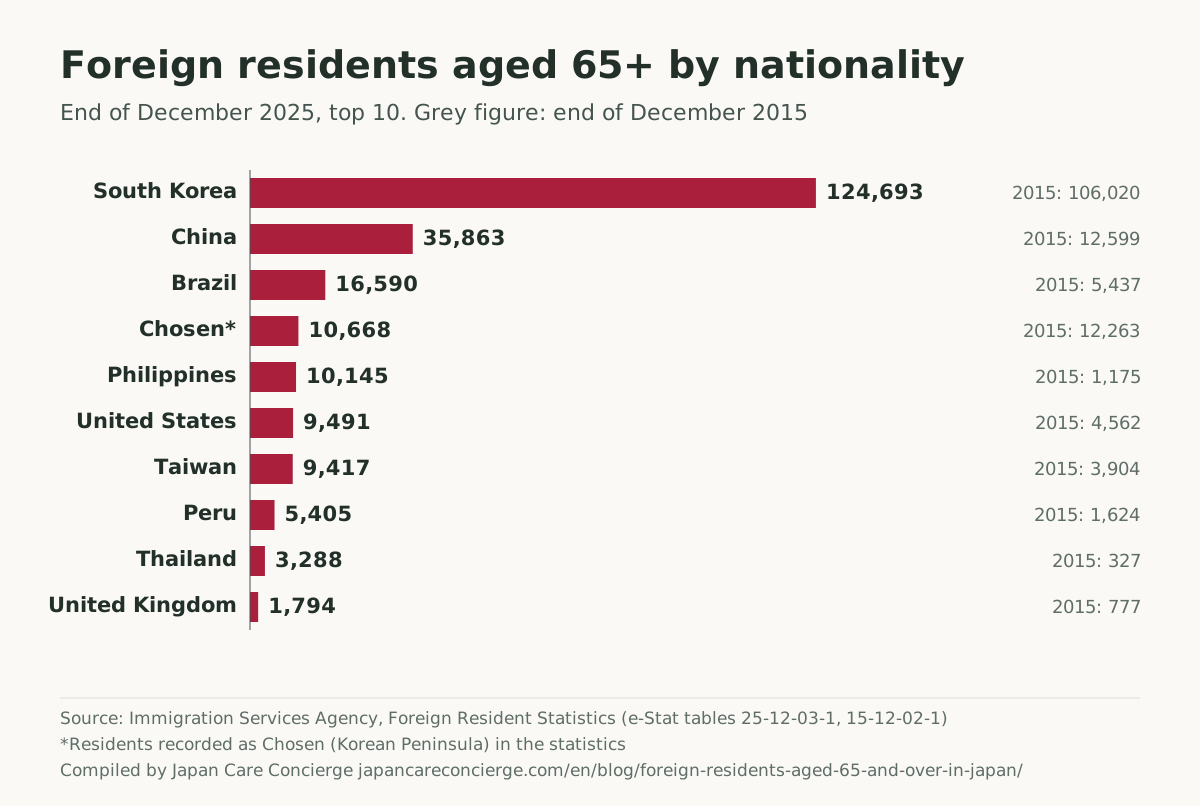
Two very different groups make up the older foreign population: long-settled Korean residents, many of them born in Japan, and a faster-growing group of Chinese, Brazilian, Filipino and other residents who came as adults.
South Korean nationals were 51.6 percent of all foreign residents aged 65 or over, and with residents recorded as Chosen the share rises to 56.0 percent. Nearly half of Korean nationals aged 65 or over (62,911 of 124,693) were already 75 or older. This is an older population that has used Japanese public services for decades.
The growth sits elsewhere. Over ten years the number aged 65 or over rose about 2.8 times among Chinese nationals, 3.1 times among Brazilians, and 8.6 times among Filipinos. These are people who mostly arrived as adults to work or marry, and in many cases their children have grown up or moved away. The Chosen group is the only large one that shrank, from 12,263 to 10,668.
The pipeline is larger still. At the end of 2025, 75,354 Chinese nationals, 67,381 South Koreans, 52,875 Filipinos and 30,454 Brazilians in Japan were aged 55 to 64.
| Nationality | Aged 65+ (2025) | Share of that nationality aged 65+ | Aged 75+ (2025) | Aged 65+ (2015) |
|---|---|---|---|---|
| South Korea | 124,693 | 30.6% | 62,911 | 106,020 |
| China | 35,863 | 3.9% | 8,699 | 12,599 |
| Brazil | 16,590 | 7.9% | 3,269 | 5,437 |
| Chosen (recorded as Korean Peninsula) | 10,668 | 48.1% | 6,368 | 12,263 |
| Philippines | 10,145 | 2.8% | 727 | 1,175 |
| United States | 9,491 | 13.6% | 3,464 | 4,562 |
| Taiwan | 9,417 | 12.9% | 2,594 | 3,904 |
| Peru | 5,405 | 11.0% | 1,088 | 1,624 |
| Thailand | 3,288 | 4.9% | 226 | 327 |
| United Kingdom | 1,794 | 8.0% | 534 | 777 |
Status and region
Residence status
Almost every older foreign resident holds a status with no fixed end date, which is why this is a group that grows old in Japan rather than passing through.
Permanent and special permanent residence together cover 213,016 people, or 88.2 percent of the group. The remaining 11.8 percent is spread across family, work and other statuses, led by spouses or children of Japanese nationals (11,372).
| Residence status | Aged 65+ | Share |
|---|---|---|
| Special permanent resident (tokubetsu eijusha) | 110,809 | 45.9% |
| Permanent resident (eijusha) | 102,207 | 42.3% |
| Spouse or child of a Japanese national | 11,372 | 4.7% |
| Long-term resident (teijusha) | 6,458 | 2.7% |
| Designated activities (tokutei katsudo) | 4,308 | 1.8% |
| Business manager | 1,597 | 0.7% |
Top prefectures
Older foreign residents are concentrated in five prefectures, which together held 137,448 of them, or 56.9 percent.
Osaka, Hyogo and Kyoto have older foreign populations relative to their size: about one foreign resident in nine is 65 or over, reflecting long-established Korean communities. Tokyo's share is lower at 4.8 percent, but its count rose 86.0 percent in ten years, from 20,851 in 2015, while Osaka's rose 21.3 percent from 34,114.
| Prefecture | Aged 65+ | Share of the prefecture's foreign residents | Aged 75+ |
|---|---|---|---|
| Osaka | 41,375 | 11.0% | 20,146 |
| Tokyo | 38,791 | 4.8% | 12,641 |
| Hyogo | 19,446 | 12.5% | 9,668 |
| Aichi | 19,297 | 5.4% | 7,374 |
| Kanagawa | 18,539 | 5.8% | 6,181 |
| Saitama | 11,660 | 4.0% | 2,918 |
| Chiba | 11,228 | 4.3% | 3,084 |
| Kyoto | 10,228 | 11.0% | 5,363 |
| Fukuoka | 6,775 | 5.4% | 3,060 |
| Shizuoka | 6,292 | 4.8% | 1,759 |
Kanagawa in detail
Kanagawa, the prefecture of Yokohama and Kawasaki, had 18,539 foreign residents aged 65 or over at the end of 2025, fifth in Japan, and 6,181 of them were 75 or over.
The mix matters for the people who serve it. Eight nationality groups in Kanagawa each had more than 600 residents aged 65 or over, and their first languages range from Korean and Chinese to English, Tagalog, Portuguese and Spanish. Japan Care Concierge is operated with the care-service experience of Social Welfare Corporation Shinkou Fukushikai, which provides elderly care facilities and services in Kanagawa under the Cross Heart name, so this is the prefecture we know best.
- Ten-year growth: 9,741 (2015) to 13,358 (2020) to 18,539 (2025), an increase of 90.3 percent, faster than the national 57.2 percent
- By nationality: South Korea 6,678, China 3,677, United States 1,203, Philippines 1,028, Brazil 994, Taiwan 976, Peru 836, Chosen 616
- By status: permanent residents 10,586 (57.1 percent) and special permanent residents 5,458 (29.4 percent). In contrast to Osaka, permanent residents outnumber special permanent residents
What it means for care
Care insurance applies
A foreign national registered as a resident of a Japanese municipality is enrolled in long-term care insurance at 65 on the same terms as a Japanese neighbour, and can apply for care-need certification when help is needed.
Eligibility is rarely the obstacle. What gets in the way is the process: the application, the assessment interview, the care plan and the provider contracts all run in Japanese, and the people who would usually translate, the adult children, may live in another country. How the system treats foreign residents is set out in long-term care insurance for foreigners, and the practical side in can foreigners use care services in Japan.
The numbers above suggest the language need is widening. The groups growing fastest, Chinese, Brazilian, Filipino and Thai residents, are those least likely to have grown up in Japanese, unlike many older Korean residents born in Japan. Over the same period Japan also began hiring care workers from abroad: 79,884 people held Specified Skilled Worker (i) status in the care field at the end of June 2026 (ISA preliminary figures). That is a separate population from the older residents on this page, and the two are often counted together by mistake.
For families abroad
If a parent is one of the 241,612, the useful questions are local ones: which ward office, which community support center, and who will sit in on the assessment.
The free public route is the parent's community general support center, which handles the first consultation and the certification application. Where a family abroad needs someone to keep the steps in order, explain each document in English and report back, that is the work Japan Care Concierge does. The first consultation is free; contact us with the city your parent lives in, or read how we help foreign seniors in Japan.
Method and citation
How we counted
Every figure comes from the ISA's Foreign Resident Statistics (zairyu gaikokujin tokei) as published on e-Stat. We downloaded the original Excel tables and added up the age bands ourselves.
- Population: foreign residents (zairyu gaikokujin), meaning mid- to long-term residents plus special permanent residents. Short-term visitors are excluded. Japanese nationals, including naturalised citizens, are not in these tables
- 65 and over is the sum of the five-year bands from 65–69 upward (2024 and 2025 tables) or of single-year ages from 65 upward (2015 and 2020 tables). 75 and over is summed the same way
- National and nationality figures for 2025 come from table 25-12-03-1; prefecture, residence-status and Kanagawa figures come from the 2025 microdata-style table 25-12-t1. The two give the same national total of 241,612
- Trend figures use tables 15-12-02-1 and 20-12-02-1 (nationality) and 15-12-06-0 and 20-12-06-0 (prefecture), all for December 31 of the year shown
- Percentages are our own calculations from those counts, rounded to one or two decimal places
- We have not combined these counts with Japan's total 65+ population, because that is estimated on a different date by a different agency
How to cite
You are welcome to use these figures and the CSV in articles, reports and teaching material. Please credit the Immigration Services Agency as the source of the data and Japan Care Concierge for the compilation, with a link to this page.
If you spot an error or a newer table, please tell us through the contact page; we correct against the original e-Stat files and change the update date only when the figures change.
- Short credit: Source: Immigration Services Agency, Foreign Resident Statistics (end of December 2025), compiled by Japan Care Concierge
- Full reference: Japan Care Concierge, "Foreign Residents Aged 65 and Over in Japan: The Data," japancareconcierge.com, October 18, 2026, based on ISA Foreign Resident Statistics tables 25-12-03-1 and 25-12-t1
- Link: https://japancareconcierge.com/en/blog/foreign-residents-aged-65-and-over-in-japan/
Charts and data
You can use the charts and the CSV in articles, reports and teaching material. Credit the Immigration Services Agency as the data source and Japan Care Concierge for the compilation, and link to this page.
Downloads
- CSV, 111 rows, UTF-8
- Chart (SVG): foreign-residents-65-plus-trend-en.svg
- Chart (SVG): foreign-residents-65-plus-nationality-en.svg
Suggested citation
According to the Immigration Services Agency's Foreign Resident Statistics, 241,612 foreign residents of Japan were aged 65 or over at the end of December 2025, up 57.2% from 2015 (compiled by Japan Care Concierge).
Embed code
Paste this HTML into your site or blog to show the chart with its source and a link to this page.
<figure>
  <a href="https://japancareconcierge.com/en/blog/foreign-residents-aged-65-and-over-in-japan/"><img src="https://japancareconcierge.com/data/charts/foreign-residents-65-plus-trend-en.svg" alt="Foreign residents of Japan aged 65 and over: 153,735 at the end of 2015 and 241,612 at the end of 2025, up 57.2%" width="1200" height="760" loading="lazy" style="max-width:100%;height:auto"></a>
  <figcaption>Source: Immigration Services Agency of Japan, Foreign Resident Statistics. Chart: <a href="https://japancareconcierge.com/en/blog/foreign-residents-aged-65-and-over-in-japan/">Japan Care Concierge</a></figcaption>
</figure>
<figure>
<a href="https://japancareconcierge.com/en/blog/foreign-residents-aged-65-and-over-in-japan/"><img src="https://japancareconcierge.com/data/charts/foreign-residents-65-plus-nationality-en.svg" alt="Foreign residents of Japan aged 65 and over by nationality, end of 2025, top 10" width="1200" height="806" loading="lazy" style="max-width:100%;height:auto"></a>
<figcaption>Source: Immigration Services Agency of Japan, Foreign Resident Statistics. Chart: <a href="https://japancareconcierge.com/en/blog/foreign-residents-aged-65-and-over-in-japan/">Japan Care Concierge</a></figcaption>
</figure>Frequently asked questions
How many foreign residents in Japan are aged 65 or over?
241,612 at the end of December 2025, according to the Immigration Services Agency's age tables on e-Stat. That is 5.86 percent of the 4,125,395 foreign residents on that date. 93,239 of them were 75 or over.
Which nationality makes up the largest share of older foreign residents in Japan?
South Korean nationals, with 124,693 people aged 65 or over at the end of 2025, or 51.6 percent of the group. China (35,863), Brazil (16,590), residents recorded as Chosen (10,668) and the Philippines (10,145) follow.
How many foreign residents aged 65 and over live in Kanagawa?
18,539 at the end of 2025, the fifth-highest of any prefecture, up from 9,741 in 2015. Permanent residents make up 57.1 percent of them and special permanent residents 29.4 percent.
Why does this page use end-of-2025 figures when mid-2026 totals are out?
The mid-2026 release of October 16, 2026 gives totals by nationality, status and prefecture but not by age. The age tables on e-Stat were still the end-of-2025 edition when we checked on October 18, 2026, so every age figure here refers to December 31, 2025.
Can I reuse the CSV of foreign residents aged 65 and over?
Yes. Credit the Immigration Services Agency as the data source and Japan Care Concierge for the compilation, and link to this page. The CSV lists the e-Stat table number for every row so you can check it against the original.
How Japan Care Concierge can help
We take one family's case through the steps this page describes. That means naming the office to call first, listing what to bring, and mapping the 30-day certification clock onto your own dates.
Primary and official references
We checked 8 primary or official sources below before writing this article. Rules, costs, and local procedures change by municipality and over time. Confirm the linked official source before a final decision. Last source check: 2026-10-18.
- Immigration Services Agency: Number of foreign residents at the end of June 2026 (Japanese)
- Immigration Services Agency: Foreign Resident Statistics index (Japanese)
- e-Stat: Foreign Resident Statistics, table 25-12-03-1, nationality by age, end of 2025 (Excel)
- e-Stat: Foreign Resident Statistics, table 25-12-t1, nationality, status, prefecture and age, end of 2025 (Excel)
- e-Stat: Foreign Resident Statistics, table 24-12-03-1, nationality by age, end of 2024 (Excel)
- e-Stat: Foreign Resident Statistics, table 20-12-02-1, nationality by age, end of 2020 (Excel)
- e-Stat: Foreign Resident Statistics, table 15-12-02-1, nationality by age, end of 2015 (Excel)
- Immigration Services Agency: Specified Skilled Workers at the end of June 2026, summary (Japanese, PDF)
About this article
This page is general orientation, not medical, legal or individual care advice. Japan Care Concierge is operated with the care-service experience of Social Welfare Corporation Shinkou Fukushikai, established in 1999, which runs elderly care facilities and services in Kanagawa under the Cross Heart name. We take no referral fees from facilities or providers. We do not provide medical treatment, diagnosis, emergency response or hands-on care. Japan has 1,559 long-term care insurers and each sets its own rules and timelines, so confirm your own case with the municipal long-term care insurance desk or your local community support center. The publication and update dates above are actual dates. How we research, source, and correct content is described in our editorial policy.