
Before you buy
Short answer
Yes, older visitors can still get the consumption tax back. For purchases since 1 November 2026, refunds generally follow customs confirmation at departure. You pay the tax-included price in the shop, show your own passport, and generally receive an amount equal to the tax after customs confirms at departure that the goods are leaving Japan.
Three points matter more for a visitor with limited stamina than for a young shopper. The customs check must be finished before you check your bags. The check is built around the buyer's own passport and the goods in hand. And anything you eat, drink or use up in Japan can cost you the refund on that whole receipt.
This page follows one purchase from the shop counter to the refund, using the Japan Tourism Agency pages, the leaflet issued with the National Tax Agency and Japan Customs, and the National Tax Agency Q&A of July 2026. It is general information, not tax advice. Shops and airports run the details differently, so ask them before you rely on a step. The other 2026 changes, such as the departure tax, are covered in Japan's 2026 travel rule changes for older visitors.
Who qualifies
The scheme is for visitors who are not residents of Japan. The National Tax Agency Q&A lists the statuses that count: Temporary Visitor (tanki taizai, 短期滞在), Diplomat and Official, certain landing permissions such as shore leave and emergency landing, and members of the US forces.
Temporary Visitor is the status given to tourists and to relatives visiting for a short stay, so most readers of this site fall under it. The Japan Tourism Agency's list adds a time test for Temporary Visitors: you must be less than six months from entry when you buy. Designated Activities (tokutei katsudou, 特定活動), the status used for some long-stay arrangements, is not on the list, so do not plan on a refund with that status. Shops read your status from the passport, so ask at the counter if yours is anything other than Temporary Visitor.
Japanese citizens who live abroad are covered by a separate test with its own documents. This page does not cover it.
Numbers to know
A few figures decide whether a purchase can be refunded at all. They are set by the agencies, not by individual shops.
The minimum is counted before tax, per buyer, per shop, per day. Purchases made at different times or on different floors of the same shop that day can be added together. Where shops share a tax-free procedure counter, purchases at several shops on the same day may be combined there. The rule refers to the same buyer, so spouses who shop in the same store are counted separately.
| Point | Rule | What it means for an older visitor |
|---|---|---|
| Minimum purchase | 5,000 yen or more before tax, same buyer, same shop, same day | Small buys such as one pack of pads may not qualify alone |
| Customs deadline | Within 90 days of purchase, counted from the day after purchase | A purchase on 1 November has 30 January as its last day (National Tax Agency example) |
| Quantity | Only what you can carry out of Japan yourself | A bulky item that you cannot carry through the terminal is a poor tax-free purchase |
| High-value items | Customs may ask for a certificate of authenticity or warranty for items of 1 million yen or more before tax | Keep the papers with the item |
| Excluded goods | Gold and platinum bullion and coins, and items that carry no consumption tax | Qualifying wheelchairs and walkers fall here, because there is no tax to refund |
In the shop
Paying at the counter
Tell the shop at the start that you want to buy tax-free. The shop must see the buyer's own passport, or the Visit Japan Web QR code that holds the passport data if the buyer is a Temporary Visitor. A family member's passport cannot stand in for the buyer's.
You then pay the full tax-included price. The shop must explain the 90-day rule, that the customs check cannot be done after you check your bags, and that goods must leave Japan. Ask which refund methods the shop offers and register one now. The agencies list bank transfer, credit card, app payment and cash at the departure airport as possible methods, and say that the methods vary by shop.
Keep the receipt. Customs works one receipt at a time, so how items are grouped on receipts matters later. If you already know that some items will be eaten, opened or used before you leave, it is worth asking whether the shop can put them on a separate receipt. That is a suggestion, not a rule, and whether a shop agrees is up to the shop.
Things you will use
Special sealed bags for consumables are gone, and so is the old 500,000 yen daily cap on them (National Tax Agency overview). What remains is a plain rule: food, drinks, medicines, cosmetics and other consumables that are eaten, drunk or used up in Japan cannot be refunded.
If only part of a consumable has been used, do not use the terminal. Go to the customs counter and say so. Items that are not consumables may be used in Japan and still qualify, as long as they leave the country with you. The Q&A advises keeping boxes and bags, and any label showing the model number, until the check is done.
Medicines need one more check. Your home country may limit what you can bring in, so look at its rules before buying medicine to take home.
| Type of purchase | Used in Japan before departure | What to do |
|---|---|---|
| Food and drinks | Any part eaten or drunk disqualifies the whole receipt | Report it at the customs counter, not at the terminal |
| Medicines and cosmetics | Same as food | Same as food |
| Disposable care goods such as pads or wipes | The Q&A does not name them, but it adds "other consumables", so plan on treating them like food | See buying care supplies as a visitor |
| Taxed walking sticks, cushions, clothing, bags | Use is allowed if the item leaves Japan with you | Keep packaging and model labels |
Sending items home
Posting tax-free purchases home yourself no longer works. The Japan Tourism Agency says the separate shipment method, in which the buyer mailed the goods as parcels, was abolished on 31 March 2025, and the Q&A adds that a postal receipt does not replace customs confirmation.
Some shops offer their own overseas shipping or a carrier contract signed at the counter. That is handled under a separate export exemption, where the shop may sell without tax and you normally do not take the goods through the customs check yourself. Whether a shop offers it varies, so ask before you buy something heavy. Do not treat it as part of the refund route described here.
Departure day
Order of steps
The terminals are in the international departure lobby, before baggage check-in. Everything bought tax-free must be with you when your passport is scanned, so the suitcase stays with you until the check is done.
Reading the passport takes a few seconds and the screen then shows green or red. Green ends the procedure. Red sends you to the customs inspection area, where you show the goods and may be asked for receipts. Finish the whole check before the boarding procedure. If you stop midway because you are short of time, you are treated as not having been checked, and neither the airline nor customs compensates a missed flight.
| Step | Where | What happens | Planning point |
|---|---|---|---|
| 1. Gather | Hotel or flat | All goods from every tax-free receipt, plus your passport | Put them in one bag that is easy to open |
| 2. Terminal | Departure lobby, before check-in | The buyer's passport is scanned | Do this before queuing at the airline desk |
| 3a. Green | Same place | Procedure complete | Go to check-in |
| 3b. Red | Customs inspection area | Goods are checked, receipts may be asked | Allow extra time and a place to sit |
| 4. Check bags | Airline counter | Normal check-in | Cannot be undone for tax-free reasons |
| 5. Refund | Shop or its provider | Paid after customs confirmation, by the method you registered | Timing varies by shop |
Online check option
At Narita, Haneda, Kansai, Chubu, New Chitose, Fukuoka and Naha you can do the check on a smartphone through Visit Japan Web instead of the terminal. It works inside the area covered by the dedicated wireless network, up to the security checkpoint.
You must register on Visit Japan Web before the check, and the online route is open only to Temporary Visitors, diplomats and officials. For a traveler who is uneasy with phones, the terminal remains the plain route. If you connect from a domestic flight to an international one, do the check at the airport you leave Japan from.
Stamina and time
No official page gives a number for how long to allow, because the terminal takes seconds and an inspection takes as long as it takes. A sensible plan, offered as a suggestion, is to treat the check as an extra errand before check-in and to schedule it early enough that a red result does not push you toward the boarding deadline.
Ask your airline about airport assistance when you book. Say that you have a tax-free errand before check-in, and ask whether a helper can take you to the terminal first. How far you must walk from the entrance to a terminal depends on the airport, and the airport's own site shows where its terminals are.
If your relative needs care-aware planning around the trip, Japan Care Concierge's accessible travel support covers its care and accessibility side. It does not give tax advice and does not handle shop or customs procedures. For the wider picture of a trip with parents, see traveling to Japan with elderly parents.
Wheelchair and companions
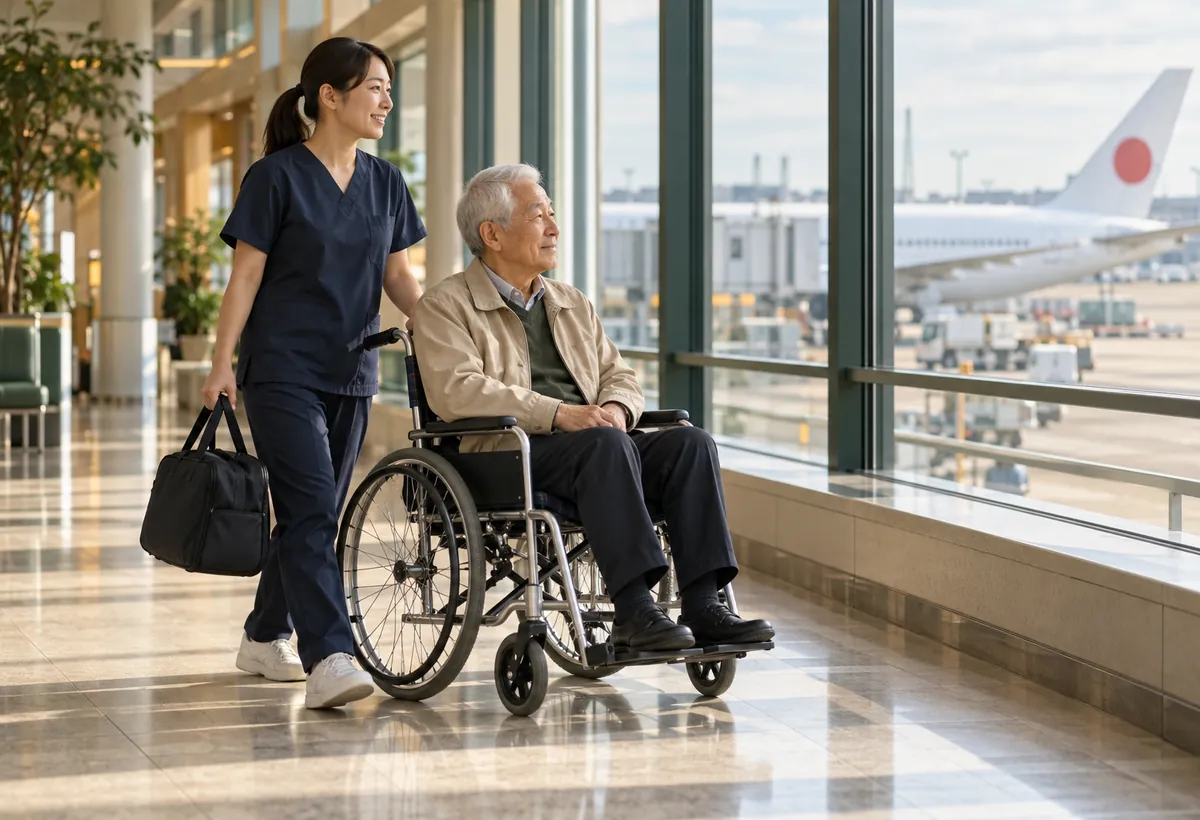
The official pages describe the check in terms of the buyer's passport and the buyer's goods. They do not describe a proxy or a family member doing the check for someone else, and they do not say anything specific about wheelchair users. They do not stop a companion from pushing the chair or carrying bags beside the buyer, but plan for the buyer to be present with the passport and the goods.
That has practical effects. If you shop alone while your spouse rests at the hotel, you are the buyer and you must carry the goods to the terminal. If your spouse buys, the shop records your spouse's passport, not yours. If the person who bought something cannot make the trip to the airport, the safest assumption is that the purchase will not be confirmed.
The agencies say the terminals and inspection areas are in the international departure lobby before baggage check-in. A qualifying wheelchair or walker carries no consumption tax, so there is nothing to refund on it, and buying care supplies as a visitor explains which ones qualify. For help with chairs at airports, see accessible Japan and wheelchair travel. For a question about a particular airport, the airport's customer line or the customs office there is the one to ask.
Getting the refund
The refund generally follows customs confirmation. A shop may refund earlier, but customs confirmation is still required for the tax exemption. The Japan Tourism Agency says it is generally processed after the sale is confirmed at the airport or seaport and that the amount goes back by the method you registered at the shop. No official page gives a payment time, so ask the shop when you buy.
Cash refunds at the airport are one of the options, not the rule. Haneda Airport's own page, for example, shows that the check terminals sit before security while its cash refund machines sit after security, and it adds that some shops are not covered by that cash service. Check where a cash refund is paid if you chose that option.
Goods that passed customs must be exported without delay. If they are not taken out of Japan, the tax is collected and penalties can apply.
When it goes wrong
Common traps
Most failures come from the order of steps or from a missing item. The table lists the ones the agencies describe.
| Situation | Result | What to do |
|---|---|---|
| Suitcase with tax-free goods checked in first | The check cannot be done; checked bags cannot be retrieved | Do the terminal check before the airline desk |
| One item from a receipt is missing | The whole receipt, including items still in hand, is not confirmed | Keep each receipt's goods together |
| Consumable partly used | Cannot be confirmed | Tell the customs counter, skip the terminal |
| More than 90 days since purchase | No customs confirmation for that purchase | Buy in the last 90 days of your stay |
| Goods mailed home | Not refundable | Carry them out yourself |
| Passport replaced after a loss | Receipts under the old passport can still be checked | Scan the new passport and tell the customs counter that the old one was also used |
| Domestic flight before the international one | The check is at the last airport in Japan | Do it there |
Long stays
The 90 days run from the day after each purchase, and the clock starts at the till. For a stay of 90 days or less, purchases made during the trip fall inside the deadline if you leave on schedule. Nationals of a few countries can apply inside Japan to extend a visa-free stay to as long as six months. For them, a purchase made in month one will be past its 90 days before they leave, and anything bought six months or more after entry does not qualify.
Plan bigger purchases for the last 90 days of the trip, and inside the first six months. Whether you can extend a stay and when, which affects those dates, is in Japan's 90-day limit for older visitors. Where the trip is a base for weeks of rest, the choice of base and the wider rules are in a long stay in Japan.
What to carry
On the day of departure, carry the following in your hand luggage or a bag you can reach without unpacking.
- Your passport, the same one used at the shop
- Every tax-free receipt and all the goods listed on it, in original packaging where possible
- Any certificate or warranty for a purchase of 1 million yen or more before tax
- Your phone with Visit Japan Web registered, if you plan to use the online route
- The refund method you registered at the shop, such as the card or account details
- A note of the shop's contact details, for questions about when your refund will arrive
Frequently asked questions
Can my daughter do the customs check for me if I use a wheelchair?
The official pages describe the check as the buyer presenting the buyer's own passport with the goods, and they do not describe a proxy. A companion can push the chair and carry the bags, but plan for the buyer to be present. If this is a concern, ask the customs office at your departure airport before the day.
What happens if I check my suitcase before visiting the tax-free terminal?
The check cannot be done after bags are checked in, because the goods must be in your possession when the passport is scanned, and checked bags cannot be retrieved. The purchase is then not confirmed and no refund is paid. Do the terminal check first and go to the airline desk afterwards.
Can I post my tax-free purchases home instead of carrying them?
Not for the refund route. The Japan Tourism Agency says that the buyer mailing goods themselves ended on 31 March 2025, and a postal receipt does not replace customs confirmation. Some shops run their own overseas shipping under a different export rule, so ask the shop before buying.
How much time should an older traveler allow for the tax-free check at the airport?
No official page gives a figure. The terminal takes seconds, and a red result adds a customs inspection that must finish before boarding. As a suggestion, treat the check as a separate errand before check-in and arrive early enough that a red result does not push you toward the boarding deadline.
Is the tax-free refund paid in cash, and when does it arrive?
It depends on the shop. The agencies list bank transfer, card, app payment and cash at the departure airport as possible methods and say that the amount is generally refunded after customs confirmation. No official page gives a payment time, so ask the shop when you register your method.
How Japan Care Concierge can help
The first consultation is 30 minutes and free, and we normally reply to inquiries within two business days. You leave it with a sequence: which office to contact first, what to prepare, and what your family abroad needs to see.
Primary and official references
We checked 7 primary or official sources below before writing this article. Rules, costs, and local procedures change by municipality and over time. Confirm the linked official source before a final decision. Last source check: 2026-11-02.
- National Tax Agency: Q&A on the tax-free shop system, refund method, July 2026 (Japanese)
- National Tax Agency: Overview of the tax-free shop system, refund method (Japanese)
- Japan Tourism Agency: What is the Refund Method? (English)
- Japan Tourism Agency: Frequently Asked Questions for Travelers, Refund Method (English)
- Japan Tourism Agency, METI, National Tax Agency and Japan Customs: Refund Method leaflet for travelers (English)
- Japan Tourism Agency: List of eligible tax-free purchasers, refund method (Japanese)
- Haneda Airport Passenger Terminal: Tax Refund (Japanese)
About this article
This page is general orientation, not medical, legal or individual care advice. Japan Care Concierge is run by Shinkokai, Inc. and draws on the care services of Social Welfare Corporation Shinkou Fukushikai, established in 1999 in the same group, which runs elderly care facilities and services in Kanagawa under the Cross Heart name. We take no referral fees from facilities or providers. We do not provide medical treatment or diagnosis; in an emergency, call 119 first. Hands-on care and guarantor support come through our group companies. Long-term care insurance is run by each municipality or union of municipalities, and each sets its own rules and timelines, so confirm your own case with the municipal long-term care insurance desk or your local community support center. The publication and update dates above are actual dates. How we research, source, and correct content is described in our editorial policy.