
What to expect
Buy, rent or bring
A visitor can buy most care supplies in Japan without insurance, a residence card or a doctor's note. Diapers, pads and soft foods are ordinary retail goods, and walkers and wheelchairs are sold to the public by specialist shops. What changes for a visitor is tax, because a few mobility aids are sold without consumption tax and everything you use up cannot be refunded under the tax-free system that changed on 1 November 2026.
The question for a stay of one to three months is which items to buy, which to rent and which to bring from home. One approach is to buy things that are used up, such as diapers, pads and thickener, on arrival instead of carrying them in bulk. For something you will use for weeks and may not want to take home, such as a wheelchair, compare renting with buying. Our guide to wheelchair rental and accessible travel covers rental and airport loans, so this page concentrates on buying.
For the wider picture of a stay this long, see our guide to long-term stay in Japan. Nothing here replaces advice from the doctor or therapist who knows the person. Ask them before the trip which items are essential, which brand and size work, and what to do if the usual product is not on the shelf. The table summarises where each category stands.
| Category | Where to look | What to check | Tax treatment |
|---|---|---|---|
| Diapers and pads | Drugstores and supermarkets are a sensible first stop | Type (tape, pants, pad) and the size range printed on the pack | Not on the exempt list, so expect tax; no tax-free refund on what you use up |
| Walkers and canes | Specialist shops that sell welfare equipment | Height setting, folding, weight, whether the shop treats it as tax-exempt | Qualifying walkers and some canes are sold without consumption tax; ordinary canes are outside the exemption |
| Wheelchairs | Specialist shops, or private rental for short stays | Seat width, folding size, who will push it | Sold without consumption tax if it qualifies; no handbook needed |
| Bathing aids | Specialist shops; ask the lodging first | Anti-slip surface, seat height, whether it fits the tub | Not on the ministry's exempt list, so expect tax |
| Soft foods and thickener | Supermarkets and drugstores | Texture marks on the pack; the product the doctor or therapist named | Food; if consumed in Japan, not eligible for the tax-free refund |
Why insurance rental is closed
Japan's care insurance pays for rented walkers, wheelchairs and beds, but a visitor cannot use it. Article 9 of the Long-Term Care Insurance Act makes a person an insured member only if the person has an address in a Japanese municipality and is aged 65 or over (or aged 40 to 64 and enrolled in a health plan).
A temporary visitor is not a registered resident of a municipality, so the insured rental system and the services built on it are outside reach. Municipal lending schemes differ and change. One Tokyo city's English page states that its city-hall free wheelchair loan has ended and points users to the social welfare council or private services. The page does not say whether visitors may borrow, so treat any municipal loan as something to ask about, not to count on.
The practical result is private payment, by purchase or by commercial rental. Our guide to seeing a doctor during a long stay explains the same gap for medical costs.
Choosing the item
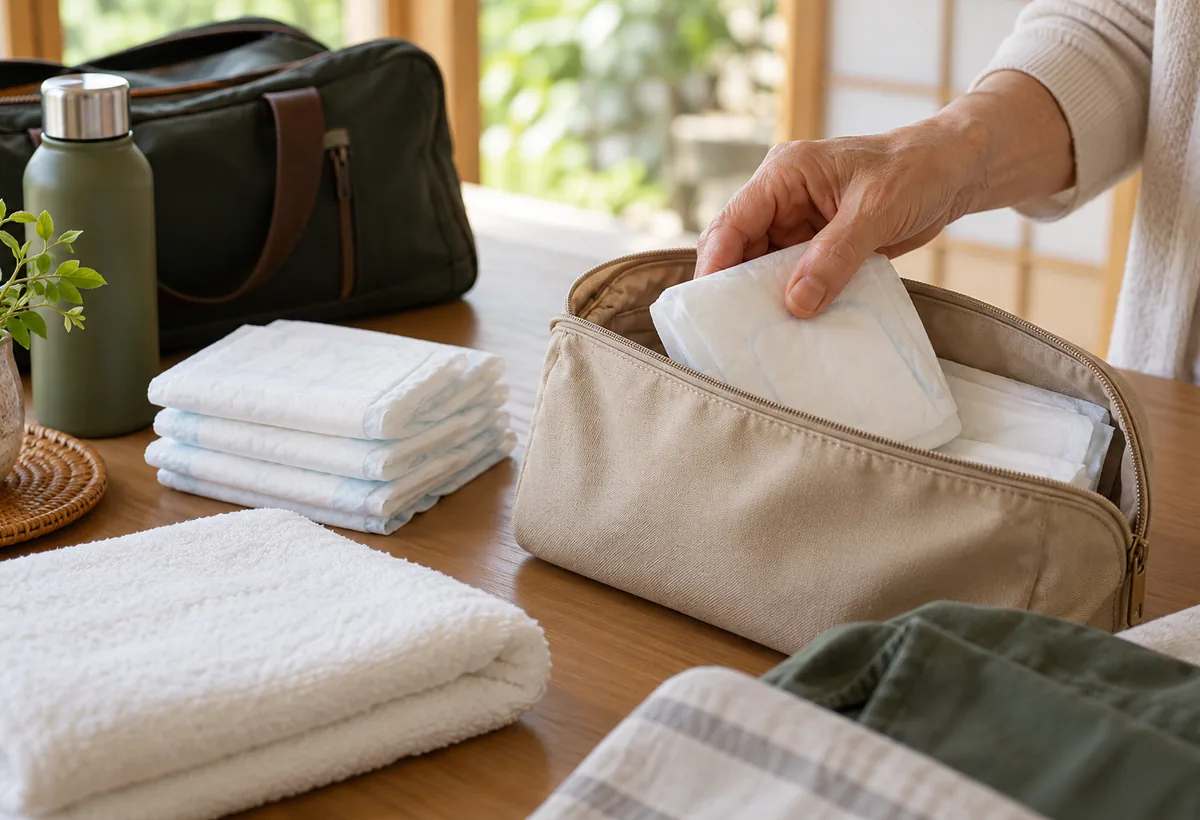
Diapers and pads
Adult diapers come in tape, pants and pad types, and the size on the pack is a body measurement, not a general S, M or L. One major maker's customer Q&A says to choose pants-type products by waist (the trunk measurement) and tape-type products by hip.
Measure the person before shopping and write the waist and hip numbers in centimetres on your phone. Then compare them with the range printed on the pack. Other makers may label sizes differently, so read each pack and do not assume that an M from one maker fits like an M from another. Ask the nurse or therapist who knows the person which type fits before you leave. Pants-type products are pulled on like underwear and tape-type products are fastened at the hips.
Buy a small pack first and keep the receipt. If the fit or the skin reaction is wrong, you have lost little, and you know the correct size before buying a case. Packing quantities, the three label words and carry-on tips are in our guide to managing incontinence on a Japan trip, so they are not repeated here. If the need is new or sudden, tell a doctor, as described in the guide to incontinence care for an elderly parent in Japan.
Walkers and canes
A walker or cane bought in Japan may or may not carry consumption tax, depending on the model. The Ministry of Health, Labour and Welfare notice on tax-exempt equipment lists walkers that meet its product standard and four kinds of walking aid: crutches, Canadian crutches, Lofstrand crutches and multi-leg canes. Any other cane is outside the list.
That means an ordinary single-point cane falls outside the exemption, while a multi-leg cane or a qualifying walker may be sold with no tax at all. The notice says the exemption also applies to ordinary retail purchases, and the buyer does not need to show a disability certificate. It also says that parts and accessories sold alone are not exempt. Ask the shop how the receipt will treat the model, and check that the receipt shows no consumption tax before you assume it.
Fit matters more than price. Ask the person's therapist for the correct height in centimetres before you travel, and ask the shop to adjust the new item at the counter. If you are unsure what the stay will need, JCC's accessible travel support looks at mobility and health needs before a trip. It does not sell or order equipment.
Wheelchairs and bath aids
A wheelchair, including a pushed attendant model, is on the ministry's exempt list. A shower chair with casters is not counted as a wheelchair, and the notice lists no bath chairs or bath boards, so expect tax on bathing aids.
For a stay of four to eight weeks, compare the purchase price with the rental fee for the same period, and note that the ministry's notice covers rental of listed items as well as sale. Remember too that you must carry the chair home or leave it behind. The section on tax-free shopping below explains why a tax-exempt wheelchair gives no refund: there is no tax to return.
Bathing deserves a call to the lodging before you book. Ask whether the bathroom has a seat, a grab bar and a non-slip floor, and whether the tub edge is low enough to step over. If the room lacks them, an anti-slip mat or a stable shower stool may be worth buying. Ask the person's therapist before buying anything the person must put weight on.
Soft foods and thickener
Japan marks foods for people who have trouble chewing or swallowing, and the marks are worth learning. The Ministry of Agriculture, Forestry and Fisheries runs a Smile Care Food scheme with a yellow mark for foods for people who find chewing difficult and a red mark for foods approved for people who have difficulty swallowing.
A separate private scheme, the Universal Design Food mark set by the Japan Care Food Council, shows texture and thickness in four categories. Both schemes tell readers to consult a professional about chewing or swallowing problems, and so should you. Swallowing difficulty is a medical matter, so do not assume that another thickener behaves like the one used at home.
If the person uses a thickener, bring the same product for the first weeks, show the pack to a Japanese doctor or speech therapist if you need a replacement, and do not change the product or the amount without asking. Food and thickener eaten here cannot be confirmed at departure, so they earn no refund.
Tax and refunds
What tax-free covers
From 1 November 2026, a shop licensed for tax-free sales normally charges tax at the till and refunds it after customs confirms at departure that you carried the goods out. A shop may offer an earlier refund under its own conditions, but customs confirmation is still required. A temporary visitor (short-stay status) can use the system. The purchase must reach ¥5,000 or more before tax at one shop on one day, and customs must confirm within 90 days of the purchase.
The National Tax Agency counts the 90 days from the day after purchase. Its own example is a purchase on 1 November, with the last day being 30 January. Customs confirmation happens before you check baggage, and it cannot be done after the bags are gone. The shop sets the refund method. The agency's Q&A gives bank transfer, card, app and cash at the departure airport as examples, so ask the shop which one it uses and when. Our guide to the tax-free refund for older travelers walks through the airport steps, and the travel rule changes for older visitors lists the other 2026 changes.
Goods on which consumption tax is non-taxable are outside the system, which is why a tax-exempt wheelchair has nothing to refund. Goods posted home by yourself do not qualify, because customs can confirm only what you carry. Direct shipping arranged at the shop is a separate system with its own contract, and it normally needs no customs step at departure.
Used items and receipts
Items you use up are not eligible, and items you carry home must still be in your hands. The Q&A says that if a consumable such as food, medicine or cosmetics is eaten or used in Japan, customs cannot confirm it, and the visitor should tell customs staff at the counter. It does not name diapers, but a pack partly or fully used in Japan has the same problem.
Other goods, such as a walker, can be used in Japan and still be confirmed if they leave with you. The Q&A advises keeping the boxes and bags in their purchase state, because customs may be unable to identify an item without its packaging. Customs may ask to see the goods.
Confirmation works on the sale as a whole, which in practice means the receipt. If one item on a receipt is missing at the counter, none of the items on that receipt can be confirmed. As a suggestion, not a rule from the Q&A, ask the cashier to ring up take-home items separately from items you will use here, so a used-up pack does not endanger the refund on a walker.
| Purchase | Outcome at departure |
|---|---|
| Unopened pack of diapers carried out, total ¥5,000 or more before tax | Can be confirmed if every item on that receipt is carried out |
| Pack opened and used in Japan | Cannot be confirmed; tell customs staff, and expect no refund on it |
| Thickener or soft food eaten during the stay | Not eligible; consumed in Japan |
| Taxed walker, used during the stay and carried out | Can be confirmed if it leaves with you; keep the packaging |
| Wheelchair sold without consumption tax | Nothing to refund |
| Item posted home before departure | Not eligible |
| Total under ¥5,000 before tax at one shop that day | Not eligible |
Before you pay
Shop checklist
Take this list to the till and keep the receipt in a pocket that is easy to reach on departure day.
- Ask whether the item is sold with or without consumption tax and see it on the receipt.
- Ask whether the shop is a tax-free shop and what refund method it uses.
- Show your passport if you want tax-free treatment, and check the pre-tax total reaches ¥5,000.
- Keep opened and unopened goods separate, and keep packaging for goods you will carry home.
- Ask for the size range or height setting to be explained in centimetres, not letters.
- Ask the person's doctor or therapist before buying anything the person must lean on or swallow.
- For a long stay, read the guide to medication supply alongside this list.
Frequently asked questions
Which shops should a visitor try first for adult diapers in Japan?
Drugstores and large supermarkets are a sensible first stop. This is a practical suggestion, not a rule, and stock varies by shop. Read the type and size range on each pack, buy a small pack first, and see the guide to managing incontinence on a Japan trip for the label words.
How do I choose a diaper size from a Japanese pack?
Use body measurements in centimetres. One major maker's Q&A says pants-type products are chosen by waist and tape-type products by hip. Size ranges differ between products, so read each pack instead of matching letters across makers.
Should I ask for diapers and a walker on separate receipts?
It is worth asking. Customs confirms goods by sale, which in practice means the receipt, and one missing item on a receipt means none of its items can be confirmed. The Q&A does not promise that a shop will split a sale, so treat it as a request. A used-up pack and a walker you carry home then do not depend on each other.
Are diapers, walkers and wheelchairs eligible for the tax-free refund?
Only goods that you still hold at departure and that reach ¥5,000 before tax at one shop on one day. Diapers partly or fully used in Japan and eaten food cannot be confirmed. A wheelchair or qualifying walker that was sold without consumption tax has no tax to refund. A taxed walker can qualify if you carry it out.
Can a visitor use Japan's care insurance to rent a wheelchair or walker?
No. Article 9 of the Long-Term Care Insurance Act covers people with an address in a Japanese municipality who are 65 or over, or 40 to 64 and enrolled in a health plan. A temporary visitor is not a registered resident, so expect to pay privately, by buying or renting commercially.
How Japan Care Concierge can help
The first consultation is 30 minutes and free, and we normally reply to inquiries within two business days. You leave it with a sequence: which office to contact first, what to prepare, and what your family abroad needs to see.
Primary and official references
We checked 7 primary or official sources below before writing this article. Rules, costs, and local procedures change by municipality and over time. Confirm the linked official source before a final decision. Last source check: 2026-11-02.
- National Tax Agency: Q&A on the tax-free sales system, refund method (July 2026, Japanese)
- Ministry of Health, Labour and Welfare: notice on consumption tax treatment of equipment for persons with disabilities (Japanese)
- e-Gov Laws: Long-Term Care Insurance Act, Article 9 (Japanese)
- Kao: Q&A on choosing the size of Relief adult diapers (Japanese)
- Ministry of Agriculture, Forestry and Fisheries: Smile Care Food (Japanese)
- Japan Care Food Council: Universal Design Food outline (Japanese)
- Inagi City: Free Wheelchair Rental (service ended notice)
About this article
This page is general orientation, not medical, legal or individual care advice. Japan Care Concierge is run by Shinkokai, Inc. and draws on the care services of Social Welfare Corporation Shinkou Fukushikai, established in 1999 in the same group, which runs elderly care facilities and services in Kanagawa under the Cross Heart name. We take no referral fees from facilities or providers. We do not provide medical treatment or diagnosis; in an emergency, call 119 first. Hands-on care and guarantor support come through our group companies. Long-term care insurance is run by each municipality or union of municipalities, and each sets its own rules and timelines, so confirm your own case with the municipal long-term care insurance desk or your local community support center. The publication and update dates above are actual dates. How we research, source, and correct content is described in our editorial policy.