
Counting back
The 90-day line
Three months is the full length of the short-stay status that most visa-waiver visitors receive, so a 90-day trip has no spare days built in. Plan backward from a departure date that sits at least a week inside day 90, and settle medicine, insurance and paperwork before you fly.
Japan's Immigration Services Agency (ISA) lists the period of stay for the "Temporary Visitor" status as 90 days, 30 days or 15 days. The officer decides which one you receive at landing, so look at the permission given to you on arrival and write the last date in your phone and on paper. Do not assume the longest period applies to your passport. A few nationalities can apply for a longer stay after landing, and our guide to the 90-day limit for older visitors explains how that works.
Why a margin matters for an older traveler: the ISA says a Temporary Visitor extension is allowed in principle only for truly humanitarian reasons or similar special circumstances, and names the need for medical treatment as an example. A short delay from a cold is unlikely to meet that test. A planned departure at day 83 absorbs a missed connection or a bad week. A departure at day 90 absorbs nothing. This is a planning suggestion rather than a legal rule, and immigration decides every entry and every extension.
The parent article on long-term stays in Japan covers the wider picture of tourist limits and longer routes. If you already know you want more than 90 days, read about the long-stay visa for retirees before you book anything. This page is for the person who will use all of the 90 days and go home.
Order of work
Most trouble on a three-month stay comes from tasks done in the wrong order. A medicine import confirmation has to exist before you leave home, and a policy has to be checked before the ticket is paid for. The table below puts the tasks in the order they depend on each other.
The timing column is our suggestion, and no office treats it as a deadline. Each row has a different office behind it, so leave room.
| When | Task | Who decides |
|---|---|---|
| Several months out | Ask the home doctor whether a 90-day trip is sensible, and request a written medicine list with generic names | Prescribing doctor |
| Several months out | Read the insurance terms on age, pre-existing conditions, trip length, medical transport and cashless payment | Insurer |
| Before booking | Check passport validity against the planned return date, and book a return flight that can be changed | Your passport office, airline |
| Before flying | Apply for the import confirmation (yunyu kakunin-sho, 輸入確認証) if you will carry more than one month of any prescription | MHLW |
| Week 1 in Japan | Note the landing permission date, save the hotline and hospital details, and give a family member the schedule | You |
| Around week 6 | Review how the stay is going and whether more medicine or a clinic visit is needed | You, local clinic |
| Last 3 weeks | Confirm the flight, avoid collecting more medicine than you will use, and pack medicine for the flight home | You, airline |
Medicine and cover
Medicine for 90 days
The Ministry of Health, Labour and Welfare (MHLW) lets a traveler carry up to one month of prescription medicine for personal use without an Import Confirmation. A 90-day stay needs roughly three times that, so something has to be arranged for the other two months.
There are two routes to discuss with your doctor. One is to apply for an import confirmation before leaving home and carry the larger amount. The MHLW page states that the confirmation must be received before you leave and shown to the customs officer. The other is to carry one month and see a doctor in Japan about the rest. That doctor decides whether to prescribe, and a foreign prescription is not something to count on at a Japanese pharmacy. Neither route is a decision for a website to make. Your prescribing doctor decides whether a dose can be split, changed or covered by another supply, and you should never stretch or skip doses to fit a limit.
Some medicines need more than an import confirmation, and some cannot come in at all. The MHLW page says narcotics and stimulant raw materials need prior permission, and that prohibited drugs cannot be brought in. Check each drug by its generic name before you plan the stay around it. Our article on bringing medication to Japan walks through the one-month rule, the online application and the banned categories. For a person with a long-term illness, traveling to Japan with a chronic condition adds the questions to ask your own doctor.
If you plan to buy refills locally, a Japanese pharmacy charges separately from the clinic, according to the Japan National Tourism Organization (JNTO) medical guide. Visitors are outside public insurance, so expect to pay the full price. The amount depends on the drug and the clinic.
Cover for 90 days
A policy that works for two weeks can fail at week ten. Ask the insurer five things and get the answers in writing, covering the oldest age covered, the treatment of pre-existing conditions, the longest trip allowed, medical transport home, and direct payment to the hospital.
The wording matters more than the brand. Some policies cap the length of a trip, so a 90-day trip is either refused or covered only for the first part. Some exclude a condition you have had for years, and some treat an older age band differently. Do not compare products by price alone; compare what each line of the terms says about your own conditions. We do not recommend insurers.
JNTO's guide for sick or injured visitors says clinics generally accept cash only, that card payment is usually limited to major hospitals, and that a visitor with overseas insurance that includes cash-free payment may not need to pay at the counter. It adds that cash-free conditions vary by insurer. It also warns that a visitor who fails to pay medical expenses may be denied entry in the future. For a 90-day stay, that last point is worth taking seriously. A hospital bill after a fall may be more than a visitor carries in cash.
JNTO also notes that some travel insurance can be bought after you arrive in Japan. That is a fallback, not a plan, because a policy bought after a symptom appears may treat that symptom as pre-existing.
The middle weeks
Week six check
The middle of a 90-day stay is when small problems turn into real ones. Around week six, check the medicine you have left against the days you have left, and find out where you would go if something worsened.
Find the clinic while you are well. JNTO's medical institution search lets you filter by area, language and department, and marks hospitals designated to take foreign emergency patients. Search for the one nearest to where you sleep. Save the address in Japanese and in English on your phone and on paper. Our guide to English-speaking doctors in Japan explains the limits of language filters and how to prepare for a visit.
For an emergency, 119 is the ambulance and fire number and 110 is the police, as JNTO lists them. JNTO also runs a 24-hour multilingual Japan Visitor Hotline for visitors who are ill or injured and need help finding a medical institution. Its number is 050-3816-2787. Put these in the phone before an accident, not during one.
Ask your doctor at home before you leave whether a mid-stay review makes sense for you. If you have a long-term condition, the answer may be to see a Japanese doctor once, when you are stable, so that someone already knows your history if you become unwell.
Seasons across 90 days
Ninety days crosses a change of season. Pick the start date with the end date in mind.
The Japan Meteorological Agency (JMA) gives the typical rainy season in the Kanto and Koshin area, which includes Tokyo, as running from around 7 June to around 19 July. Other regions differ, and the north starts later, around mid-June in northern Tohoku. A stay that starts in May or ends in late July sits across it. Wet pavements, damp stations and slippery steps matter more for someone with balance problems than the rain itself.
The more serious season is summer. The Ministry of the Environment's leaflet for older people says heat illness is common indoors and at night, and advises using air conditioning, checking the room temperature and replacing water and salt often, following your doctor's instructions on fluids and salt. If someone seems seriously unwell, call 119. Lodging for a long stay should have working air conditioning that the guest controls. Ask before you pay.
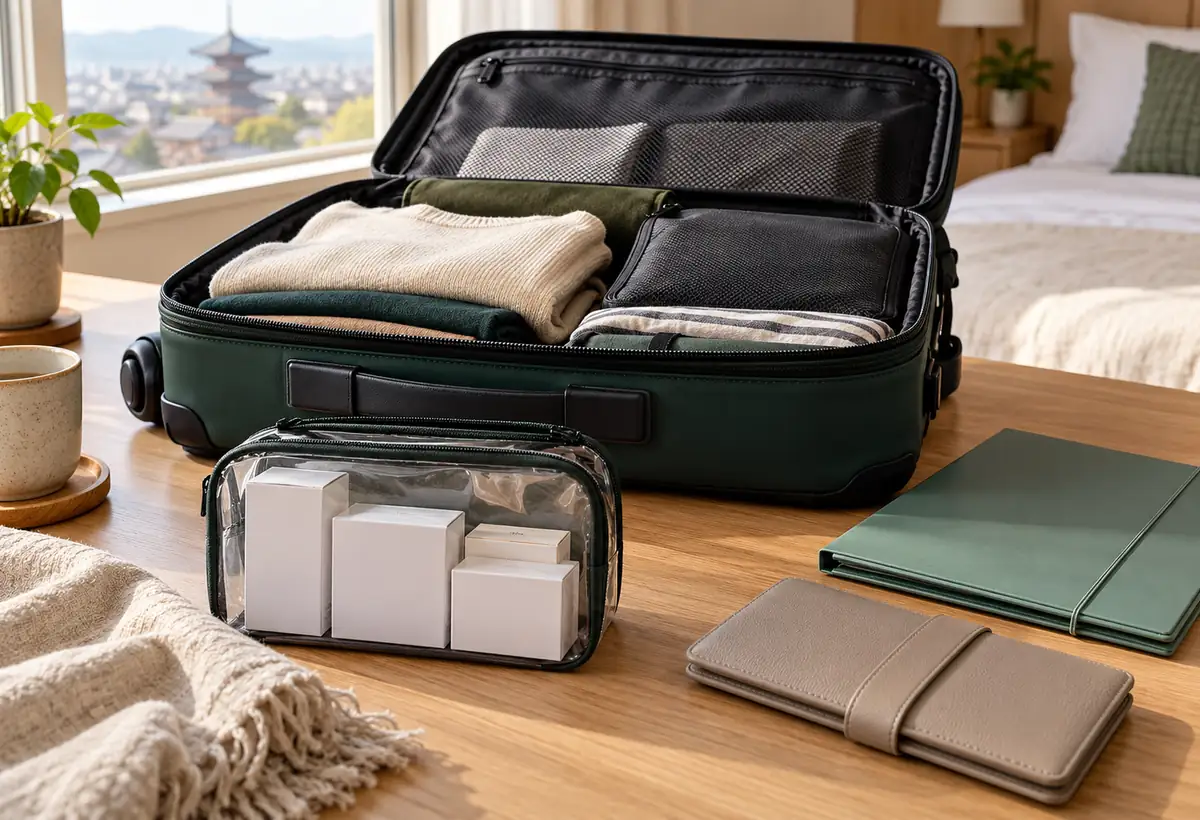
Laundry, shoes and spare clothing change with the season too. A stay that ends in a different season from the one it began in means packing for both, which is a reason to keep the luggage to what one person can lift.
When help is needed
A three-month stay works best when someone besides the traveler knows the plan. That might be a spouse, an adult child abroad or a friend in Japan.
Japan Care Concierge (JCC) is a care concierge affiliated with a Japanese social welfare corporation. We are not a travel agency, insurer, medical institution or law office. For an older visitor who needs help with appointments, medicine routines or an accompanied outing during a stay, our accessible travel support is the place to start a conversation. We do not arrange flights, tours or lodging, and we do not decide who may travel or what medicine may be taken.
For paid company without a care service, see our article on travel helpers and paid care companions in Japan.
The last weeks
If you cannot leave
If illness or injury means you cannot fly on day 90, act before the permitted date. The ISA has a specific page for a Temporary Visitor who must be hospitalized after arrival.
The ISA says the visitor must show that a doctor has judged that urgent hospital treatment is needed and that the visitor can pay for the stay and the trip home. If treatment including hospitalization will take 90 days or less, the application is an extension of the period of stay. If it will take more than 90 days, the application is a change to Designated Activities (medical stay). The application is made at a regional immigration office. If the patient cannot attend because of illness, the ISA allows relatives, hospital staff and certain other people to file with proof of identity, where the bureau accepts them.
Keep copies of the insurance policy, the passport and the return ticket in one folder that a relative can reach, because the page asks for proof that you can pay for treatment and for the trip home. The full list and the fee are in our guide to the 90-day limit.
On timing, the ISA says in its general guidance that extensions should be filed within a window before expiry, and that holders of a period of three months or less may apply from about the halfway point of that period. That guidance is written for status holders in general, so ask the regional immigration office how it applies to a short stay. For a ruling on your own case, ask the office, your embassy or an administrative scrivener (gyoseishoshi). The ISA information centre is the first call for general questions.
Leaving with margin
The return trip is the last piece of the plan, and the cheapest one to fix early. A seat that can be changed, a flight that does not leave on the final day, and enough medicine in hand luggage for two extra days cost little before you fly and a lot afterward.
Hold the medicine for the flight home in your carry-on, in original packaging, with the doctor's list. If you used an import confirmation, keep the paper until you are home. Leave a day at each end for rest. A traveler who lands tired at the end of a three-month stay and goes straight to a flight has used up the margin the stay was meant to protect.
Tell the family the real departure date, the flight number and the plan if it changes. If you hope to return later in the year, do not treat the end of one stay as a reset. Immigration decides each entry on its own, so a new visit is a new decision. For a shorter first trip, see one month in Japan, or two months in Japan for a stay with two bases.
Frequently asked questions
How many spare days should I leave before day 90 for the flight home?
There is no official number. A margin of a week or more is a practical suggestion for older travelers, because a missed connection, a cold or a hospital visit can easily use a few days. The Immigration Services Agency allows an extension of a Temporary Visitor stay in principle only for humanitarian or similar special reasons, with medical treatment given as an example, so a longer buffer is safer than relying on one. Check the landing permission you received, as the period can be shorter than 90 days.
Should I carry three months of tablets or buy refills in Japan?
Either can work, and your prescribing doctor decides which is safe for your medicines. The Ministry of Health, Labour and Welfare allows up to one month of prescription medicine for personal use without an Import Confirmation. A larger supply needs an import confirmation received before you leave home. Refills in Japan mean seeing a doctor and paying the full price, because visitors are outside public insurance. Narcotics need prior permission, and prohibited drugs, including amphetamine-type stimulants, cannot be brought in at all.
Which papers can run out during a three-month stay in Japan?
Check five things before you go: the passport against your return date, the landing permission and its last date, the prescriptions and the written medicine list, the insurance period and its trip-length limit, and the return ticket. Credit card expiry dates and daily withdrawal limits are worth checking too, since clinics usually take cash and cards are mostly accepted at major hospitals, according to JNTO. Keep copies where a relative can find them.
What happens if I am in hospital in week eleven and cannot fly on day 90?
Tell the hospital and your family at once, and contact the regional immigration office before the permitted date. The Immigration Services Agency says a Temporary Visitor who needs urgent hospital treatment can apply for an extension if treatment including hospitalization takes 90 days or less, and to change to Designated Activities (medical stay) if it takes longer. A doctor's statement and proof of funds are required. A relative may file for you if you cannot attend.
Can I leave after three months and re-enter Japan the next day?
There is no right to do so. Entry is decided by the immigration officer each time, and a pattern of back-to-back stays may draw questions. The Immigration Services Agency lists the period of a Temporary Visitor stay as 90, 30 or 15 days, and a new entry starts a new decision rather than a refreshed clock. If you expect to spend most of a year in Japan, ask an embassy or an administrative scrivener, and read about longer-stay routes before you plan.
How Japan Care Concierge can help
The first consultation is 30 minutes and free, and we normally reply to inquiries within two business days. You leave it with a sequence: which office to contact first, what to prepare, and what your family abroad needs to see.
Primary and official references
We checked 9 primary or official sources below before writing this article. Rules, costs, and local procedures change by municipality and over time. Confirm the linked official source before a final decision. Last source check: 2026-11-02.
- Immigration Services Agency: Status of residence "Temporary Visitor" (Japanese)
- Immigration Services Agency: Temporary Visitors who need hospital treatment beyond the period of stay (Japanese)
- Immigration Services Agency: Applying for a change or renewal within the period of stay (Japanese)
- MHLW: Information for those bringing medicines for personal use into Japan (English)
- JNTO: Guide for when you are feeling ill in Japan (English)
- JNTO: Japan Visitor Hotline (English)
- JMA: Onset and end of the rainy season (Baiu) by region (English)
- Ministry of the Environment: Heat illness countermeasures for the elderly (English)
- e-Gov Law Search: Enforcement Rule of the National Health Insurance Act, Article 1 (Japanese)
About this article
This page is general orientation, not medical, legal or individual care advice. Japan Care Concierge is run by Shinkokai, Inc. and draws on the care services of Social Welfare Corporation Shinkou Fukushikai, established in 1999 in the same group, which runs elderly care facilities and services in Kanagawa under the Cross Heart name. We take no referral fees from facilities or providers. We do not provide medical treatment or diagnosis; in an emergency, call 119 first. Hands-on care and guarantor support come through our group companies. Long-term care insurance is run by each municipality or union of municipalities, and each sets its own rules and timelines, so confirm your own case with the municipal long-term care insurance desk or your local community support center. The publication and update dates above are actual dates. How we research, source, and correct content is described in our editorial policy.